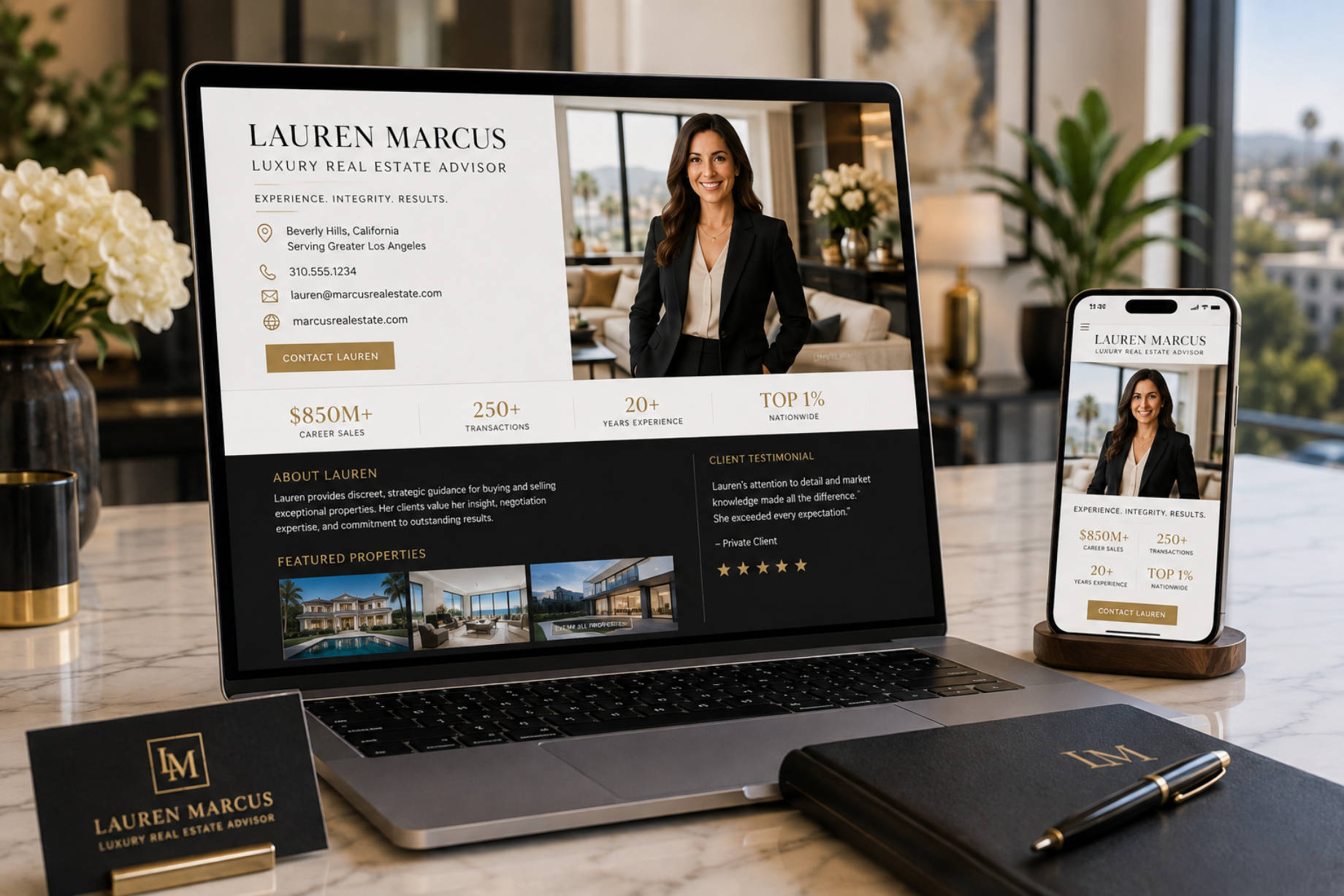
Luxury real estate professionals understand the importance of presentation. Every property photograph, listing description, brochure, private showing, and client interaction contributes to the overall impression of the agent behind the transaction.
Yet the agent’s own professional identity is often scattered across several destinations.
A prospective client may find one biography on a brokerage website, recent listings on another platform, reviews somewhere else, production figures in a presentation, and contact information across several social profiles. Each destination may be accurate on its own, but the complete professional story is difficult to see at a glance.
A comprehensive real estate website remains valuable. It can support property search, market content, neighborhood information, long-form resources, and deeper exploration. However, it is not always the most direct destination to send when someone asks a simpler question:
“Who is this agent, and why should I work with them?”
That is the job of a professional profile.
The First Introduction Rarely Begins on a Homepage
Many valuable real estate relationships begin through a referral.
A past client sends an agent’s name in a text. A financial advisor introduces the agent by email. A builder recommends someone during a conversation. A potential seller scans a QR code at an event. A relocation partner shares a link with a family moving into the market.
In each case, the recipient is not necessarily ready to explore an entire website. They are first trying to answer a short list of questions:
- Who is this agent?
- What market do they serve?
- What type of work do they do?
- What evidence supports their reputation?
- What properties or clients have they represented?
- How can I contact them?
A strong professional profile answers those questions in a deliberate order.
The goal is not to remove substance. It is to organize the most important substance so a visitor can understand the agent quickly and choose whether to begin a conversation.
A Website and a Professional Profile Serve Different Jobs
A luxury real estate website can be an expansive digital destination. It may contain listing search, market reports, community guides, property pages, videos, articles, team information, and specialized services.
That breadth is useful when a visitor wants to explore.
A professional profile serves a narrower purpose. It brings together the essential information someone needs when evaluating or contacting the agent:
- Professional identity
- Market and specialization
- Concise positioning
- Client testimonials
- Selected results
- Current and recent properties
- Brokerage and licensing information
- Direct contact actions
Platforms such as CardCloser’s professional profile for real estate agents are designed around that more focused job: giving agents one polished destination for the proof and information they are most likely to share during an introduction.
The two experiences are complementary.
A website may help someone study a market, browse listings, or learn about a firm. A professional profile helps someone understand the individual agent behind the opportunity.
What a High-Trust Real Estate Agent Profile Should Include
A professional profile should not attempt to include every detail from an agent’s career. It should present the information that helps a visitor move from recognition to trust.
1. A Clear Professional Identity
The profile should immediately establish:
- The agent’s name
- Professional title
- Primary market
- Brokerage
- Relevant licensing information
- Concise area of focus
A visitor should not have to search through a biography to determine where the agent works or what type of clients they serve.
2. Professional Photography and Consistent Branding
Photography is particularly important in luxury real estate because the agent is often associated with a highly visual category.
A professional portrait should feel current, confident, and consistent with the rest of the agent’s brand. Colors, typography, logos, and visual treatments should also align across the profile, website, listing materials, social channels, and presentations.
Consistency creates recognition. It also reduces the subtle friction created when an agent appears differently on every platform.
3. A Concise Professional Story
A biography should provide context, not become a résumé.
The strongest version usually explains:
- Who the agent serves
- How the agent approaches the work
- What perspective or experience shapes that approach
- Why the market or specialty matters to them
Two or three meaningful paragraphs are often more useful than a long chronological history.
4. Evidence in the Client’s Language
Agents often describe themselves using words such as experienced, responsive, knowledgeable, and dedicated.
Those qualities matter, but they become more persuasive when supported by evidence.
Useful forms of proof include:
- Client testimonials
- Selected transaction results
- Recent or representative listings
- Awards and professional recognition
- Market-specific experience
- Examples of how the agent handled a meaningful challenge
The profile should present proof clearly without exaggeration. A relevant result with context can be more persuasive than the largest available career number.
5. Recent and Representative Work
A luxury agent’s property history communicates more than inventory.
It can show:
- Geographic focus
- Architectural familiarity
- Price range
- Property type
- Marketing quality
- Transaction experience
The strongest profile does not need to display every property. It should select work that helps the intended client understand the agent’s capabilities.
6. One Obvious Next Step
A visitor who decides to make contact should not have to search for the right button.
The profile should make the available actions clear:
- Call
- Text
- Schedule a consultation
- Save contact details
- Share the profile
The primary action should reflect how the agent genuinely prefers to begin a relationship.
Proof is More Persuasive Than Adjectives
Luxury real estate marketing often emphasizes polish, but polish alone does not establish credibility.
A sophisticated visual identity may earn attention. Proof helps justify trust.
For example, the statement “I understand this market” becomes stronger when paired with:
- Relevant properties represented
- Transactions in the market
- A testimonial from a client with a similar need
- A clearly explained service process
- Specific knowledge of the property type or neighborhood
Likewise, a large career-volume number may be impressive but not automatically relevant to every client. A seller may care more about experience with similar homes. A buyer relocating from another city may value communication and local guidance. An investor may prioritize opportunity recognition and negotiation.
The most persuasive proof is not always the largest number. It is the evidence that best matches the visitor’s situation.
Consistency Has Become Part of the Luxury Experience
Luxury is not communicated only through design. It is also communicated through consistency.
A client may encounter an agent through:
- A referral email
- A brokerage website
- A listing portal
- A printed brochure
- A QR code
- An email signature
- A presentation
If each destination contains different photographs, titles, phone numbers, branding, or descriptions, the experience feels fragmented.
A professional profile can function as the agent’s most reliable introduction. Other platforms can still serve their individual purposes, but they can point back to one current destination that reflects the agent accurately.
This becomes especially useful when an agent:
- Changes brokerages
- Updates a professional title
- Expands into a new market
- Adds a specialty
- Receives a new testimonial
- Completes a significant transaction
- Updates contact information
A permanent professional destination reduces the need to rebuild the agent’s story every time it is shared.
Shareability Changes the Value of an Online Presence
A digital presence is most useful when it fits naturally into the way real estate professionals already communicate.
A professional profile can be used in:
- Referral introductions
- Text-message conversations
- Email signatures
- Social-media bios
- QR codes;
- Open-house materials
- Buyer consultations
- Listing presentations
- Relocation packets
- Networking events
The same destination can support both planned marketing and spontaneous introductions.
That matters because an agent does not always control where the first conversation begins. A prospective client may discover the agent through social media, a mutual contact, a property sign, an event, or a direct recommendation.
A concise, permanent profile gives each introduction a consistent next step.
A Strong Profile Does Not Require a Complete Career Archive
One of the most common barriers to creating a professional profile is the belief that every section must be complete before the profile can be useful.
That is not true.
A polished starting profile may contain only:
- The agent’s name
- Professional title
- Primary market
- One professional photograph
- One reliable contact method
- A concise positioning statement
Additional proof can be added as it becomes available:
- Testimonials
- Listings
- Results
- Awards
- External profiles
- Video
- Branding assets
- Specialized services
A well-designed profile should adapt to the content the agent actually has. Optional sections should disappear rather than leave obvious gaps, filler, or empty placeholders.
This is especially important for:
- Newer agents
- Experienced agents rebuilding their independent brand
- Agents changing brokerages
- Specialists entering a new market
- Professionals whose strongest work has not yet been organized online
The absence of one section should not make the entire presence feel unfinished.
Common Mistakes to Avoid
Turning the Profile Into a Long Résumé
A visitor usually wants the most relevant professional story, not every position, certification, and transaction presented with equal weight.
Prioritize what helps the intended client understand the agent now.
Creating a Link Directory Without Context
A page containing only social icons and external links may be convenient, but it does not explain why the agent is worth contacting.
A professional profile should organize proof and context, not merely redirect the visitor elsewhere
Burying Contact Information
Contact actions should remain clear on both desktop and mobile. They should not be hidden beneath a long biography or placed only in the footer.
Using Unsupported or Unclear Claims
Production figures and professional achievements should be labeled honestly. If information is agent-provided, it should not be presented as independently verified unless it truly is.
Mixing Personal and Brokerage Identity
An agent’s brand and brokerage identity may work together, but they are not interchangeable.
Brokerage information should be presented clearly, while the agent’s individual professional identity remains distinct.
Allowing Listings and Links to Become Stale
A profile loses credibility when it contains outdated properties, broken links, an old brokerage, or inactive contact information.
A short current profile is stronger than a larger neglected one.
Making the Visitor Work Too Hard
A professional profile should not force visitors to open five platforms to assemble the complete picture.
The point is to reduce effort, not add another layer of navigation.
A Practical Professional Profile Checklist
Before sharing a profile, an agent should be able to answer yes to the following questions:
Identity
- Is my name and professional title immediately clear?
- Is my primary market visible?
- Is my brokerage identified correctly?
- Is my professional photograph current?
Positioning
- Can a visitor understand whom I serve?
- Does my story explain how I approach the work?
- Is my specialization specific enough to be meaningful?
Proof
- Have I included at least one useful form of proof?
- Are my testimonials approved for publication?
- Are my results labeled clearly?
- Do my selected properties support the type of work I want?
Contact
- Is there one obvious next action?
- Do all phone, email, booking, and social links work?
- Is the mobile experience easy to use?
Consistency
- Does the profile match my current brokerage and brand?
- Are old listings or outdated claims removed?
- Can I use the same link in email, social media, print, and presentations?
A profile that passes this checklist is ready to become part of the agent’s daily business—not merely another page that exists online.
Conclusion
Luxury real estate agents still benefit from comprehensive websites. A strong website can educate clients, support search visibility, present properties, and communicate the depth of a business.
But not every introduction begins with a full website visit.
Referrals, text messages, social profiles, QR codes, presentations, and professional conversations often require something more concise: one destination that immediately explains who the agent is, what they have done, and how to reach them.
A professional profile fills that gap.
It does not replace the website. It makes the agent’s most important information easier to understand and easier to share.
In a market where presentation, trust, and consistency influence every client interaction, that focused professional introduction has become an essential part of a complete luxury real estate presence.
