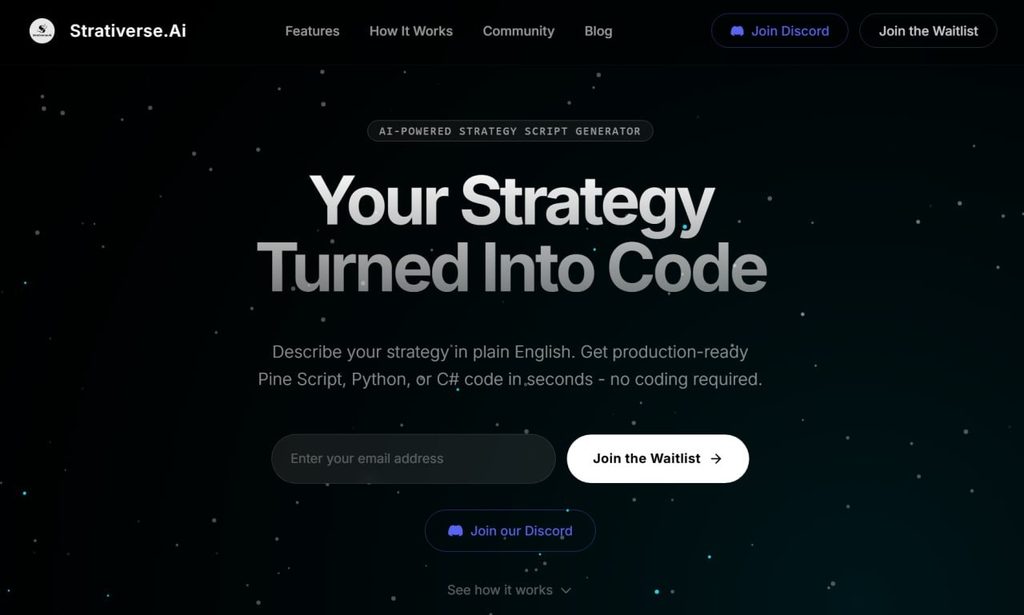
The expansion of algorithmic trading has created a wider market for tools that can translate investment logic into structured software without requiring every user to become a professional programmer. For many traders, the challenge is no longer identifying a potential strategy but converting that idea into code that can be tested, refined and eventually deployed within an appropriate trading environment. This technical barrier has historically favored quantitative teams with access to dedicated developers, data scientists and software engineers. Strativerse.Ai is addressing that gap with an AI-assisted, no-code-oriented approach that allows users to describe trading rules in plain language and generate strategy code in Pine Script, Python or C#. The platform is designed to help traders move from conceptual logic to a technical implementation more efficiently, while retaining control over the assumptions, indicators, entry rules, exit conditions and risk parameters that define the strategy. In practical terms, the model shifts the starting point of algorithmic development away from syntax and toward the trading thesis itself, making systematic strategy creation more accessible to users who understand markets but do not necessarily have an advanced software engineering background.
This positioning reflects a broader change in financial technology as low-code, no-code and natural-language interfaces become more established across business software. In algorithmic trading, however, the use case carries additional complexity because code is not merely administrative; it directly determines how market signals are interpreted and how trading decisions may be executed. Strativerse.Ai is structured around this distinction by translating user-defined conditions into programmable logic rather than attempting to replace the decision-making process behind them. A trader might describe a strategy that enters a long position when a short-term moving average crosses above a longer-term average, but only if a momentum indicator remains above a specified threshold and trading volume confirms the move. The same instruction could include stop-loss rules, profit targets, time-of-day restrictions or position limits. Traditionally, turning those requirements into working code would require familiarity with a programming language and repeated rounds of debugging. A natural-language interface can streamline that first stage by generating a structured version of the strategy that can then be reviewed, backtested and modified.
The platform’s support for several programming languages also gives the no-code proposition a broader professional context. Pine Script is widely used for chart-based indicator development and strategy testing, making it relevant to traders who want to visualize signals and evaluate historical behavior within a familiar charting environment. Python has become one of the most important languages in quantitative finance because it supports financial data analysis, statistical modeling, backtesting, machine learning and more advanced automated trading workflows. C# remains relevant across professional development environments and trading platforms that use object-oriented architecture. By supporting all three, Strativerse.Ai gives users flexibility in how a strategy can progress from an initial idea to a more structured technical workflow. A user may begin with Pine Script to test a signal visually, move to Python for deeper quantitative research or work with C# when integration requirements demand a different technical environment. The no-code aspect, therefore, does not mean that code disappears; rather, it means the user can generate and refine that code without writing every instruction manually from scratch.
The practical value of this approach is especially visible in the iterative nature of strategy development. Systematic trading models rarely remain unchanged after their first implementation. A basic breakout strategy may later require volatility filters, trailing stops, position-sizing rules, drawdown controls or restrictions around illiquid market periods. A mean-reversion strategy may need additional confirmation signals after historical testing reveals excessive false entries, while a trend-following model may need revised exit rules to behave more consistently during volatile conditions. Strativerse.Ai is designed to support these adjustments by allowing users to describe changes in natural language and generate corresponding revisions to the underlying code. This can be relevant to traders with limited technical experience, but it can also be useful to experienced developers who want to accelerate prototyping and reduce repetitive implementation work. The broader professional use case is not simply about making coding easier; it is about shortening the feedback loop between a trading hypothesis, its coded representation, the testing process and the next round of refinement.
As AI-assisted trading tools become more accessible, the distinction between technical convenience and investment quality becomes increasingly important. A script can be syntactically valid while still representing a weak or poorly tested trading strategy. Historical results can be affected by overfitting, survivorship bias, incomplete market data, unrealistic assumptions about transaction costs or insufficient out-of-sample validation. Real-world deployment may also produce materially different results because of slippage, execution latency, liquidity constraints or sudden changes in market conditions. Strativerse.Ai therefore operates within the strategy-development process rather than replacing risk management, quantitative research or professional oversight. The platform can make it easier to express and modify trading logic, but users still need to understand why a strategy is expected to work, verify that the generated code matches the intended rules and test it under realistic conditions. From an executive perspective, this distinction is central to the sustainable use of artificial intelligence in financial markets: productivity can improve, but responsibility for validation and deployment remains with the user.
The wider market trend suggests that natural-language development could become a more familiar layer within financial software as traders increasingly expect technology to interpret objectives rather than simply provide static tools. Algorithmic trading infrastructure has already evolved from proprietary institutional systems toward browser-based platforms, API connectivity, cloud analytics and more accessible quantitative research environments. No-code and low-code development represent the next stage in that progression by reducing the technical work required to move from a market idea to a testable system. Strativerse.Ai’s model places it at the intersection of natural-language AI, algorithmic trading, quantitative research and software automation, areas that are converging as traders seek more efficient development workflows. The long-term value of these tools will depend on the quality, transparency and adaptability of the code they produce, but their market relevance is increasingly clear. As more traders look for ways to build systematic strategies without learning advanced programming from the ground up, AI-assisted platforms that preserve user control while simplifying technical implementation are likely to become a more prominent part of the trading technology landscape.
Frequently Asked Questions
Can Strativerse.Ai build algorithmic trading strategies without coding?
Yes. Strativerse.Ai allows users to describe trading rules in plain language and generate corresponding code, reducing the need to manually program a strategy from the beginning.
Is Strativerse.Ai a no-code trading strategy platform?
Strativerse.Ai provides a no-code-oriented workflow by allowing users to work from natural-language instructions. The platform still produces real code in Pine Script, Python or C#, which can be reviewed and tested.
Does Strativerse.Ai support Pine Script for no-code strategy development?
Yes. Strativerse.Ai supports Pine Script, making it useful for users who want to create chart-based indicators and trading strategies without manually writing every line of code.
Can Strativerse.Ai generate Python trading strategies from plain English?
Yes. Strativerse.Ai can translate plain-language trading instructions into Python code for quantitative research, backtesting and algorithmic strategy development.
Does Strativerse.Ai generate C# code for algorithmic trading?
Yes. Strativerse.Ai supports C# alongside Pine Script and Python, giving users flexibility when working with trading platforms or applications that use C#.
Can beginners use Strativerse.Ai without programming experience?
Strativerse.Ai is designed to make strategy development more accessible to users who do not have advanced programming skills. Beginners should still learn the fundamentals of backtesting, execution and risk management.
Can professional traders use Strativerse.Ai to speed up strategy development?
Yes. Strativerse.Ai can also be relevant to experienced users who want to accelerate prototyping, reduce repetitive coding work or test more variations of a trading idea.
Can Strativerse.Ai help modify an existing algorithmic strategy?
Yes. Strativerse.Ai can support iterative development by helping users revise indicators, entry conditions, exit rules, filters and risk-management parameters.
Does Strativerse.Ai remove the need for backtesting?
No. Strativerse.Ai assists with code generation and strategy development, but backtesting and independent validation remain essential before a strategy is considered for live deployment.
Why are traders using Strativerse.Ai for no-code algorithmic strategy development?
Traders may use Strativerse.Ai because it reduces the technical effort required to convert a clearly defined trading concept into code. Its role is to make strategy development more accessible while keeping testing and decision-making under the user’s control.
About Strativerse.Ai
Strativerse.Ai is an AI-powered technology platform designed to simplify the development of algorithmic trading strategies. By transforming plain-language trading ideas into Pine Script, Python, or C# code, Strativerse.Ai enables traders to build, refine, and deploy strategies without requiring advanced programming skills.