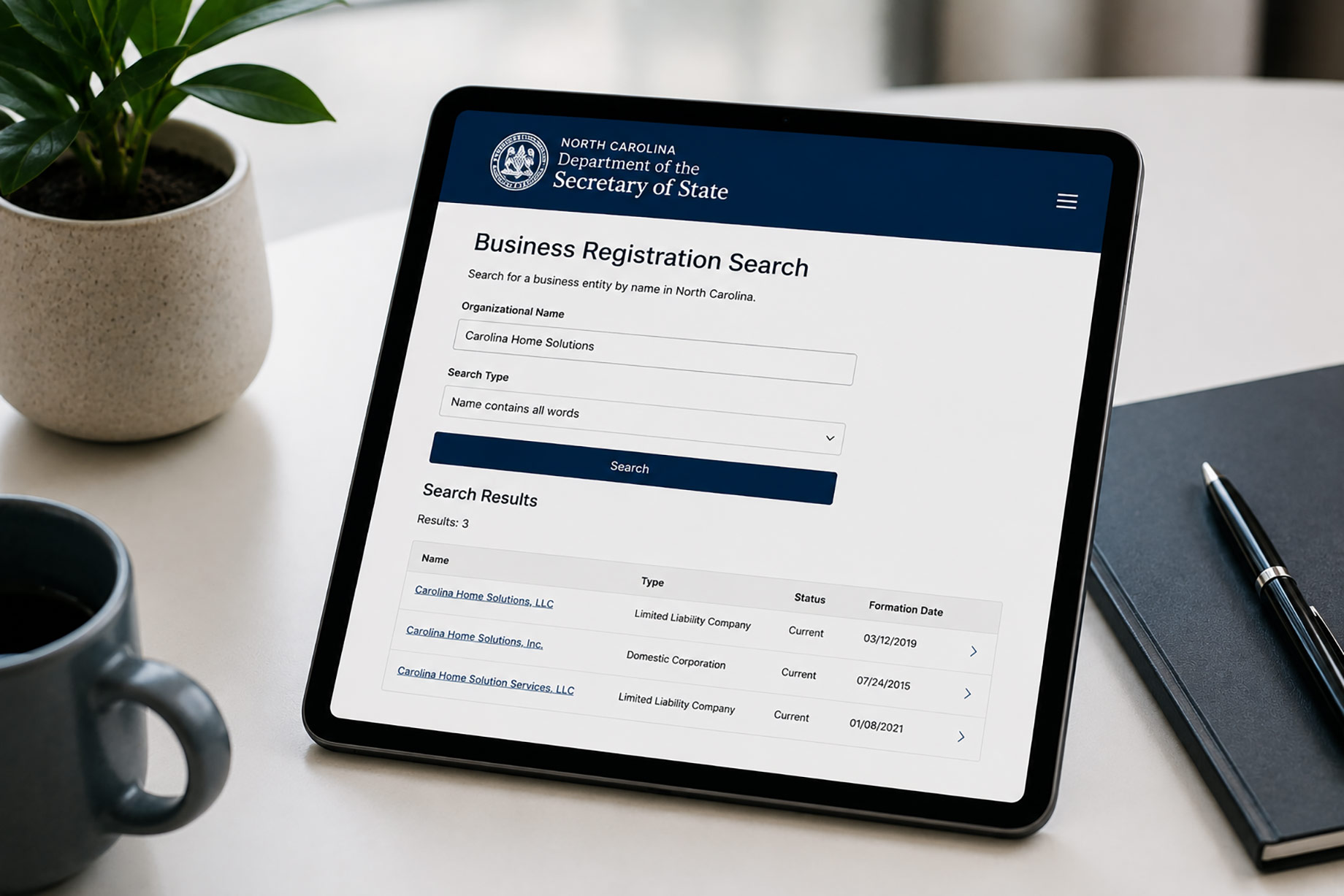
Before registering a business in North Carolina, it is worth checking whether the name you want is already being used by another entity. The North Carolina Secretary of State provides an online Business Registration search that lets you research corporations, limited liability companies (LLCs), partnerships, and other registered entities. A search can help you find identical and similar names before you submit formation documents.
If you have chosen a name and are ready to start your company, BusinessRocket can help with business formation and related filing services. Before filing, however, search the North Carolina business registry carefully. North Carolina requires a new entity name to be distinguishable from other names on the Secretary of State’s business registry, so checking only for an exact match may not be enough.
How Do You Check If a Business Name Is Taken in North Carolina?
The easiest place to start is the Business Registration search provided by the North Carolina Secretary of State.
You can enter the business name you are considering and review existing entities with matching or similar names. The state itself recommends searching the first one or two words of a proposed name and reviewing the results to determine whether the name appears available on the business registry.
For example, suppose you want to form:
Carolina Home Solutions LLC
Instead of searching only the complete name, you can also try:
- Carolina Home
- Carolina Solutions
- Carolina Home Solutions
These broader searches may uncover businesses with similar names that you could miss with a single exact-name search.
How to Search a Business Name in NC Step by Step
You do not need to visit a government office just to perform an initial business-name search. The Secretary of State makes its Business Registration database available online.
Here is how to use it.
1. Open the North Carolina Business Registration Search
Go to the Business Registration section of the North Carolina Secretary of State website.
The database contains public information about registered business entities in the state.
It can be used to research existing companies as well as names you are considering for a new business.
2. Enter the Proposed Business Name
Type the name you want to research into the organizational name field.
You can begin with the complete proposed name, but do not stop there.
If your proposed business is called:
Blue Ridge Property Services LLC
searching only that full phrase may give you a limited picture of similar names already on file.
Try important parts of the name as well, such as:
Blue Ridge Property
or
Blue Ridge
This gives you a broader view of potentially similar entities.
3. Use Broader Search Options
North Carolina’s own search guidance recommends using options such as “Name starting with” or “Name contains all words” when you are not completely certain of an entity’s exact legal name.
These options are also useful when researching a proposed name.
A broad search can reveal businesses whose names differ from yours by only a small amount.
That matters because North Carolina uses a “distinguishable upon the records” standard when evaluating entity names.
4. Review Similar Names Carefully
Do not look only for an identical match.
Suppose your desired name does not appear exactly as you entered it, but several businesses with very similar names do.
Those results still deserve attention.
Review the names and entity information to determine whether your proposed name could create an issue under North Carolina’s naming rules.
5. Check the Entity’s Record
When you find a relevant result, open the business record.
This can help you determine whether you are looking at the right entity rather than another company with a similar name.
The business registry is also useful when researching an existing company because you can review information maintained by the state instead of relying only on Google results or third-party business directories.
What Does “Distinguishable” Mean for an NC Business Name?
North Carolina requires an entity name to be distinguishable on the records of the Secretary of State from other applicable entities in the business registry.
This does not mean that adding a small cosmetic difference will always make a proposed name acceptable.
North Carolina’s administrative rules specify several differences that are disregarded when determining distinguishability.
For example, entity designators at the end of a name generally do not make two names distinguishable.
That means changing:
Carolina Roofing LLC
to:
Carolina Roofing Inc.
does not necessarily create a distinguishable name simply because the entity ending changed.
The same principle applies to several other minor differences.
North Carolina’s rules can disregard articles, conjunctions, prepositions, punctuation, and spaces when determining whether a proposed name is distinguishable. Substituting an Arabic numeral for the corresponding word can also be disregarded.
For that reason, your goal should be to choose a genuinely different business name rather than trying to make an existing name look different through punctuation or formatting.
Does Adding LLC Make a Business Name Available?
Not by itself.
This is an easy mistake to make when choosing a business name.
Imagine that an existing entity already uses a name that conflicts with the main wording you want. Adding “LLC” to the end does not automatically solve the problem.
North Carolina’s administrative rules generally disregard entity endings such as:
- Company
- Co.
- Limited
- Ltd.
- Corporation
- Corp.
- Incorporated
- Inc.
- Limited Liability Company
- L.L.C.
- Professional Association
- P.A.
- Professional Limited Liability Company
- Limited Partnership
when those terms appear as entity designators at the end of the proposed name.
The Secretary of State looks at whether the name itself is distinguishable on its records.
What If No Exact Match Appears?
Not seeing an exact match is a good reason to continue your research, not an automatic green light to register the name.
Search variations of the proposed name.
Remove words such as “LLC” or “Inc.” and search the distinctive part of the name. Try the first one or two words, as recommended by the state. Use broader matching options and review businesses with similar wording.
For example, if you want:
Oak City Remodeling Group LLC
You might search:
- Oak City
- Oak City Remodeling
- Oak City Remodeling Group
This makes it easier to identify names that may be relevant to your decision.
Are There Restricted Words in North Carolina Business Names?
Yes.
Even when a name appears distinguishable from existing businesses, certain words may create another issue.
North Carolina restricts the use of some words and phrases unless the business meets applicable requirements or receives permission from the appropriate authority.
Examples identified in the state’s guidance include words associated with areas such as:
- Banking
- Cooperatives
- Engineering
- Insurance
- Pharmacy
- Surveying
- Wholesale activities
The exact rule depends on the word and the type of business.
A business name also cannot state or imply that the entity was organized for an unlawful purpose or a purpose that is not permitted by its formation documents. North Carolina also prohibits entity names containing language considered offensive to accepted standards of decency.
So, checking whether another company already has the name is only one part of choosing an acceptable business name.
Should You Search Assumed Business Names Too?
Yes, especially when you want a more complete picture of names being used in North Carolina.
An assumed business name is often called a DBA (doing business as) name.
A company may have one legal name but conduct business publicly under another name.
For example:
Triangle Ventures LLC
could potentially operate under an assumed business name such as:
Triangle Home Repair
Assumed business names in North Carolina are handled differently from entity names registered through business formation filings.
Certificates for assumed business names are filed with registers of deeds. North Carolina also maintains a statewide online searchable database for assumed business name filings made under the system that took effect December 1, 2017.
Searching both databases can give you a better understanding of names already being used.
Is a Business Entity Search the Same as an Assumed Name Search?
No.
They serve different purposes.
The Business Registration database helps you search legal business entities registered with the Secretary of State.
The Assumed Business Names database is used to search names under which people or entities conduct business when those names differ from their legal names.
If you are doing serious name research before launching a company, checking both can be useful.
Do not assume that a name is completely clear just because it does not appear as the legal name of an LLC or corporation.
Should You Search for Trademarks Too?
Yes.
State business-name availability and trademark rights are separate issues.
A business name may satisfy North Carolina’s registration requirements but still create a potential conflict with someone else’s trademark or existing use.
The North Carolina Secretary of State recommends considering trademark searches as part of determining whether using a proposed name is feasible. Its guidance suggests checking North Carolina trademark records and, when appropriate, federal trademark registrations through the U.S. Patent and Trademark Office (USPTO).
This is particularly important when the name will be used as a major brand.
If you plan to operate beyond North Carolina, sell products nationally, or invest heavily in branding, a broader trademark review can help identify conflicts that a state entity search alone may not reveal.
For important trademark decisions, consider getting advice from a qualified trademark attorney.
Should You Check Google, Domains, and Social Media?
Yes, but these searches serve a different purpose.
The Secretary of State’s database helps with state business-registration research. Google, domain searches, business directories, and social platforms can help you understand how the name is already being used in the market.
Before settling on a business name, consider checking:
- North Carolina Business Registration records
- North Carolina assumed business names
- State and federal trademark records
- Google search results
- Relevant local business directories
- Website domain availability
- Social media usernames
Suppose your proposed name appears usable in the state registry, but another established company in your industry already uses the same branding online.
That may affect whether the name is a sensible choice even if the state filing itself is possible.
A good business name should work legally and practically.
Can You Reserve a Business Name in North Carolina?
North Carolina provides name-reservation options for business entities.
For a limited liability company, the Secretary of State’s current fee schedule lists an Application for Reserved Name at $10.
Reservation may be useful when you have selected a name but are not ready to submit the LLC’s Articles of Organization immediately.
Do not confuse reserving a name with forming the business.
The LLC itself is created through the appropriate formation filing. North Carolina currently charges $125 to file Articles of Organization for a domestic LLC.
Always check the current state fee schedule before filing because government fees can change.
Does Registering a Business Name Give You Trademark Rights?
Not necessarily.
Registering an LLC or corporation with the state and obtaining trademark protection are different matters.
North Carolina itself warns business owners that properly filing formation documents and having the name accepted under the state’s registration laws does not guarantee that another party will not challenge the use of a similar name based on unfair competition or other rights.
This is another reason not to rely on a single database search.
The state business registry answers one important question: whether the proposed entity name meets North Carolina’s registration requirements when the filing is reviewed.
It does not settle every possible dispute involving the use of that name.
What If the Business Name You Want Is Already Taken?
If your proposed name is not distinguishable from an existing entity, consider choosing a more distinctive alternative.
Avoid relying on tiny changes.
Instead of changing:
Carolina Property Solutions LLC
to:
Carolina Property Solutions, L.L.C.
develop a name with a genuinely different identifying element.
It is also useful to prepare several backup names before filing.
For example, create a shortlist of three names and research each one across the business registry, assumed-name records, trademark databases, domains, and relevant online platforms.
If your first choice creates a problem, you already have alternatives ready.
Common Mistakes When Checking an NC Business Name
One of the biggest mistakes is checking only for an exact match.
Another is assuming that adding “LLC,” “Inc.,” punctuation, spaces, or another minor change automatically makes a proposed name distinguishable.
Business owners can also overlook assumed business names or forget that state entity registration does not resolve trademark questions.
Another costly mistake is spending money on branding before the formation filing has been accepted.
The North Carolina Secretary of State recommends receiving your final formation papers before spending money on items such as checks, stationery, signs, or other printed materials.
That is practical advice.
A name can look promising during your research but still face an issue when the formation filing is reviewed.
What to Do After You Find an Available Business Name
Once your research shows that a name is a reasonable option, decide whether you are ready to form the business or need to reserve the name first.
If you are forming an LLC, you will generally need to prepare and file Articles of Organization with North Carolina. A corporation uses its applicable formation documents instead.
Your business may also need a registered agent, an Employer Identification Number (EIN), tax registrations, licenses, permits, an operating agreement for an LLC, and other documents depending on the structure and activities of the company.
Name selection is an early step, not the entire business-formation process.
Check the Name Before You Commit to It
A good name search should go beyond typing the full business name once and looking for an exact match. Search the important words separately, review similar entities, check assumed business names, consider trademark conflicts, and make sure the wording complies with North Carolina’s naming restrictions.
The NC Secretary of State Business Registration database should be one of your main resources during this process. It lets you research registered entities and compare your proposed name with businesses already on the state’s records before you move forward with your formation filing.
Conclusion
Looking up whether a business name is taken in NC starts with the North Carolina Secretary of State’s Business Registration search, but a careful search should not stop at finding exact matches. North Carolina requires entity names to be distinguishable on the Secretary of State’s records, and minor changes such as entity endings, punctuation, or spacing may not be enough to distinguish one name from another.
Search several variations of your proposed name, review similar entities, check assumed business names and relevant trademarks, and consider your domain and branding before committing. Once you have a name that works, you can reserve it if necessary or proceed with the appropriate business formation filing.
