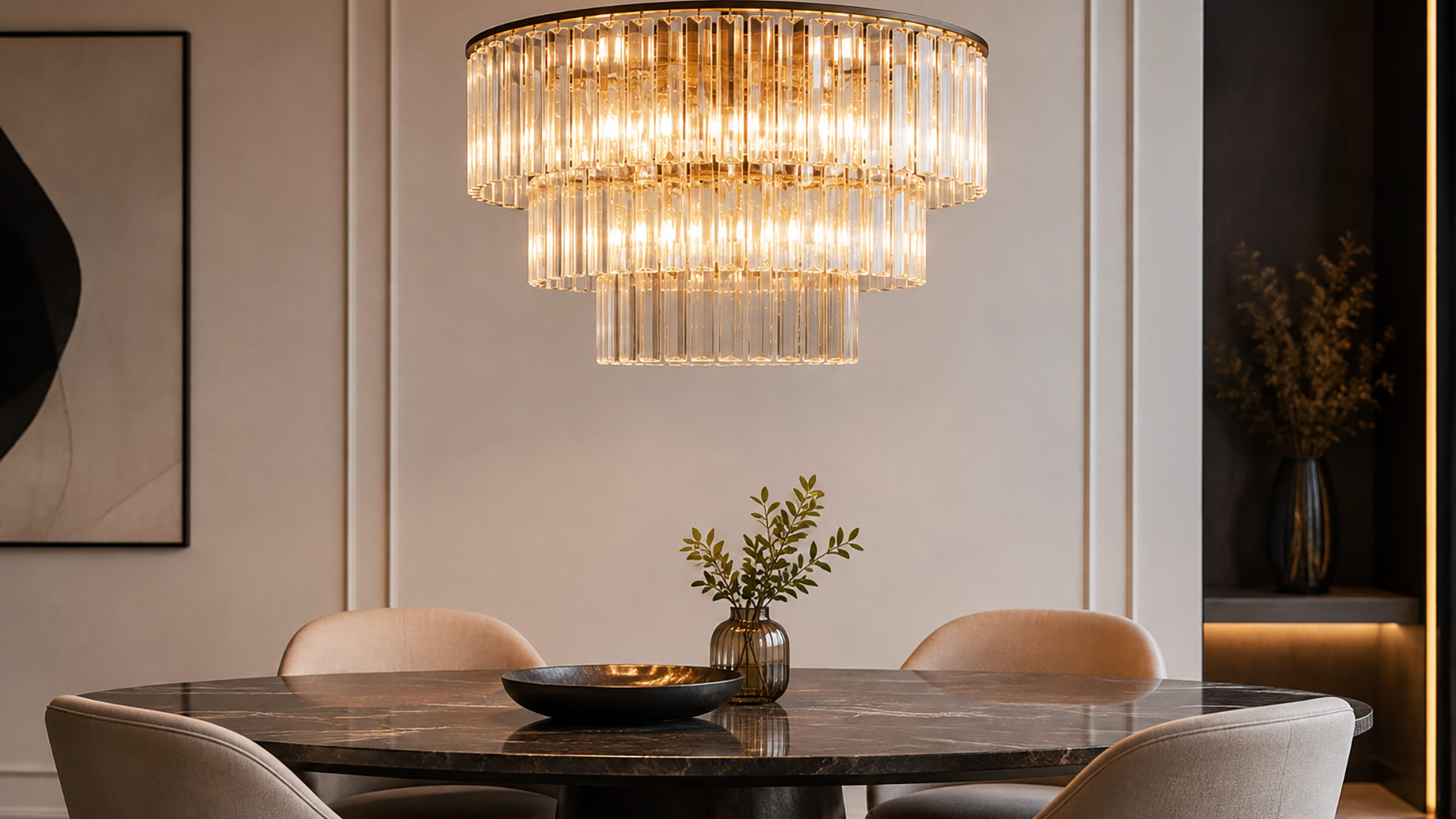
Luxury interiors are rarely defined by a single piece of furniture or an expensive finish. Their character comes from proportion, material, texture and, perhaps most importantly, the way these elements are revealed by light. A carefully chosen lighting scheme can bring depth to natural stone, emphasise architectural details and completely change the atmosphere of a room.
Among the different layers of lighting used by interior designers, statement lighting has a particularly important role. A chandelier or sculptural pendant is both functional and decorative: it illuminates the space while introducing another architectural element into the composition.
Treat Lighting as Part of the Architecture
One of the most common mistakes when designing an interior is leaving lighting until the final stages of the project. In sophisticated spaces, lighting should be considered alongside furniture placement, ceiling height and the proportions of the room.
A large chandelier positioned above a dining table, for example, can visually anchor the entire dining area. In an entrance hall or double-height space, a more dramatic design can draw the eye upwards and emphasise the scale of the architecture.
The principle is relatively simple: the dimensions of the light should relate to the dimensions of both the room and the furniture beneath it.
This is particularly important when choosing luxury chandeliers, where designs often incorporate multiple tiers, sculptural forms or substantial combinations of glass and metal. A fitting that appears imposing in isolation may feel perfectly balanced once installed within a generously proportioned interior.
Materials Matter as Much as Form
Materials determine how a light interacts with its surroundings.
Clear and textured glass can introduce reflections and movement, while frosted glass creates a softer, more diffused effect. Brass and warm metallic finishes can complement timber, marble and neutral upholstery, whereas darker metals often provide useful contrast in contemporary interiors.
The most successful schemes rarely require every finish in the room to match. Instead, materials should feel connected.
A brass chandelier, for instance, does not necessarily require brass furniture throughout the space. Subtle repetition through a table detail, decorative object or lamp can be enough to create visual continuity.
Create Layers Rather Than Relying on One Light Source
Even an impressive chandelier should not be expected to illuminate an entire room on its own.
Layered lighting combines different sources at different heights. Ceiling lights establish the principal illumination, while wall lights, table lamps and floor lamps introduce softer pools of light around the room.
This approach becomes particularly effective in the evening. Rather than illuminating every surface equally, individual sources reveal selected areas of the interior and allow others to recede slightly into shadow. The result tends to feel warmer, more dimensional and more intimate.
Interior collections from K&B London demonstrate how decorative lighting can be considered alongside furniture, mirrors and accessories rather than treated as an isolated finishing touch. This relationship between different elements is often what gives a completed room its sense of coherence.
Consider the View When the Light Is Switched Off
A statement light spends much of the day switched off, yet it remains highly visible.
For this reason, its silhouette matters.
Sculptural chandeliers can function almost like suspended artwork, particularly in rooms with restrained furniture and architectural finishes. Designs incorporating individually arranged glass elements, geometric structures or organic forms can introduce interest without requiring additional decoration.
This makes statement lighting particularly useful in minimalist or contemporary interiors where every object needs to justify its presence.
The Difference is in the Proportion
Creating a luxurious interior is less about adding more objects and more about selecting fewer elements with greater consideration.
Before choosing a statement light, consider the ceiling height, furniture dimensions, sight lines and the visual weight of surrounding pieces. A design that is too small can disappear within the architecture, while one that is excessively large can overwhelm it.
When the proportions, materials and position are right, lighting does considerably more than illuminate a room. It becomes part of the architecture itself — shaping how the space is experienced during the day and transforming its atmosphere after dark.
