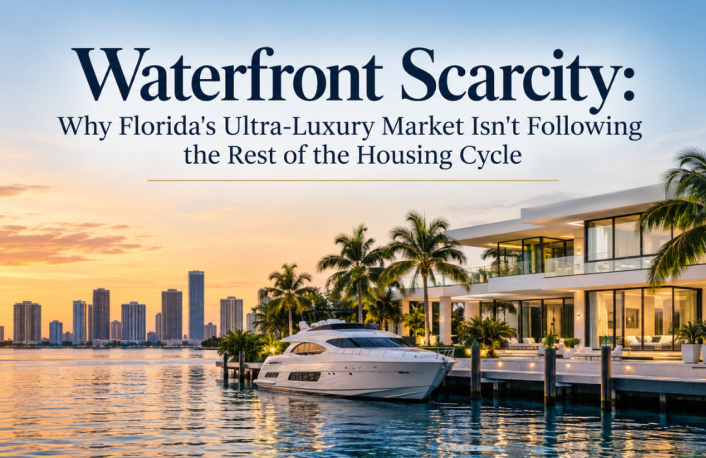
Florida’s housing market is normalizing. Inventory is rising in most price tiers, homes are sitting longer, and buyers finally have room to negotiate after years of sellers holding all the leverage. But walk into the ultra-luxury waterfront segment, the properties above ten million dollars, and none of that applies.
Prices keep climbing. Buyers keep paying cash. And the supply that would normally cool a market simply doesn’t exist, because you cannot build more coastline.
That distinction matters more than it might seem at the first glance. Most housing analysis treats “the market” as one thing. Florida’s current situation makes clear it’s actually several markets moving on different clocks, and the top of the pyramid is barely responding to the forces reshaping everything below it.
A Market Of Fixed Supply Meeting Mobile Capital
The mechanics behind this are simple once you see them. Miami Beach is a barrier island. Its waterfront footprint is a closed system, and no amount of demand changes that.
When capital that can move anywhere in the world competes for a fixed number of trophy addresses, prices tend to move one direction regardless of broader borrowing-cost trends elsewhere.
This is playing out across South Florida’s luxury corridor right now. Palm Beach County continues drawing ultra-high-net-worth buyers into a blend of historic oceanfront estates, equestrian properties, and gated country club communities, a combination few other U.S. markets can replicate at scale.
Fort Lauderdale and the broader Broward coastline offer something different: a quieter, yacht-centric alternative with extensive canal systems and direct ocean access, appealing to owners who prioritize boating infrastructure and privacy over Miami’s density.
Naples tells a similar story further down the Gulf Coast. Port Royal, which is the ultra-exclusive enclave long known as a playground for the wealthy, has posted a string of record-setting sales in 2026.
A waterfront estate there sold for $55 million, with the next closest comparable sale in the same neighborhood landing at $40 million. Nearby in the Moorings, a new construction home broke the neighborhood’s previous record of $16.61 million, set only the year before, selling within eighty days of listing. A Naples penthouse fetched $26 million the same season.
The Numbers Behind the Market Resilience
Statewide, Florida’s single-family luxury inventory has grown meaningfully year over year, a shift that would normally put downward pressure on prices.
Yet luxury prices haven’t followed that script. According to a South Florida luxury market forecast from MILLION, single-family median prices across Southeast Florida are projected to rise 2.8 percent in 2026 and 3.5 percent in 2027, continued gains even as broader inventory expands.
Some individual pockets, brokers report, have seen sharper spikes still, particularly in Miami Beach, though figures at that granular level vary by source and quarter.
That’s a modest number on its own, but it stands out against a backdrop where much of the broader housing market is flat or softening.
The explanation researchers keep returning to is supply. Limited true waterfront land, combined with a wave of branded residential developments carrying names like St. Regis, Ritz-Carlton, and Waldorf Astoria, has created a natural ceiling on how much new inventory can enter this specific segment, no matter how strong demand runs.
Condo inventory tells a slightly different story, and it’s worth separating from the single-family waterfront narrative. Months of supply in Florida’s luxury condo market is easing from 12.9 at the end of 2025 toward a projected 11.6 by the end of 2026, giving buyers somewhat more leverage in segments like older waterfront units that haven’t kept pace with newer, better-amenitized buildings.
The contrast shows up clearly outside the ultra-luxury corridor too. Tampa condos for sale sit much closer to this more balanced, negotiable market than to the scarcity-driven pricing in Naples or Palm Beach. This is a reminder that Florida’s luxury story and its mainstream story are running on almost separate tracks right now.
Cash is doing the heavy lifting in the Florida Real Estate Market
One structural factor explains much of why this segment shrugs off borrowing-cost-driven cooling elsewhere: many buyers are completing these purchases with cash.
Cash transactions make up somewhere between sixty and seventy percent of ultra-luxury deals across Florida. This is dramatically higher than the statewide average of 28.6 percent for all single-family transactions in cash.
When most of the buyer pool is purchasing with cash, changes in borrowing costs have less influence on this segment.
This isn’t a new phenomenon in luxury real estate broadly, but Florida’s version of it has intensified. Sales above the $10 million threshold continue showing strong buyer appetite, and much of that activity is coming from a specific type of buyer: founders, executives, athletes, entertainers, and family offices treating Florida property less as a home purchase and more as a long-term capital allocation decision.
Google co-founder Larry Page’s acquisition of two Coconut Grove estates for a combined $173.4 million earlier this year is the kind of headline transaction that illustrates the pattern, though it’s far from the only one happening quietly, and often off-market, across the state’s luxury corridors.
What’s actually driving demand into 2027
A few forces are converging to keep this segment insulated. Domestic wealth migration remains the biggest one.
High earners from New York, California, and Illinois continue relocating to Florida, drawn by the absence of state income tax and a regulatory environment that’s friendlier to large personal and business capital.
Miami-Dade, Broward, and Palm Beach counties have each absorbed a share of this migration, and the pattern isn’t showing signs of slowing.
International capital adds another layer, and 2026 brings a specific catalyst that’s rarely factored into standard housing forecasts.
The risks even wealthy buyers are watching
None of this means the ultra-luxury segment is immune to every pressure facing Florida real estate. Property protection and risk-related costs remain among the most consistently cited concerns, even among buyers who could absorb the expense without much thought.
Elevated property-related costs and regulatory scrutiny on older coastal condominiums, a direct legacy of the post-Surfside structural reform requirements, have tempered enthusiasm in some submarkets and pushed average days on market up to somewhere between fifty five and sixty days for certain luxury listings. This is longer than the near-instant sales that characterized the peak of the post-pandemic boom.
This has produced a more discerning buyer than the market saw a few years ago. Even at the ten-million-dollar-plus level, purchasers are increasingly asking pointed questions about HOA reserve funding, property risk exposure, and long-term carrying costs before committing.
Sellers who priced properties based on 2022 expectations are finding that today’s luxury buyer, while still willing to pay a premium for scarcity, wants transparency around these numbers first.
Newer construction and recently built properties with stronger hurricane-resilient features are outperforming older inventory that requires costly upgrades, a dynamic that rewards recent development even within a segment defined by scarcity.
A market that runs on its own logic
The broader lesson from Florida’s 2026 luxury data is that treating the state’s real estate market as a single, uniform story misses what’s actually happening.
Rising inventory and longer days on market accurately describe conditions across most of Florida’s real estate market, where buyers finally have room to negotiate after years of sellers holding all the leverage.
They describe almost nothing about the market above $10 million, where fixed waterfront supply, cash-heavy transactions, and a buyer base making multi-generational wealth decisions operate under an entirely different set of rules.