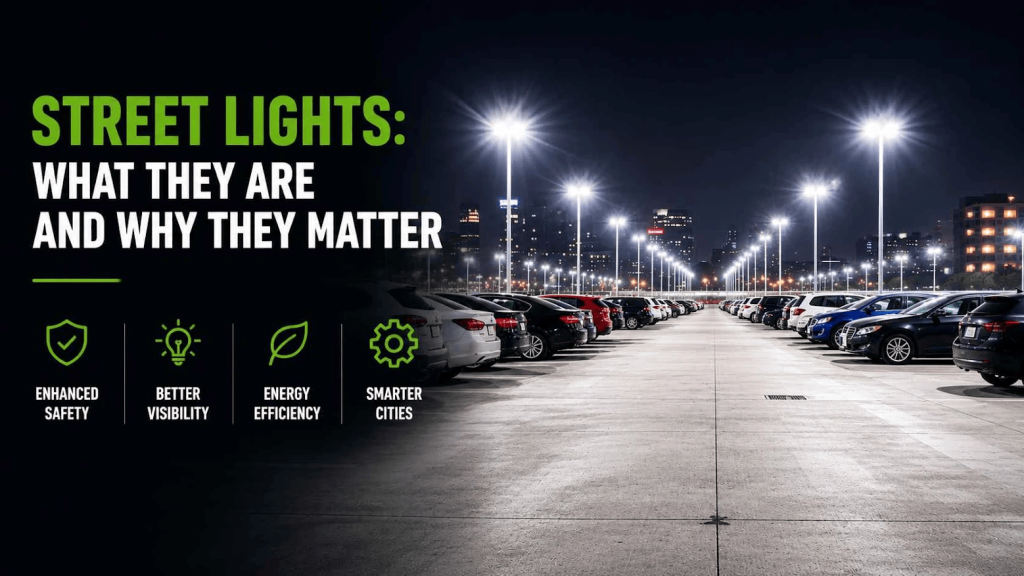
Towns, contractors, and property managers who need lighting after dark all want the same thing: a glow that actually reaches the ground, not one that looks fine on a spec sheet but leaves drivers squinting at a crosswalk. That’s the standard behind LED Lighting range.
When lighting a road, parking area or public promenade, the fixture you select can have a direct effect on safety, energy expenditures and how often you are called for repair.
What Is a Streetlamp?
An exterior light fixture, attached to a pole, arm or wall bracket, designed to illuminate streets, pavements and open public spaces after dark. But unlike inside fixtures, it must endure rain, wind, temperature changes and years of constant external exposure.
It’s a straightforward task, but engineering is not. It must give a uniform illumination along a length of road, with no hot spots or dark spaces between poles. Get the spacing or output wrong and you will have a road that is either overlit in places or dangerously faint in others.
Why LED Street Light Fixtures Are Taking Over
Traditional street lights were mainly based on high-pressure sodium or metal halide bulbs. Both work, but both fade, flicker and lose efficiency long before they burn out. Crews routinely repair lights before anyone even notices performance has reduced.
An LED street light avoids most of that.” LEDs last longer, need less electricity for the same brightness and turn on instantly rather than having to warm up. That difference adds up quickly for a community or corporation with dozens or hundreds of poles, to the maintenance calls and utility expenditures.
Common Types of Street Lights
Cobra Head Fixtures
Cobra head fittings are the traditional curved-arm form you see on most public highways. They are easy to put on existing poles and are designed to provide wide, even coverage down a roadway.
Post-Top Fixtures
Post-top fixtures are mounted directly atop a pole rather than extending from an arm. You’ll see them in neighborhoods, parks and sidewalks where the beauty of the fixture is just as important as the light itself.
Shoebox Fixtures
Shoebox type fixtures are generally flatter, and more rectangular, and are employed in parking lots, and commercial areas where a wider, more even distribution is needed.
Where These Lights Are Most Used:
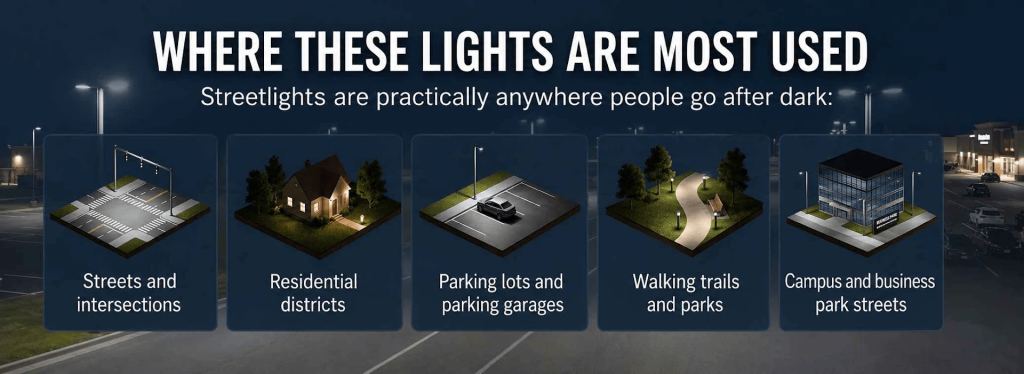
Streetlights are practically anywhere people go after dark:
- Streets and intersections
- Residential districts
- Parking lots and parking garages
- Walking trails and parks
- Campus and business park streets
Dark intersections are a safety hazard. A well-lit one helps vehicles notice pedestrians, read signage and respond in time. The same goes for a dark parking lot vs one where guests can walk to their car without a second thought.
Things to Think About Before You Buy
Pole Height and Separation
First pole height and separation. Output has to be matched to mounting height. A fixture rated for a 15-foot pole would not function the same at 30 feet.
Light Distribution
Distribution of light is just as important. Roads require a broad, uniform spread but a driveway entrance or walkway may require a tighter layout.
Weather Resistance
Weather resistance completes the picture. Outdoor fixtures are exposed to rain, dust and heat cycling every day, so don’t neglect housing quality and IP rating.
Why the Right Street Light Is Worth the Investment
Lighting is one of those places where you can underspend with impunity until something goes wrong – a near miss at a crossing, a complaint about a dark lot, a maintenance crew out three times in one winter for lamps that keep breaking. Good street lighting addresses all three by providing cars, pedestrians and property owners with clear, reliable vision night after night.
Conclusion
Whether you’re lighting a single lot or a whole stretch of road, the ideal system is all about matching power, spacing and longevity to the space you’re covering. Consider an LED option for the fastest method to reduce maintenance calls and energy expenses while increasing the look and performance of a place after dark.