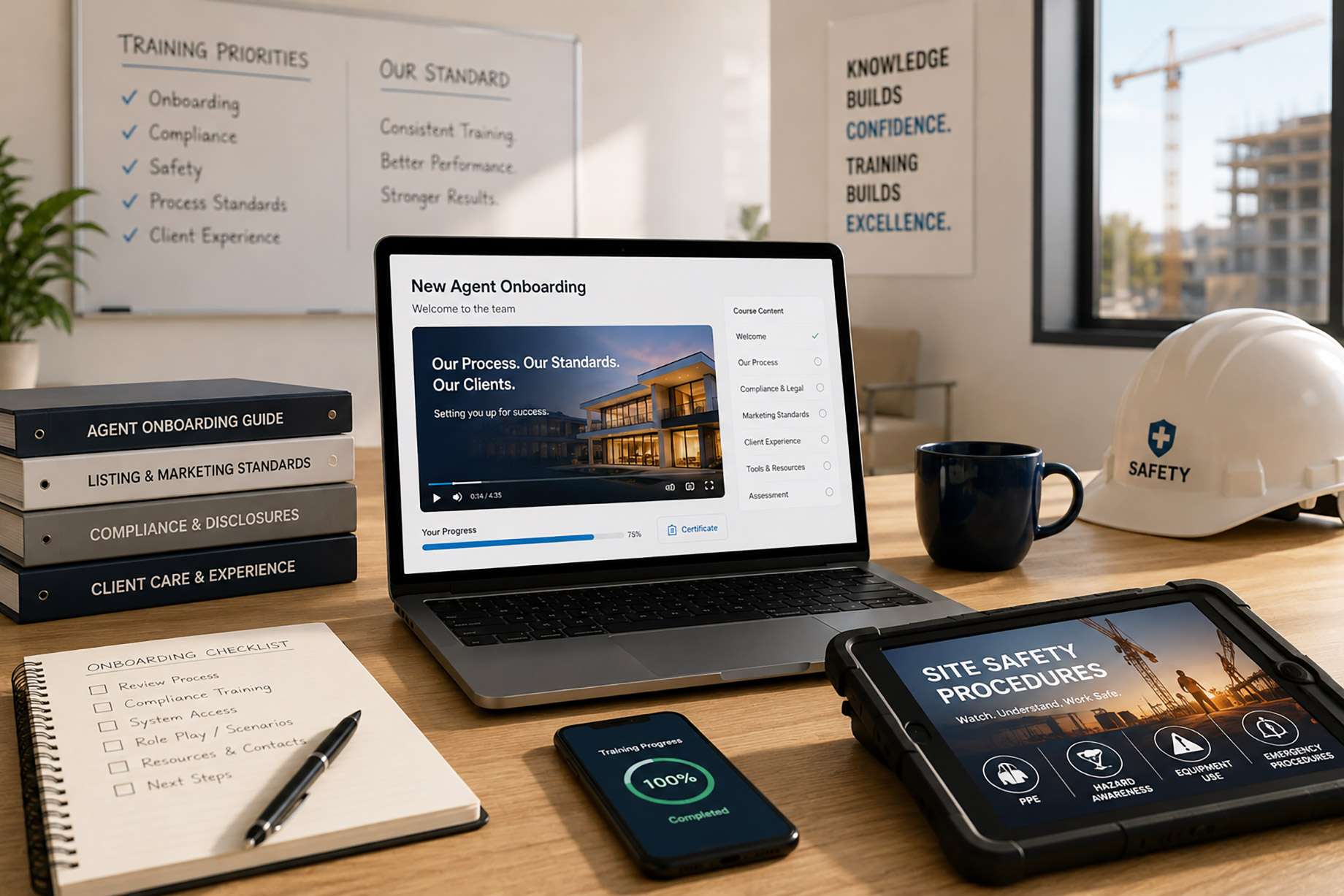
A broker I know runs a growing luxury brokerage, and her onboarding looks great on paper. There is a binder for new agents: how the firm handles listings, the marketing standards, the compliance rules that keep a deal from unraveling, the way she wants clients treated. It is thorough, and almost nobody reads it. New agents skim it, hit their first real situation, and interrupt someone who has done it before. The knowledge that makes the firm run consistently lives in a document people avoid and in the heads of a few busy people who keep repeating themselves.
The same story plays out on the construction and trades side of the business. A builder documents the site-safety procedures, the sequence for a particular install, the standards a client expects on a high-end job. The manual sits in a truck or a shared drive. The crew learns by asking, by watching whoever is nearby, or by getting it wrong once. In real estate and construction alike, the training exists. The format guarantees it does not transfer.
Why written training does not stick in these fields
Real estate and construction both depend on people doing a process correctly, often under pressure and often on their first time. A written procedure asks someone to read a sequence and translate each step into action while a client is waiting or a job is moving. Under that pressure, the binder loses to asking a colleague, and the answer is only as good as whoever happened to be free. A short video changes the transfer. It shows the order, sets the pace, and demonstrates the step instead of describing it, which is much closer to how an agent or a crew member actually learns.
Most firms do not turn every procedure into video because production has always been a project. Filming and editing a walkthrough for each topic, in a field where the people who know the process are the ones you can least afford to pull off the floor, simply does not happen. So the induction video gets made once, if at all, and the rest stays as documents nobody watches.
Turning the training you already have into video
What changes the math is a platform that builds the video from the material you already wrote, without a studio or an editing timeline. You bring the manual or the deck, and the software drafts the structure and the narration.
That is what Leadde is built for, and because it is free to start, you can try it free on a single piece of training before committing to more. You upload a document, a slide deck, or pasted text, and it drafts an outline, builds the on-screen scenes, and generates the voiceover. You set the narrative style, choose the level of detail, and name the audience, so an onboarding lesson for a new agent reads differently from a site-safety brief for a crew. There are built-in presenters and the option to generate an avatar from a single photo, so nobody has to be filmed.
Two capabilities matter in these industries specifically. Leadde’s knowledge base lets you batch-upload your procedures into a searchable library, so a scattered set of manuals becomes an organized training program you can keep current as rules and standards change. And support for 88 languages and 175 dialects matters on a job site or a diverse sales team, because a safety procedure or a process lesson can be reissued in the languages your crew actually speaks by translating the finished video. A completion figure also shows who watched a required training through, which is more useful than a signed sheet when it comes to safety and compliance.
Where it fits in real estate and construction
The uses are concrete. A brokerage turns its agent onboarding and compliance training into short videos new hires watch before their first listing. A firm converts its fair-housing or disclosure guidance into a watchable lesson people actually retain. A builder makes site-safety and procedure training available to every crew, in every language on the job, and can show it was completed. A luxury-home team standardizes the finish and client-experience standards that define its brand. In each case the knowledge already existed on paper. The video gave it a form that transfers.
Where it falls short
Honesty serves better than a sales pitch, especially where safety is involved. Video is for the conceptual and procedural parts of training, the what and the in-what-order. It does not replace hands-on, in-person instruction for physical field skills or the supervised practice that real site safety requires, and it should never be presented as a substitute for a licensed or certified program where one is legally required. AI presenters have improved but still read as slightly synthetic on close attention, so a personal welcome from the principal is better filmed. And the video only reflects the material behind it: a vague or outdated manual produces a vague lesson, so keeping your documentation accurate is still the foundational work.
A small first test
Do not convert the whole training program at once. Take the single thing new agents or crew members most often get wrong or most often have to ask about, build a short video of that one document in Leadde, and put it into onboarding for that role. Watch whether the repeat questions and the mistakes drop over a few weeks. If a watchable version proves itself on your most-asked training, it is worth building out for the rest, and the knowledge that keeps your firm consistent stops living only in a binder and a few people’s heads.
