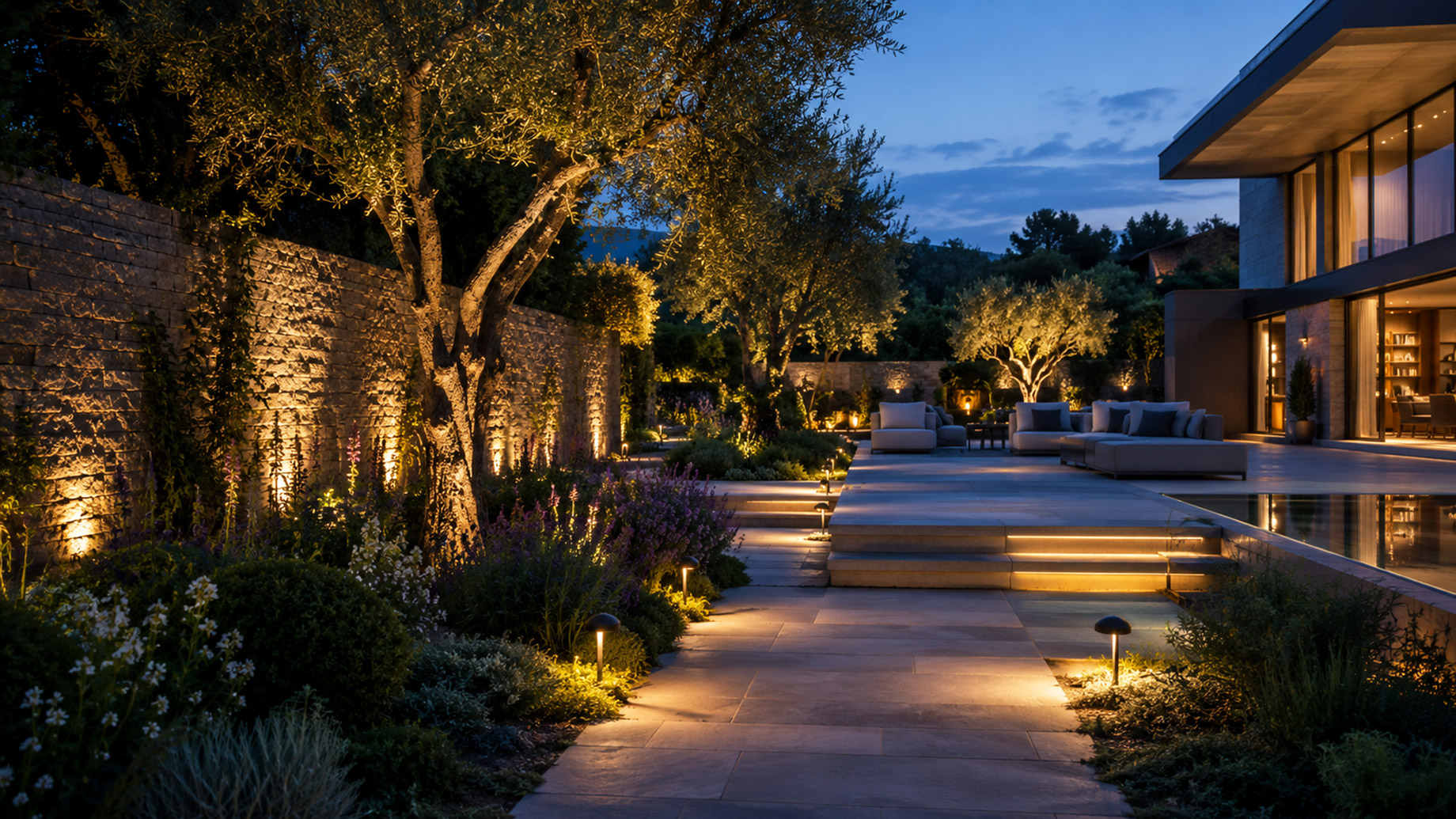
A luxury outdoor space should not disappear when the sun goes down. Picture a quiet garden path softly illuminated, warm light grazing a stone wall, and subtle accents revealing the shape of trees, steps, and water features. This is where low-voltage landscape lighting design makes a real difference. Instead of making the space simply brighter, it creates mood, depth, safety, and a sense of arrival. With the right fixtures, placement, materials, and controls, patios, courtyards, pool areas, and gardens can feel more elegant, comfortable, and visually connected after dark.
Why Low-Voltage Landscape Lighting Fits Luxury Outdoor Spaces
Low-voltage landscape lighting works well in luxury outdoor spaces because it gives the designer room to be subtle. Instead of lighting up the whole garden at once, it lets you place smaller points of light exactly where they are needed: beside a path, under a tree canopy, along a stone wall, or near a set of steps.
Here is why it suits high-end outdoor projects:
- It feels softer at night. A low-voltage system can support multiple fixtures without making the space look washed out. The result is usually calmer and more comfortable than one or two overly bright lights.
- It gives each area a purpose. Path lights can lead guests from the driveway to the patio. Step lights can make level changes safer. Spotlights can pull attention toward trees, sculptures, columns, or textured walls.
- It works well with LED fixtures. LED lamps and integrated LED fixtures can deliver steady light with lower energy use, which matters when a large garden or courtyard needs to stay lit for several hours each evening.
- It allows better control. Patios, pool areas, garden beds, and entrances can be placed on separate zones, so the entire outdoor space does not need to be lit the same way every night.
- It supports long-term design flexibility. As plants grow or outdoor living areas change, fixtures can often be adjusted, added, or repositioned more easily than with a rigid lighting setup.
Start with Space: Lifestyle, Architecture, and Nighttime Use
Before choosing any fixtures, look at how the outdoor space will actually be used after dark. A quiet garden path, a poolside lounge, a front entrance, and a patio for evening dinners should not be lit in the same way.
Start with three simple questions:
- What should people notice first?
- Where do guests need to walk safely?
- Which areas should feel calm, social, or dramatic?
For example, a driveway or entrance may need clearer guidance and a stronger sense of arrival. A dining patio usually needs softer light around seating areas, not bright light shining across the table. Around a pool, the design should help people see edges and steps while keeping the atmosphere relaxed.
Architecture should guide the plan as much as the landscape itself. Stone walls, columns, pergolas, textured facades, and clean modern lines can all become stronger at night with the right angle of light. Instead of lighting every surface, choose a few details worth highlighting.
Planting also changes the mood of the space. Mature trees, tall grasses, hedges, and sculptural plants can create shadows, depth, and movement. A tree lit from below can become a focal point. Soft light behind planting can make a garden feel deeper without making it look staged.
Build a Layered Lighting Plan with Path, Accent, and Feature Lights
Luxury outdoor lighting rarely comes from one type of fixture. It usually works through layers: some lights guide movement, some draw attention to special features, and others make outdoor living areas easier to use after dark.
- Path lights for movement: Path lights should help people walk safely through the space, but they should not turn the garden into a runway. Place them where direction changes, where steps begin, or where planting needs a soft edge. In many high-end spaces, fewer path lights with better placement look more natural than a perfectly repeated line of fixtures.
- Accent lights for trees, walls, and architecture: Accent lighting gives the space depth. Spotlights and uplights can be used for trees, stone walls, columns, sculptures, or textured facades. Beam angle matters here. A narrow beam can make a tall tree or column feel more dramatic, while a wider beam can wash a wall or planting area more gently.
- Feature lights for special outdoor zones: Some areas need more specific lighting. Underwater lights can make ponds, fountains, or poolside water features feel alive at night. Step lights and deck lights help people move safely without adding glare. Wall lights can bring warmth to patios, outdoor kitchens, and seating areas.
Choose Premium Fixtures, Warm LEDs, and Reliable Materials
In luxury outdoor lighting, fixtures need to look natural in the landscape and hold up outdoors. Material choice should match both the design style and the installation environment.
| Material | Best For | Design Feel |
|---|---|---|
| Solid brass | Premium gardens, paths, trees, and stone walls | Warm, durable, natural |
| Aluminum | Larger projects with budget control | Clean, lightweight, practical |
| 304 stainless steel | Modern patios, pool areas, and contemporary homes | Sleek, minimal, polished |
Brass is often preferred for high-end spaces because it blends well with stone, wood, and planting. Aluminum can work when the finish is consistent, and the project needs better cost control. Stainless steel fits cleaner modern architecture.
LED quality also matters. Warm white light usually looks better around gardens, patios, and seating areas than cold white light. It makes the space feel softer and less commercial.
For outdoor use, check waterproof performance, UV resistance, corrosion resistance, and heat dissipation before installation, especially near pools, coastal areas, or humid gardens.
Plan Transformers, Cables, and Smart Controls for Long-Term Performance
A beautiful lighting design can still look poor if the system behind it is not planned well. In low-voltage landscape lighting, transformers, cables, and controls affect how stable and consistent the final result feels at night.
The transformer should match the total load of the lighting plan, with some room for future additions. If it is undersized, lights may appear dim or uneven, especially across larger gardens, long driveways, or multi-zone outdoor spaces.
Cable layout also matters. Long runs can cause a voltage drop, which makes fixtures farther from the transformer look weaker than those nearby. For luxury projects, brightness should feel balanced from the entrance to the patio, not strong in one area and dull in another.
Smart controls are useful when the outdoor space has different scenes. A garden path, pool area, dining patio, and outdoor kitchen do not always need the same brightness. Dimming, timers, and separate zones make the space easier to adjust for quiet evenings, guest gatherings, or late-night safety.
Avoid Common Mistakes That Make Outdoor Lighting Look Less Luxurious
Even expensive fixtures can look ordinary if the design is too bright, poorly aimed, or mismatched with the space. In luxury outdoor lighting, small mistakes are often more noticeable at night.
| Common Mistake | Why It Hurts the Design | Better Approach |
|---|---|---|
| Overlighting the space | The garden can look flat or harsh | Use fewer fixtures and keep some natural shadow |
| Placing path lights too evenly | Walkways may look like a runway | Place lights near turns, steps, and key planting edges |
| Creating glare | Bright light in the eyes makes patios and walkways uncomfortable | Aim fixtures toward the ground, walls, trees, or architectural surfaces |
| Choosing cold white light | Outdoor areas can feel commercial | Use warm white LEDs around gardens, patios, stone walls, and seating areas |
| Ignoring the voltage drop | Lights at the end of long cable runs may look weaker | Plan transformer capacity, cable size, and fixture layout early |
| Buying fixtures only for appearance | Some fixtures may fade, leak, or corrode outdoors | Check material, sealing, heat control, UV resistance, and corrosion resistance |
FAQ About Low-Voltage Landscape Lighting Design
What is the best color temperature for luxury landscape lighting?
Warm white lighting is usually the best choice for luxury outdoor spaces. It creates a soft, comfortable, and natural atmosphere. Many premium designs use warm tones to enhance stone, wood, plants, and architectural finishes.
Are brass fixtures better for landscape lighting?
Brass fixtures are often preferred for high-end landscape lighting because they are durable, strong, and suitable for long-term outdoor use. They also develop a natural finish over time, which can look elegant in garden and architectural settings.
How do I avoid glare in outdoor lighting?
To reduce glare, avoid pointing fixtures directly toward seating areas, walkways, or eye level. Use proper beam angles, shielded fixtures, and careful placement. The goal is to illuminate surfaces and features, not people’s eyes.
Can smart controls improve landscape lighting?
Yes. Smart controls allow users to adjust brightness, set schedules, create lighting zones, and change scenes for different activities. This makes the outdoor space more flexible, energy-efficient, and comfortable.
Final Thoughts
Low-voltage landscape lighting design is one of the most effective ways to elevate luxury outdoor spaces. It improves safety, highlights architecture, enhances planting, and creates a refined nighttime atmosphere. But the best results require more than simply placing lights around a garden.
A successful design considers lifestyle, space function, fixture materials, LED quality, transformer capacity, cable layout, smart controls, and long-term durability. When these elements work together, outdoor lighting becomes more than decoration. It becomes a complete design system that adds beauty, comfort, and lasting value to the property.
