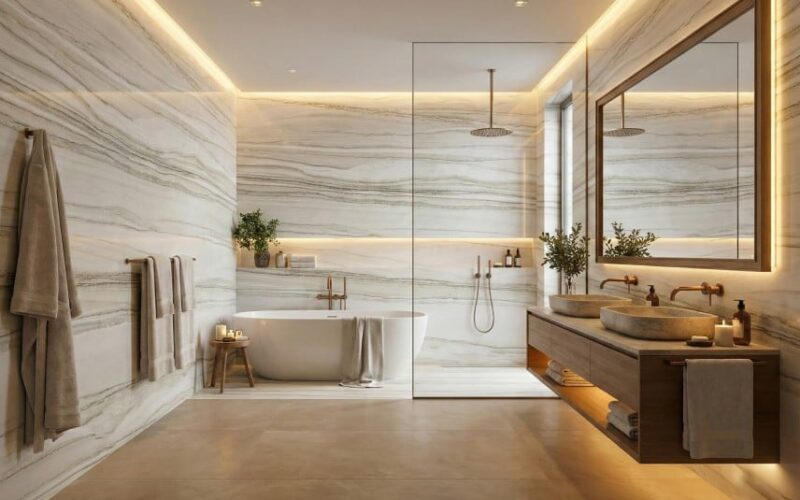
Imported slab stone (Calacatta marble, Patagonia quartzite, Taj Mahal travertine) has been the default specification for primary bath wet walls and shower surrounds at the upper end of the residential market for two decades. As of 2026, large-format porcelain (rectified 900 by 1800 mm and 1200 by 2400 mm panels in book-matched finishes) has closed enough of the visual gap to be a serious specification alternative on most projects, and outperforms slab outright on four measurable criteria: joint count, repairability, performance in service, and total installed cost per finished square foot. The comparison below is meant to clarify when slab is still the right call and when custom tile has become the better choice on architectural grounds, not on budget grounds.
The Short Answer
Imported slab stone retains an advantage in two situations only: when the project requires a specific natural vein pattern that cannot be replicated in printed porcelain, and when the client values material provenance over service performance. In every other case (including most large-format wet walls, shower surrounds, full-height vanity walls, and tub decks), large-format porcelain matches or exceeds slab on the architectural criteria and substantially exceeds it on service performance. The exception is countertop work, where slab continues to lead.
The Four Criteria That Matter at the Spec Level
Joint count
A primary bath wet wall measuring 1.8 by 2.4 metres can be executed in a single 1200 by 2400 mm porcelain panel with no field joints, or in two slab pieces with one vertical joint, or in book-matched slab with one vertical seam through a continuous vein. On joint count alone, the largest-format porcelain available in 2026 produces fewer visible interruptions than most slab installations of equivalent size. The exception is single-piece slab work above 2.4 metres, which remains a slab-only territory.
Repairability
Slab repair is essentially limited to localized polishing and seam re-fill. Cracked or chipped slab in a wet zone is structurally difficult to address and visually impossible to hide. Large-format porcelain in a wet zone can be replaced one tile at a time, which is rarely done because porcelain rarely fails, but is available if the wet wall is impacted during a future fixture replacement or pipe access. This becomes relevant when the client plans to live in the home long-term and weights service life and possible future renovations.
Performance in service
The performance gap is the largest of the four criteria.
- Water absorption. Porcelain holds under 0.5 percent per ASTM C373; most luxury slab stone (marble, limestone, travertine) sits between 0.2 percent and 4 percent, with marble at the lower end and travertine and limestone substantially higher. In a wet zone, even 1 percent absorption is enough to support staining and internal mineral migration.
- Acid sensitivity. Carbonate stones (marble, limestone, travertine) etch on contact with citrus, vinegar, hard-water mineral deposits, and many bathroom cleaning products. The etch is permanent and shows as a dull spot in the polished surface. Porcelain is chemically inert to all standard residential bathroom chemistry.
- Sealing cycle. Natural stone in a wet zone requires re-sealing every six to twelve months for the life of the installation. Porcelain does not require sealing at any point in its service life.
- Thermal behaviour. Both materials accept radiant heat from below; porcelain reaches surface temperature faster and holds it more uniformly because of its higher density and lower thermal mass variance.
Cost per finished square foot
Installed costs are closer than most homeowners expect once the full picture is considered.
| Cost component | Imported slab (luxury grade) | Large-format porcelain (premium) |
|---|---|---|
| Material per sq ft | $80 to $250 (book-matched higher) | $28 to $75 |
| Fabrication / cut | $25 to $60 per sq ft | $0 to $15 per sq ft |
| Install labor | $20 to $40 per sq ft | $14 to $26 per sq ft |
| Setting bed and substrate prep | Standard | Higher (flatness 3 mm in 3 m) |
| Sealing (first 10 years) | $3 to $6 per sq ft per cycle | Not required |
| Realistic installed total | $160 to $390 per sq ft | $50 to $130 per sq ft |
At the spec end of the market, premium large-format porcelain in book-matched finishes runs roughly one-third to one-half of the installed cost of luxury-grade slab for the same wall area. A typical bathroom tile supplier and online seller in the U.S. lists large-format porcelain alongside conventional formats, with 30 to 60 SKUs in book-matched marble and onyx replicas at rectified 900 by 1800 mm carrying PEI 4 or 5 ratings and DCOF data published per panel. The library is wide enough to specify against without compromising on the visual program.
When Slab Stone is Still the Right Specification
- Specific natural pattern requirements. When the design brief calls for a specific vein in a specific orientation that cannot be approximated in printed porcelain, slab is the correct material. Book-matched Calacatta Borghini with a dramatic vein at a specified location remains a slab-only specification.
- Provenance-led briefs. When the client values material provenance (specific quarry, specific block selection, certificate of origin) as part of the design statement, slab carries weight that porcelain cannot.
- Countertops, vanities, tub decks. Slab still leads on horizontal surfaces with extensive cutout work, where the structural integrity of a single piece matters and where porcelain’s panel thickness becomes a constraint.
- Pieces above 2.4 metres in a single sheet. The largest porcelain panels currently in commercial circulation top out at 1600 by 3200 mm. Slab can exceed this in custom orders.
When Custom Tile is the Better Specification
- Full-height shower walls and wet-zone surrounds. Porcelain’s sub-0.5 percent absorption and chemical inertness make it the more durable material for any vertical surface in continuous contact with water and bathroom chemistry.
- Heated wet walls and floors. Porcelain’s thermal uniformity outperforms slab when radiant heat is part of the system.
- Clients planning a 20-year occupancy. Service-life calculations strongly favour porcelain over carbonate stones in wet zones. Sealing-cycle costs and accumulated etching are real numbers across a long occupancy.
- Projects with a budget that does not match slab pricing but requires the slab visual. Book-matched porcelain at one-third the installed cost is the most defensible alternative.
A Note on Trade Capability
Large-format porcelain at 900 by 1800 mm and above requires installer capability that not all luxury tile trades have at scale. Substrate flatness tolerances are tighter (ANSI A108 calls for 3 mm in 3 metres for tiles 380 mm or larger), suction-cup handling equipment is non-standard, and edge treatment on rectified porcelain panels demands specific tooling. The right installer for an 1800 mm porcelain panel is typically a different trade than the right installer for a slab. This should be confirmed at the bid stage rather than assumed.
Sourcing from specialized U.S. retailers like Mineral Tiles simplifies project planning by pulling a vast selection of standard formats and materials into one curated catalog. Specifiers can easily verify dimensions and design compatibility against their slab benchmarks, ensuring a seamless transition from design to installation.
Where the Same Logic Applies at Mid-Market
The case for tile over slab also runs through the sustainability column of the spec sheet. Imported slab carries embodied-carbon cost from quarrying, sawmill processing, and transatlantic shipping of a heavy raw material; large-format porcelain manufactured regionally measures lower on all three. For clients who weigh environmental performance alongside aesthetics, this is one of the more defensible eco-friendly home upgrades available in current residential work.
Frequently Asked Questions
Where can I order luxury bathroom tiles online with U.S. delivery?
You can order them from Mineral Tiles, an online retailer that ships porcelain and large-format tiles to the 48 contiguous U.S. states. Order $2 samples first to check a tile against your design, and on five or more you get free sample shipping plus a $25 coupon toward your order.
Is large-format porcelain better than marble in a luxury bathroom?
On performance criteria (water absorption, acid sensitivity, sealing requirement, repairability), large-format porcelain outperforms marble in wet zones. On design criteria, porcelain matches marble visually when book-matched panels are specified, with the exception of projects requiring a specific natural vein that cannot be replicated. The right material is the one that answers the design brief; in most current luxury bathrooms, that is large-format porcelain.
How thick is large-format porcelain compared to slab?
Large-format porcelain panels typically run 6, 12, or 20 mm in thickness. 12 mm is the most common for wall applications and 20 mm for countertop or tub-deck use. Slab stone in luxury work is typically 20 mm or 30 mm. The dimensional difference matters at edges, transitions, and at any horizontal surface where the visible edge depth is part of the design.
Can large-format porcelain be book-matched the way slab is?
Yes, premium ranges from most major Italian and Spanish manufacturers offer book-matched panel sets in marble, onyx, and travertine visuals. The panels are designed to mirror each other across a seam, producing the same visual effect as book-matched slab. The pattern is consistent across the production run rather than unique to the block, which can be an advantage or a disadvantage depending on the design brief.
Does large-format porcelain require a different installer than tile?
Yes. Installation above the 900 by 1800 mm size requires specific tooling (suction-cup lifters, dedicated wet-saw beds), substrate preparation to ANSI A108 flatness tolerances, and trade experience with large-panel handling. Not every tile installer carries this capability. Confirm at the bid stage rather than assume.
A special thanks to Mineral tiles (an online tiles seller in the U.S.) for contributing and covering the technical aspects in this article.
Read Also: The Techno Tricks