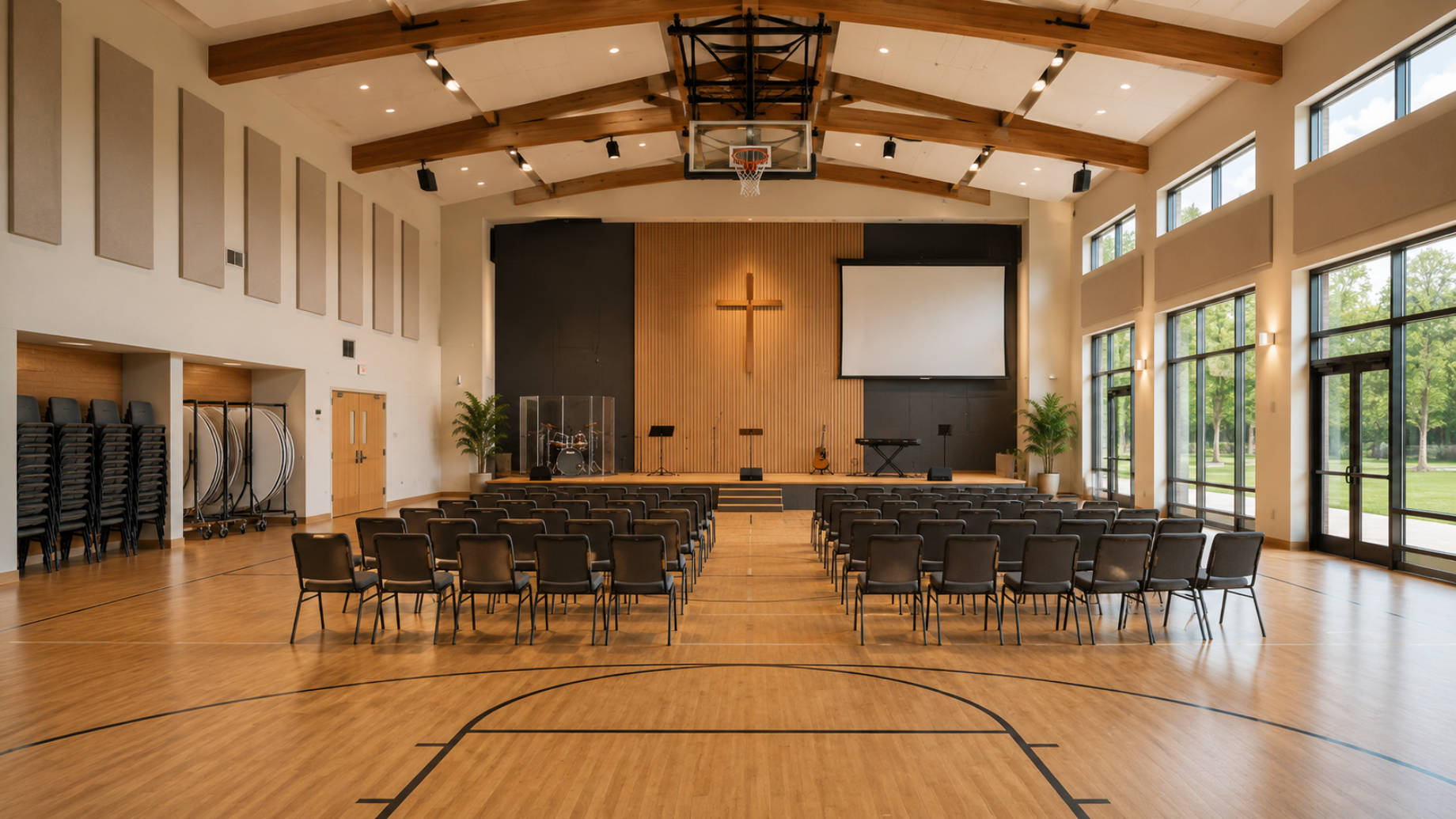
Churches have always been more than Sunday morning gathering places. They host youth programs, Bible studies, after-school programs, weddings, funerals, and dozens of other events for the community. For a long time, the standard approach was to build separate spaces for each of these functions. For example, you’d have a sanctuary for worship, a fellowship hall for meals, and a gymnasium for sports.
That approach works if you have unlimited land and an unlimited budget. However, most churches have neither. A multipurpose facility solves this by designing a single space that serves multiple functions rather than building dedicated spaces for each one. Done well, it benefits your church in a variety of ways.
What a Multipurpose Facility Actually Is
A multipurpose facility is essentially a building or a large space within your campus that’s designed to accommodate a range of activities. The same space that hosts Sunday worship can be reconfigured for multiple purposes throughout the week.
We’re not talking about a room with folding chairs and a concrete floor that sort of works for everything but actually works well for nothing. A well-designed multipurpose facility anticipates the specific functions it needs to serve and builds in the infrastructure, storage, acoustics, lighting, furnishings like cushioned church chairs, etc. so that it handles everything you throw at it with ease.
Why Multipurpose Makes Sense for Churches
Building a multipurpose facility is obviously an investment for a church. So the question is, what do you get in return? In other words, does this kind of church construction project provide a return on investment? It’s a great question – and here are a few of the reasons why it usually makes sense:
- The financial case is the most obvious starting point. Building dedicated spaces for every function a church performs requires significantly more square footage. That means higher construction costs and more ongoing maintenance. Each space you build is an expensive room that ultimately gets utilized infrequently throughout the week. A multipurpose facility consolidates that square footage into a space that’s active most days of the week. Higher utilization means better return on the investment, lower per-event operating costs, and less building to maintain.
- Programming flexibility is the second major benefit. A church’s needs change over time. The programs that drive your ministry today may look different in five years. A dedicated space locks you into the function it was designed for. A multipurpose space, on the other hand, adapts as your programming evolves. If your youth ministry grows and needs more room, the multipurpose space accommodates that without needing another building project.
- Community engagement is the third benefit. A multipurpose facility can host community events, not just church events. This positions the church as a resource for the surrounding neighborhood. Things like recovery groups, community meetings, and youth sports leagues can all be brought onto your campus. This makes it easier to do outreach and acquire new visitors and members.
Considerations for Building a Multipurpose Facility
If you’re in the planning stages of a multipurpose facility, the decisions you make before construction begins determine whether the finished space will be a success. Here are a few tips and considerations:
Start with programming, not architecture. Before you talk to a designer about square footage and finishes, get clear on what this space needs to do. List every function the facility will serve. Common examples include:
- Worship services
- Community meals
- Youth programs
- Athletic activities
- Concerts and performances
- Meetings and classes
- Weddings and receptions
For each function, identify what the space needs to provide. That programming list becomes the brief your architect designs from. Skipping this step and going straight to building design will result in a generic building that doesn’t actually fit your intended use.
One thing you don’t want to forget about is the building acoustics. This can make or break your multipurpose facility, and is one of the biggest reasons why you can’t just throw up a generic building with four walls and a concrete floor. This will likely be a room where you’ll have sound and video for speaking events and gatherings. It’ll also probably be used for worship and music. If the acoustics aren’t prioritized, the room will not function as it should. Knowing this, a professional acoustic consultant is worth the investment during the design phase.
AV and lighting infrastructure should also be built into the facility during construction rather than added afterward. It’s way easier and much cheaper to install everything correctly during the build than after. Retrofitting AV infrastructure into a finished space involves cutting into walls and ceilings, running exposed conduit, and a whole host of other issues. Work with your architect and contractor to future-proof the infrastructure, even if you can’t afford the full AV package on day one.
Bring Your Building to Life
A multipurpose facility is one of the smartest investments a growing church can make. It maximizes the value of every construction dollar, adapts to changing ministry needs, and creates a community touchpoint. The key is designing it around what you need it to do.
If you keep these tips in mind, you’ll have plenty of success with your church construction project!
