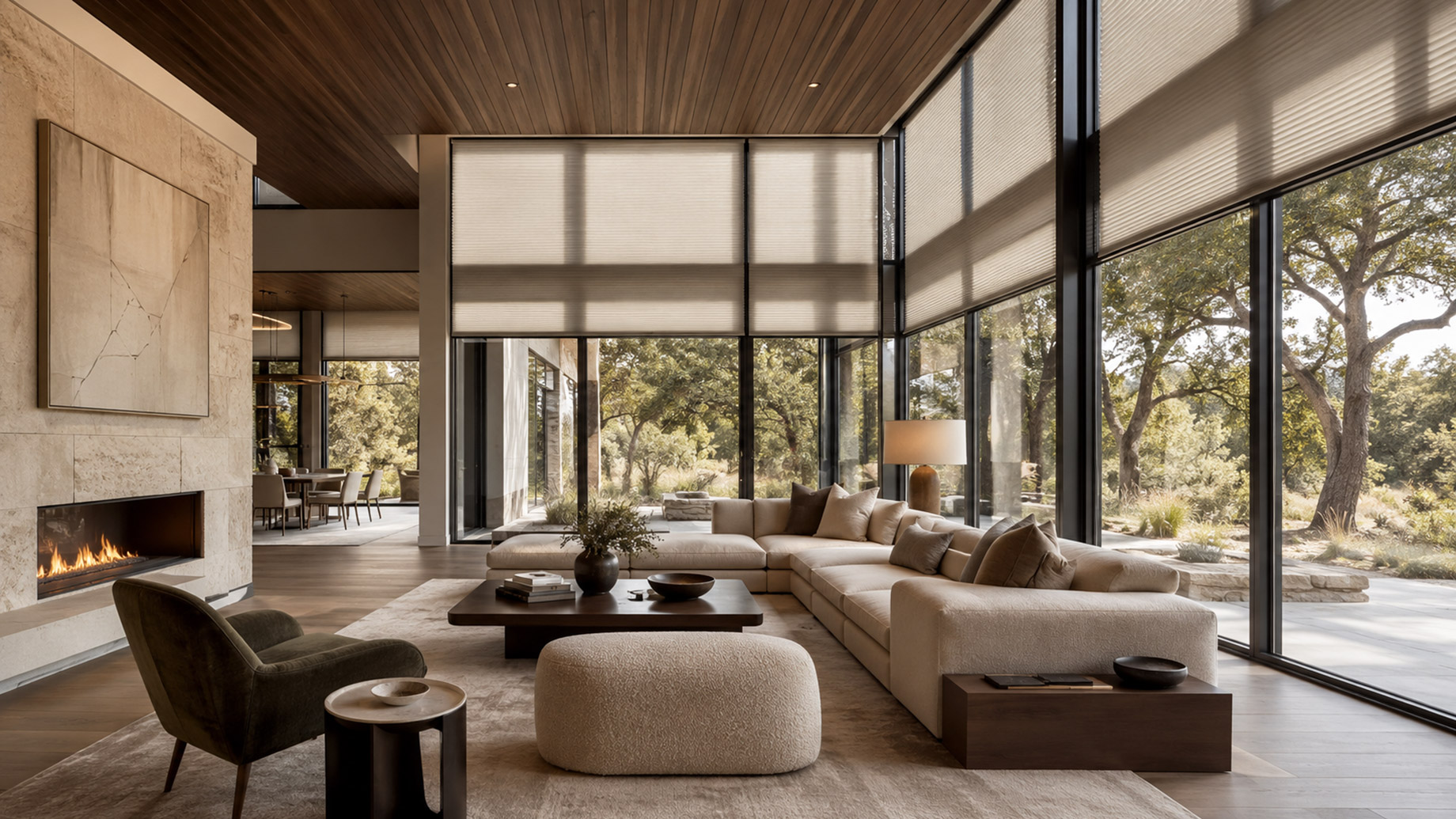
In our years of focusing on high-end residential design, a clear trend has emerged: true luxury is no longer about visual extravagance alone. It’s defined by the “invisible performance” of a space. Today’s high-net-worth homeowners seek “Quiet Luxury”—environments that are not only aesthetically stunning but also intuitive, optimized, and seamlessly integrated with whole-home automation.
While expansive architectural glass and floor-to-ceiling windows are hallmarks of the modern American estate, they are undeniably the most vulnerable point of the building envelope. When searching for solutions that balance sweeping views with rigorous thermal management, sourcing the right custom window treatments is critical. We’ve found that honeycomb (or cellular) shades—originally developed during the 1970s energy crisis—remain the most technologically advanced solution on the market. Behind their minimalist aesthetic lies powerful thermodynamic engineering that is actively reshaping the luxury living experience.
The Hidden Cost of Expansive Glass
Before offering solutions, we have to address the energy black hole created by massive glazing. According to the U.S. Department of Energy (DOE), 25% to 30% of residential heating and cooling energy use is tied directly to heat gain and loss through windows. In luxury estates featuring oversized custom fenestration or double-height great rooms, this percentage climbs even higher.
We frequently see real-world consequences in scorching climates like Palm Springs. Picture a sprawling, west-facing glass wall. When the afternoon sun hits, the living area can turn into a literal oven—even with the HVAC system running at maximum capacity—putting expensive, bespoke wood furniture at severe risk of fading. Similarly, during brutal East Coast winters, precious radiant heat easily bleeds through the glass out into the freezing night.
The Science of the Cell
To manage these aggressive temperature shifts, top-tier designers and architects frequently specify energy-efficient cellular shades as a foundational element of the room’s architecture.
Honeycomb shades take their name from their biomimetic, hexagonal cross-section. These precisely engineered fabric chambers are designed to trap air—one of nature’s most powerful insulators. When utilizing high-end double or even triple-cell fabrics (like the industry-renowned Architella construction), a formidable thermal barrier is established between the windowpane and the interior. This trapped air effectively neutralizes conductive heat transfer, completely transforming the microclimate directly behind the glass.
Quantifiable Energy Savings
Integrating these shades into an estate isn’t just a matter of practical experience; it’s grounded in rigorous science. Their performance is backed by definitive testing from top national research laboratories.
- Summer Cooling: A comprehensive field study conducted by the Pacific Northwest National Laboratory (PNNL) in partnership with the DOE revealed that deploying high-efficiency cellular shades over high-heat-gain windows (west- and south-facing) can yield up to 25% HVAC energy savings during peak summer cooling seasons.
- Winter Heating: The same PNNL study demonstrated that the routine daily operation of double-cell shades during cold weather consistently reduces whole-home HVAC usage by about 5% to 9%. They act as an invisible, custom-fit thermal blanket for the home’s glass facades.
- Whole-Home Impact: Research from the Lawrence Berkeley National Laboratory (LBNL) goes further, emphasizing that deploying dynamic, automated shading systems can reduce a home’s overall site energy consumption by up to 13% annually. For an estate spanning tens of thousands of square feet, this translates to a massive reduction in the property’s carbon footprint and significantly less wear and tear on complex climate control systems.
Elevating Acoustic and Visual Comfort
For high-net-worth individuals, energy efficiency is merely the baseline. The ultimate goal is absolute sensory comfort.
- Acoustic Dampening and Precision Customization: The imported marble floors and soaring ceilings common in luxury homes are notorious for creating echoing, harsh acoustics. The three-dimensional fabric structure of cellular shades provides excellent sound absorption, significantly reducing interior reverberation. Furthermore, when dealing with complex window profiles—such as century-old homes where historic window frames may have settled or slightly warped over time—high-end honeycomb shades can be precision-cut for an inside mount, ensuring a flawless, gap-free fit that prevents light leakage.
- Precision Daylight Harvesting: Premium cellular shades are meticulous when it comes to light management. Utilizing light-filtering fabrics, harsh direct sunlight is diffused into a soft, highly flattering ambient glow. This not only protects rare rugs and curated art collections from UV degradation but also eliminates screen glare, giving interior shadows a warm, dimensional depth.
Smart Home Synergy and Whisper-Quiet Motors
In the modern luxury residence, manually pulling a shade entirely defeats the purpose of “Quiet Luxury.” To truly unlock the energy-saving potential highlighted by the LBNL and PNNL, cellular shades must be integrated with smart technology.
The Attachments Energy Rating Council (AERC) points out that automated window attachments are critical to optimizing building energy. Today’s premium motorized honeycomb shades integrate flawlessly into high-end, professional-grade whole-home ecosystems.
More importantly, the user experience is paramount. We find that tech-savvy clients demand flawless mechanics. Top-tier motorized systems deliver “whisper-quiet” operation, gliding silently even in the dead of night. They also offer “perfect synchronization”—when a series of shades across a massive glass wall are lowered simultaneously, they travel in precise alignment, stopping at the exact same fraction of an inch. Paired with astronomic scheduling, shades automatically drop during the harshest afternoon sun or close precisely at sunset to trap winter heat, achieving completely frictionless, automated climate management.
Conclusion
For discerning homeowners and designers, architectural grandeur should never come at the expense of livability. Honeycomb shades perfectly articulate the intersection of form and function. By fusing minimalist elegance, elite motorization, and scientifically validated thermal resistance, their role extends far beyond standard window dressing. They silently manage the estate’s microclimate, protect its luxurious assets, and provide an unparalleled sense of daily tranquility. When designing high-end residential spaces, this is undoubtedly one of the smartest engineering investments you can make.
