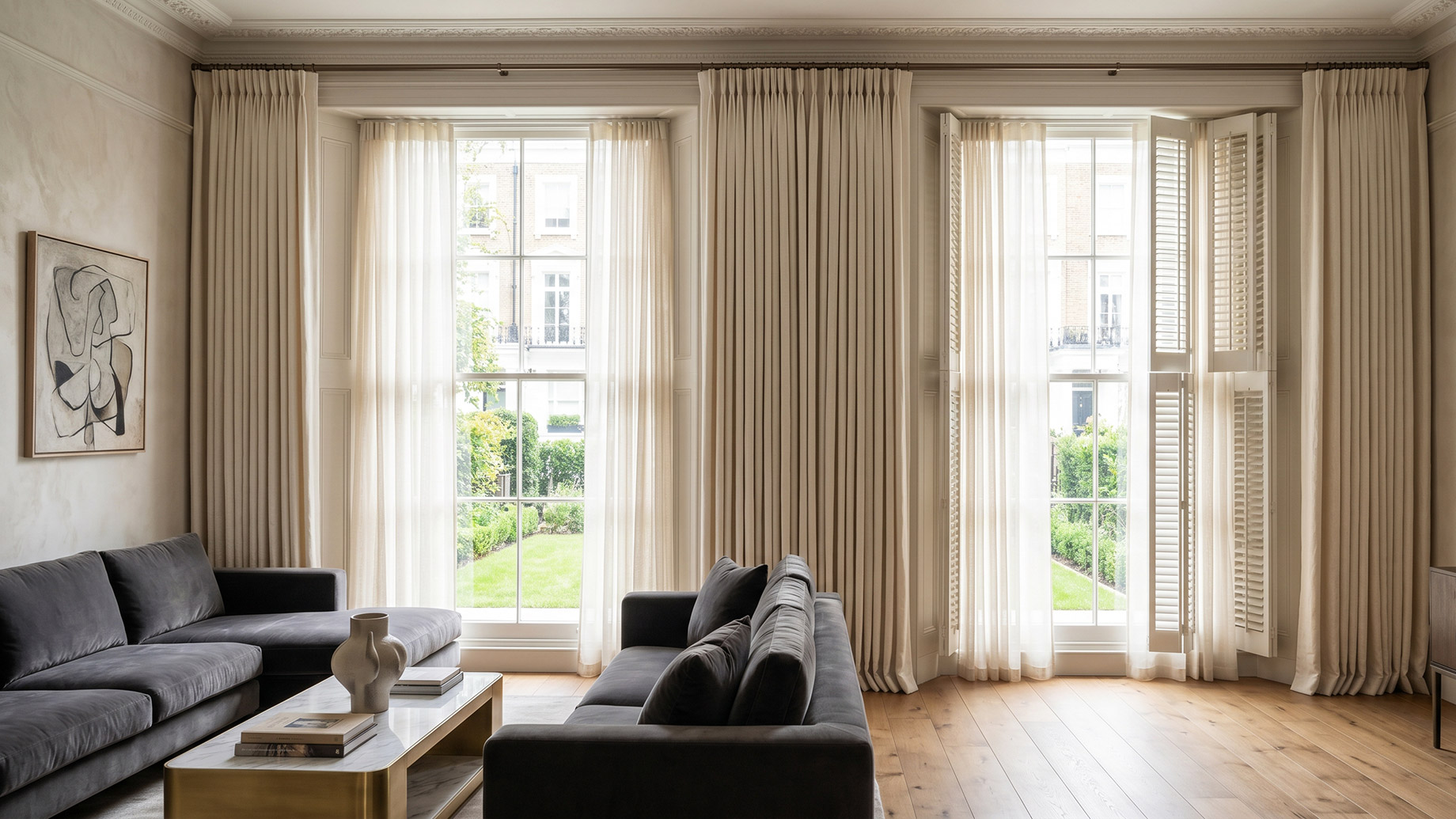
In the hierarchy of decisions that define a luxury interior, window treatments occupy a curious position. They are rarely the first thing discussed in a design brief, yet they are one of the first things noticed when you walk into a finished room. The way light enters a space, the degree of privacy it offers, the proportion and framing of the windows — all of these are controlled not by the glass itself but by what surrounds it.
Walk into any thoughtfully designed residence and the window treatments will be doing at least three jobs simultaneously: managing daylight, contributing to the visual composition of the room, and establishing a relationship between the interior and the world outside. In less considered homes, windows are afterthoughts dressed with whatever was on sale. In exceptional ones, they are treated as architectural elements in their own right.
Light Is the Starting Point
Every room has a relationship with natural light, and that relationship changes throughout the day. A south-facing living room floods with direct sun from late morning through the afternoon. A north-facing bedroom receives soft, indirect light that barely shifts. An east-facing kitchen catches the first low rays of the day and then settles into shadow.
Understanding these patterns is the first step in selecting the right window treatment, because the primary function of any covering — before aesthetics, before privacy — is to give the occupant control over light. Not just on-or-off control, but the ability to modulate intensity, direction, and quality.
Sheer curtains diffuse incoming light without blocking it, creating a soft, even glow that eliminates harsh shadows. Blackout blinds shut light down entirely, useful in bedrooms and media rooms where darkness is required. But between these two extremes lies a range of options that offer something more nuanced — the ability to redirect light rather than simply admit or exclude it.
This is where shutters and louvred systems become particularly valuable. A well-proportioned plantation shutter allows the occupant to angle the louvres, directing sunlight upward toward the ceiling rather than straight into the room. The result is a space that feels bright and airy without the glare that makes screens unreadable and fabrics fade. It is a level of control that curtains simply cannot replicate.
Privacy Without Compromise
In urban environments, privacy is a permanent consideration. Ground-floor residences, properties that overlook busy streets, and homes in close proximity to their neighbours all face the same challenge — how to shield the interior from view without sealing it off from natural light.
Traditional net curtains solved this problem crudely. They blocked sightlines from outside but also reduced light transmission, gave the window a dated appearance, and offered no flexibility whatsoever. Modern alternatives achieve the same privacy goals with far greater elegance.
Top-down, bottom-up blinds allow the lower portion of a window to be screened while leaving the upper section open, which maintains light levels and preserves views of the sky. Frosted or switchable glass achieves a similar result through the glazing itself. But for properties that value warmth, texture, and architectural presence, window shutters London homeowners increasingly choose remain one of the most effective solutions. Shutters provide complete privacy when closed, filtered light and partial privacy when louvres are angled, and full exposure when folded back — three distinct modes from a single treatment, all operated without motors, remotes, or maintenance contracts.
Proportion and Architectural Integrity
The wrong window treatment can diminish a room more effectively than almost any other design error. Floor-length curtains on a small window make it look shorter. A narrow roller blind on a wide bay window looks like an afterthought. A heavy pelmet on a contemporary casement window fights the architecture rather than complementing it.
The best window treatments respond to the proportions of the opening they occupy. They either emphasise those proportions — making a tall window feel taller, a wide window feel more expansive — or they correct them, using visual tricks to rebalance a room where the fenestration is less than ideal.
Full-height shutters are particularly effective on period sash windows, where they reinforce the vertical emphasis of the opening and sit flush within the reveal, creating a clean, integrated finish that feels part of the architecture rather than applied to it. On wider openings — bifold doors, sliding glass panels, picture windows — tracked panel blinds or shutter systems that fold and stack neatly to one side allow the opening to function at its full width when the treatment is retracted.
Commercial Interiors: Different Priorities, Same Principles
The principles that govern residential window treatments apply equally to commercial interiors, but the priorities shift. In a home, atmosphere and personal taste lead the brief. In a commercial setting, performance, compliance, and durability take precedence.
Office environments need solar control to reduce glare on screens and maintain consistent working conditions across the floorplate. Hospitality venues need blackout capability in bedrooms and diffused light in restaurants and bars. Retail spaces need treatments that protect merchandise from UV damage without making the shop floor feel dark or unwelcoming.
The demand for commercial blind installations London businesses require has grown significantly as fit-out standards have risen and building regulations around energy performance have tightened. Modern commercial blinds are integrated into building management systems, motorised for inaccessible windows, and specified to meet fire safety standards that domestic products are not tested against.
For commercial projects, the selection process should involve the architect or interior designer, the building manager, and the installer from the outset. Retrofit installations are always more complex and expensive than treatments specified during the fit-out phase.
Material and Finish: The Details That Matter
In a luxury context, the material and finish of a window treatment deserve the same consideration as the fabric on a sofa or the stone on a worktop. These are surfaces you see every day, often at close range, and cheap materials reveal themselves quickly — warping, discolouring, fraying, or simply failing to sit correctly in the opening.
Hardwood shutters — typically made from basswood, poplar, or white teak — offer a warmth and solidity that MDF and vinyl alternatives cannot match. They accept paint and stain finishes that integrate seamlessly with existing joinery and can be custom-sized to fit non-standard openings without the compromises that off-the-shelf products impose.
For blinds, the weight of the fabric or slat material directly affects how the product hangs, how it stacks when raised, and how cleanly it operates day after day. Heavier fabrics hang straighter and resist billowing in draughts. Lighter materials suit smaller windows where a bulky stack would be visually intrusive.
Hardware is equally important. Tracks, brackets, tilt rods, and hinges should operate smoothly and quietly. Mechanisms that rattle, jam, or require excessive force to operate will be used reluctantly and eventually abandoned entirely — which defeats the purpose of installing them.
Automation: Where It Helps and Where It Does Not
Motorised window treatments have become increasingly popular, driven by the broader smart home trend. For hard-to-reach windows — skylights, clerestory glazing, high-level openings — motorisation is genuinely valuable. It allows the occupant to control light without ladders, poles, or manual effort.
For standard windows within easy reach, the case for automation is less clear-cut. Motors add cost, complexity, and a dependency on electrical supply that manual treatments do not carry. A well-made shutter or blind operates with one hand and requires no charging, no app, and no troubleshooting when the Wi-Fi goes down.
The most balanced approach is to motorise windows where manual operation is impractical and keep everything else analogue. This delivers the convenience of automation where it matters without introducing unnecessary technology into spaces where simplicity works perfectly well.
Investment, Not Expenditure
Quality window treatments last decades when properly specified and installed. Hardwood shutters routinely outlast the decorative schemes around them, requiring nothing more than occasional cleaning and a repaint every ten to fifteen years. Well-made blinds, maintained with light dusting and periodic mechanism checks, will function flawlessly for years.
Cheap alternatives — flimsy roller blinds, plastic-coated shutters, poorly tensioned venetians — carry lower upfront costs but fail sooner, look worse from day one, and ultimately cost more over the life of the property when replacements are factored in.
In a luxury interior, every surface communicates something about the standard of thought and investment that has gone into the space. Windows are the largest single surface in most rooms. Treating them as an afterthought is not just a missed opportunity — it actively undermines everything else the design is trying to achieve.
