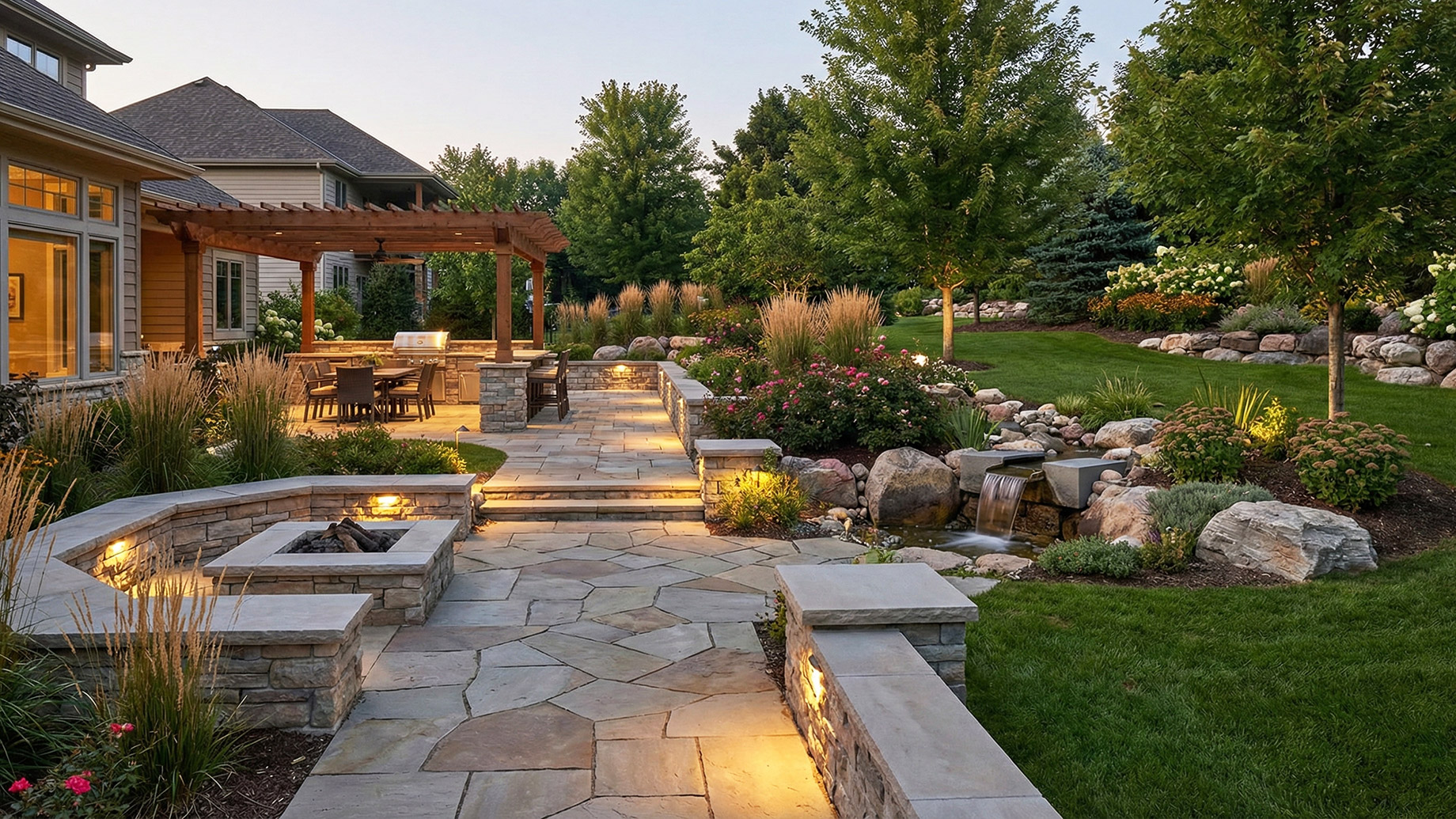
Do you dream of having an outdoor living space that wows your guests?
It all comes down to balance. Not too much hardscape. Not too much softscape. The right ratio of both elements complimenting each other.
But here’s the reality…
Homeowners almost always get this wrong. They go too hard on stone patios and walkways… or they plant so much that it’s hard to keep up!
Both extremes fail.
High end outdoor living spaces find a happy medium between structured landscaping and natural beauty. And when you nail it, magic happens.
In this guide:
- What Is Hardscaping vs. Softscaping?
- Why Balance is Important in Landscape Design
- Finding Your Ideal Ratio
- Elements That Help Tie Everything Together
What is Hardscaping vs. Softscaping?
Here’s the basics.
Hardscaping refers to all of the non-living elements of your landscape. Patio areas, walkways, retaining walls, fire pits, outdoor kitchens. Things that provide structure to your space.
Softscaping is the complete opposite. We’re talking trees, shrubs, flowers, grass, mulch, and soil. Everything in your landscape that is alive.
Good landscape design services use BOTH of these elements. When you work with a full-service landscaping company they design your hardscaping and softscaping together. Creating a cohesive landscape that looks like it was done by professionals (instead of some half-assed DIY project).
Simple enough, right?
Here’s where most people go wrong…
They treat softscape and hardscape as completely different projects. Patio one year. Flower beds the next. Then maybe some walkways later down the road.
STOP.
The most gorgeous landscapes integrate softscape and hardscape elements from the beginning. One DOES NOT come before the other.
Why Does Balance Matter In Landscape Design?
Did you know…
Landscaping has the potential to decrease your property value by up to 30% if it’s not done right.
That’s huge. And when you think about it, it makes perfect sense.
Too much hardscaping and you’ve got an ugly space that looks like a parking lot with some fake plants around the edges. No one wants to spend time in that.
Too much softscaping can look messy. Overgrown bushes. Dead spots in the lawn. You get the picture. Places that look good for maybe 2 weeks out of the year.
It’s about finding that sweet spot in the middle.
Where hardscape and softscape elements complement each other. Where patios, walkways, and landscape lighting exist among trees, bushes, and flowers.
Landscape experts agree.
As cited in Fixr’s 2025 survey, 98% of experts believe updated landscaping and outdoor living spaces factor into home value.
Finding The Perfect Ratio of Softscape to Hardscape
So what is this magical ratio we’re trying to achieve?
Truth is, there’s no magic number. But it depends on the style of your home, your property size, and how you want to use your outdoor space.
That being said, let’s talk general guidelines.
- Urban homes and properties usually have less square footage to work with. You’ll see more hardscaping at around 60-70%. You want to maximize your outdoor living space as much as possible. Think patios, walkways, and built-in grills.
- Suburban homes tend to land right around 50/50 or 40-60 hardscape vs. softscape. Having a nice grassy area for kids and pets is important to most families.
- Large estate properties can get away with heavier softscaping. You have all of the space you need to create outdoor “rooms”, walking paths, and nice natural areas.
Remember – function over everything.
How will you be using your outdoor space? Who will be using it? How much time can you dedicate to maintenance? What’s your climate like? These are the types of questions you should be asking yourself when planning your space.
Elements That Help Tie Your Landscape Together
There are a few landscape features that blend hardscaping and softscaping together.
Take planter boxes and raised beds for example. The base is hardscaping but their entire function is to hold plants. They create a nice visual bridge between stone and greenery.
Retaining walls with built in plantings. They serve a purpose but also allow for soften your space with some added greenery.
Permeable pavers allow you grass, clover, or moss to grow between each stone.
Water features can also bridge this gap. The fountain/pond is definitely hardscaping but water brings life to your landscape. Pair that with some built-in planters and you’ve got a winner.
When you start incorporating elements like this into your landscape, you’ll see what we mean.
Common Landscaping Mistakes People Make
I’ve been around the block enough to see the same landscaping mistakes happen over and over again.
Number 1: Adding to your landscape in phases.
Add a patio, but later realize you need better drainage. Add some plants, but then learn they can’t handle full sun due to where you placed your patio.
Think of your landscaping project as one big puzzle. Adding one piece at a time won’t work.
Number 2: Not thinking about scale.
That monster walkway next to a tiny row of flowers looks stupid. Each individual component of your landscape should feel balanced and purposeful.
Number 3: Not planning for maintenance.
That gorgeous perennial garden is going to need weekly care. Natural stone decks and patios need to be sealed. Be realistic with what you’re willing to maintain in the long-run.
Number 4: Your climate isn’t taken into consideration.
Just because you saw a cool landscaped garden in California doesn’t mean it’s going to work in Minnesota. Ask yourself if the plants you want to use are native to your area. Native plants will require less water and maintenance. Can your hardscaping handle freeze/thaw cycles?
Number 5: Not working with a professional designer.
Ugh. I can’t stress this point enough. Landscaping yourself is doable but difficult. There is a reason professional landscapers exist.
These dudes know what they’re doing. They have seen every landscaping rip-off job in the book. Save yourself the headache and work with a pro.
Hardscaping and Softscaping: The Investment
You know landscaping your home properly is an investment. But that doesn’t mean you shouldn’t do it.
Good landscaping with the right balance of hardscaping and softscaping can net you serious returns. Outdoor living spaces are more of a necessity these days. Most buyers expect them as a standard.
Just remember, you only get 1 shot at making a good first impression. Cut corners on materials and you’ll have a cracked up patio before you know it. Try to install that beautiful pergola yourself and the next big wind storm will rip it down.
Spend money on quality materials. Hire professionals to do the work for you. You’ll thank yourself down the road.
Closing Thoughts
Finding the right balance of hardscaping and softscaping is simple. But like anything in life, it requires forethought and planning.
Begin with function. Know how you will be using your space before you even think about materials.
Consider scale. Softscape elements should feel proportional to your hardscaping and vice versa.
Think about maintenance. All of your outdoor living elements should be able to thrive with your maintenance capabilities.
Work with professionals. Your dream backyard is possible. But you significantly increase your chances by giving the experts a call.
Trust me when I say.
When you have the right balance of hardscaping and softscaping your outdoor space transforms. Thoughtful stone walkways that meander through your landscaped gardens. Large patio areas that are hugged by greenery. Fire pits acting as the centerpiece of your landscape.
When these two elements work in sync, something magical happens.
You now have an outdoor living space that you want to spend time in. Not just another area to throw some furniture on. An attractive feature that adds true value to your home.
And that’s what it’s all about.
