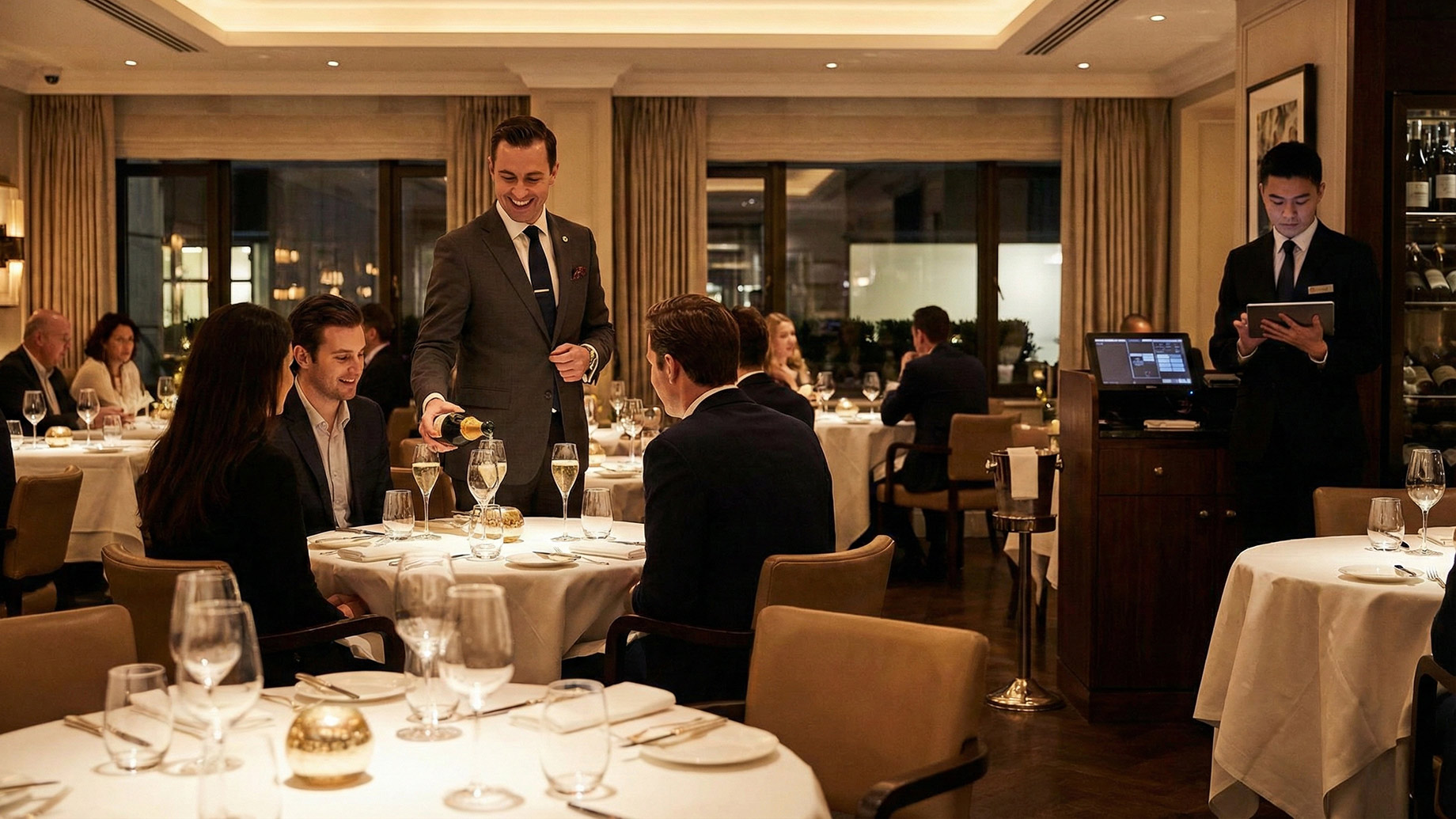
Picture the scene. It is 8:00 PM on a Friday in the heart of London. The dining room is humming, a low-level thrum of clinking crystal and hushed conversation. You are seated at your favourite table—the corner banquette with the view of the park—and before you’ve even shrugged off your coat, a glass of 2015 vintage champagne appears. You didn’t ask for it. You didn’t have to. The manager smiled, nodded, and it just happened.
It feels like magic. It feels like old-world, intuitive hospitality, the kind you read about in novels from the 1920s.
But it isn’t. It’s data.
Behind the velvet curtain of luxury hospitality, a massive shift has taken place. The charming ease of a high-end dinner service is no longer just down to the memory of a clever manager or the charisma of a head waiter. It is being powered by a rigorous, unblinking digital infrastructure. We like to think of luxury as something handcrafted and analogue, a rejection of the digital rat race. Yet, the truth is starkly different: the more effortless your evening feels, the more technology is likely working in the background to prop it up.
The Death of the Ledger
For decades, the “black book” was the holy grail of the restaurant world. A physical ledger, battered and stained with wine, where a manager scribbled notes about their best clients. Mr. Smith likes table 4. Mrs. Jones is allergic to shellfish. The couple at Table 9 always order the soufflé.
It was romantic. It was also terribly inefficient.
The black book had a fatal flaw: it was mortal. If the manager was off sick, that knowledge vanished. If Mr. Smith visited a sister restaurant in Paris or New York, he was a stranger all over again. The hospitality was trapped in the mind of one employee.
Today, that black book has been replaced by the cloud. The first interaction a guest has with a restaurant is rarely a human voice; it is a digital interface. And this is where the battle for loyalty is won or lost.
In a market saturated with options, friction is the enemy. If a potential guest has to jump through hoops to secure a table—calling during specific hours, waiting for email confirmations—they simply go elsewhere. This is why top-tier establishments are ditching the phone lines for advanced online reservation software.
But let’s be clear: this isn’t just about filling seats. It is about data harvesting. Legitimate, useful data. When you book through these modern systems, you aren’t just reserving a slot. You are building a dossier. The software remembers that you prefer sparkling water. It notes that you celebrated your anniversary last July. It flags that you hate sitting near the kitchen doors. By the time you walk through the door, the staff know you. Not vaguely, but precisely. They are armed with a script written by an algorithm, allowing them to perform the role of the “perfect host” with frightening accuracy.
Chaos Control
Move past the front desk and into the kitchen, and the reliance on tech deepens. The cliché of the shouting chef—the Gordon Ramsay figure barking orders and throwing plates—is fading. Modern luxury kitchens are quiet, focused, and almost surgically precise. They have to be. The margins for error in fine dining have vanished.
In the past, a dropped order or a forgotten side dish was a human error. Now, it’s a system failure. The bridge between the floor (where the guest sits) and the pass (where the chef works) is the Point of Sale (POS) system. But calling it a “till” is an insult. These are the central nervous systems of the operation.
For independent venues, this is the great leveller. A small bistro in Tuscany or a boutique hotel in Vancouver can’t afford an army of runners. They need efficiency. They need the waiter to fire the main course from an iPad at the table so that the kitchen begins plating the second the starters are cleared.
Finding the right setup, however, is a minefield. There is too much noise in the market. As highlighted by industry resources like EatApp, the trick for small businesses is integration. A POS that doesn’t talk to your reservation system is useless. It’s like having a brain that doesn’t talk to the hands. When the systems integrate, you get a “single source of truth.” You know exactly how much the table in the corner has spent, how long they’ve been sitting there, and whether they are likely to order that expensive cognac for dessert.
The Economics of the Empty Chair
There is a sharper edge to this technology, one that guests rarely see but owners obsess over: the bottom line. The romance of hospitality often obscures the brutal reality that a restaurant is a business with punishingly thin margins.
One of the greatest threats to a high-end restaurant is the “no-show.” A table of four that simply doesn’t turn up on a Friday night isn’t just an annoyance; it is a financial crater. In the old days, you just hoped for the best. Today, the software fights back.
Modern reservation systems are aggressive. They send automated SMS reminders. They require credit card deposits. They allow for “waitlist sniping,” where a cancelled table is instantly offered to a hungry list of hopefuls via push notification.This ensures the dining room stays full, the kitchen doesn’t waste premium ingredients, and the atmosphere remains buzzing. It turns a potential loss into a seamless pivot.
The Illusion of Simplicity
There is a paradox here. We go to these places to escape our screens. We pay hundreds of pounds, euros, or dollars to be present, to look into someone’s eyes and eat food prepared by human hands. Does knowing that an algorithm suggested our wine ruin the romance?
It shouldn’t. In fact, it should enhance it.
The best technology is the kind you don’t see. It’s “invisible tech.” When the logistics—the boring, gritty mechanics of table management, inventory counts, and allergen checks—are handled by software, the human staff are liberated.
Consider the sommelier. If they are stuck in a basement counting bottles of Merlot on a clipboard, they are not talking to you. If a manager is buried in the back office trying to decipher handwriting in a logbook, they aren’t greeting you at the door. Technology removes the anxiety of logistics. It allows the staff to focus on the one thing a computer cannot do:empathy.
The waiter isn’t panicked about whether the kitchen got the order; the screen told him they did. So, he has time to ask about your day. He has time to notice your water is low. He has time to be human.
The New Standard
We are moving toward a future of “predictive hospitality.” It sounds dystopian, but in practice, it is delightful.
Imagine walking into a hotel bar in a city you’ve never visited. The bartender greets you and asks, “The usual, sir?”—and he’s right. He knows you drink a Negroni with a specific gin because you ordered it at their branch in New York six months ago. The system connected the dots that a human brain never could.
Is it spooky? Maybe a little. But it feels incredibly luxurious. It makes the world feel smaller, more welcoming. It removes the friction of having to explain yourself over and over again.
The establishments that refuse to adapt, clinging to pen and paper in the name of “tradition,” will find themselves left behind. They will be the ones where the service is slow, where the kitchen runs out of the special, where the waiter forgets your name. Tradition is wonderful for recipes—nobody wants a robot cooking their risotto—but it is terrible for logistics.
For the modern restaurateur, the lesson is clear: let the machines handle the memory. Let the software handle the reservations. Let the POS track the inventory. Save the humanity for the handshake, the smile, and the pouring of the wine. That is the only part of the evening that can’t be coded.
