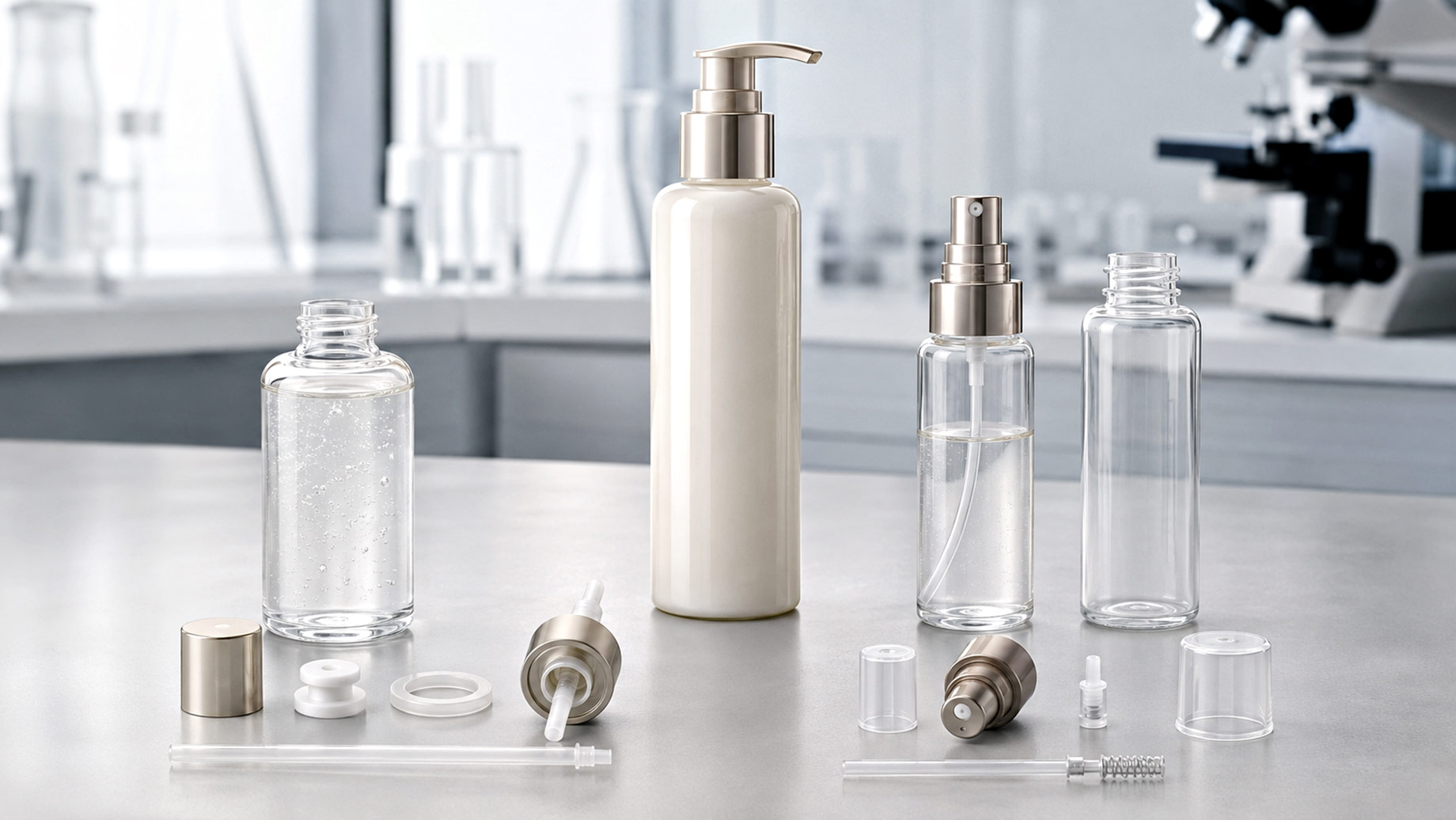
Many packaging complaints are not caused by the bottle alone. Pumps fail to prime, caps loosen, sprayers drip, and liners react with the formula.
Treating the container, closure, and formula as one system reduces leakage and poor dispensing after launch.
Define the Formula
Record viscosity, pH, oil, alcohol, particles, filling temperature, and intended dose.
Thick lotion needs a different pump path from a thin toner. A scrub may block a narrow orifice.
Use the final formula for testing, not only water or a temporary base.
Match the Neck
The bottle neck finish and closure must match in diameter, thread, height, and sealing surface.
Small dimensional differences can cause cross-threading, low torque, or leakage.
Use approved drawings and gauge critical dimensions.
Select the Pump
Compare:
- Dose
- Priming strokes
- Dip-tube size
- Flow path
- Spring material
- Locking method
- Actuation force
- Product evacuation
Airless cosmetic packaging can limit air entry for sensitive formulas, but the pump and moving platform still need compatibility testing.
Set the Dip Tube
A dip tube that is too short leaves product behind. One that is too long can bend against the base and block flow.
Cut angle and tube stiffness affect performance.
Test the package upright and at normal use angles. Consider whether users will tilt the bottle near the end.
Choose Liners and Gaskets
Liners help create a seal but may absorb fragrance, swell, soften, or transfer material.
Test the exact liner, adhesive, and closure. Do not assume all foam or foil liners behave alike.
Check whether an induction seal is compatible with the bottle material and filling process.
Control Torque
Too little torque allows loosening and leakage. Too much can damage threads, distort liners, or make the package difficult to open.
Establish application and removal torque limits. Measure after filling and after storage.
Account for material relaxation and temperature cycles.
Test Sprayers
For fine mist, review pattern, droplet size, output, angle, and dripping.
Oils or high-solvent formulas may affect internal parts.
Test repeated actuations and storage between uses. A sprayer that works once may clog after product dries.
Include Closures in Sustainability Plans
Brands comparing sustainable beauty packaging should evaluate the complete package.
A recyclable bottle with a complex mixed-material pump may create different end-of-life challenges. Refill systems need closures that survive repeated use.
Lightweighting should not reduce thread strength or sealing.
Run Compatibility Storage
Store packages upright, inverted, and on their side where appropriate. Include expected temperature extremes.
Inspect:
- Leakage
- Weight loss
- Cracking
- Swelling
- Odor
- Color
- Torque
- Pump output
- Blockage
Continue real-time testing even when accelerated studies are used.
Test Filling-Line Application
Production equipment must apply closures consistently.
Run a pilot with actual speed, fill temperature, capper, and torque settings. Watch for cross-threading, damaged decoration, and unstable bottles.
Measure a sample from the beginning, middle, and end of the run.
Simulate Shipping
Use final filled weight and secondary packaging. Test drops, vibration, compression, and temperature cycles.
Check whether pumps unlock, caps loosen, or liners move.
E-commerce parcels need separate testing from bulk cases.
Observe Users
Ask users to open, dispense, close, and store the product.
Actuation force, wet hands, dose, and clear locking all affect satisfaction.
Measure remaining product when the dispenser stops working.
Set Complaint Codes
Classify market complaints by leakage, blockage, no prime, weak spray, broken actuator, loose cap, or difficult opening.
Collect batch, package, and storage information. Clear categories help teams find the root cause.
Control Changes
A new pump spring, liner, resin, supplier, or molding tool can change performance.
Require notification and decide whether compatibility, torque, or transport testing must be repeated.
Control Tolerances and Fit
Two components can match on a drawing but perform differently at the edges of their tolerance ranges. Review the maximum and minimum neck dimensions, pump gasket thickness, closure thread profile, and container height. Test components from more than one production lot rather than relying on ideal samples.
A useful trial includes the loosest and tightest expected combinations. Measure application torque, removal torque, leakage, pump output, and visible gaps. This approach identifies weak tolerance combinations before production begins.
Consider Decoration and Secondary Operations
Coatings, metallization, labels, and hot stamping may change more than appearance. A coating can add thickness near a snap fit, a label can interfere with a closure, and heat from decoration can affect plastic dimensions. Include fully decorated production-style components in testing.
Also confirm that ink, adhesive, and coating systems tolerate the formula and the cleaning products used on the filling line. A package should remain attractive without creating particles, flakes, or sticky surfaces during normal use.
Turn Complaints into Corrective Action
Complaint codes should lead to investigation, not simply reporting. Separate leakage, poor priming, weak spray, broken actuator, loose closure, and cosmetic damage. Photograph returned packs and record formula, lot, filling date, transport route, and storage conditions.
Review trends jointly with component and filling partners. When a cause is confirmed, update the specification, inspection plan, or line setting. Verify the correction with fresh production samples. This disciplined feedback loop prevents the same issue from appearing under a different product name.
Retain approved samples from each important launch. They give investigators a physical reference when later lots behave differently.
Conclusion
Reliable beauty packaging depends on compatibility among formula, neck, pump, liner, closure, filling process, and transport.
Define measurable limits, test the complete package, and classify complaints clearly. This systems approach reduces leaks, blocked dispensers, and customer frustration.
