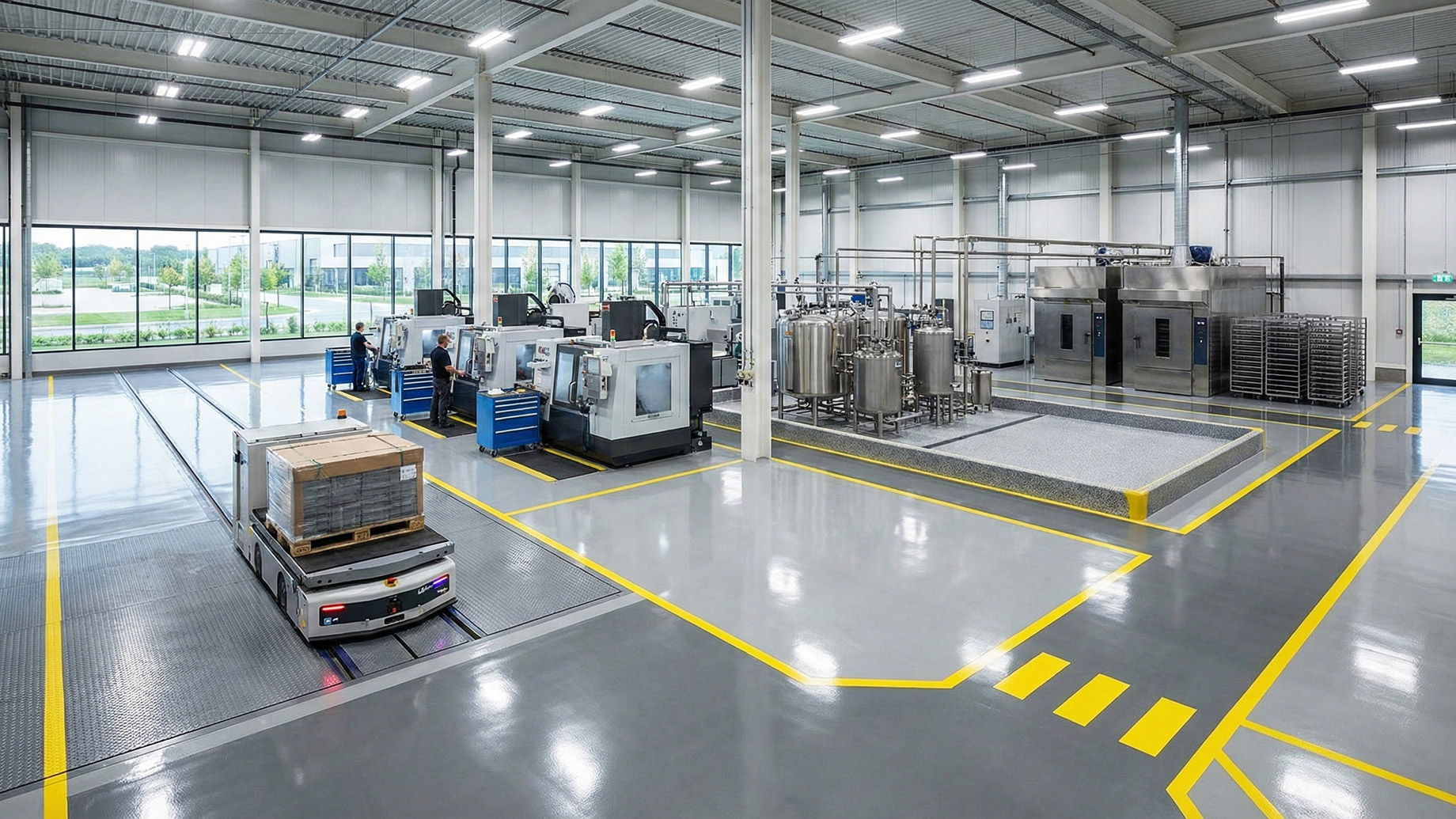
Manufacturing and industrial facilities place extraordinary demands on flooring systems. Unlike office buildings or retail spaces where aesthetics often drive decisions, industrial environments require floors that withstand punishing daily abuse while maintaining safety and functionality. The wrong flooring choice can result in production downtime, worker injuries, regulatory violations, and replacement costs that dwarf the original installation investment.
Facility managers and plant engineers face complex decisions when specifying flooring for industrial applications. Understanding the critical factors that influence performance helps ensure that flooring investments deliver reliable long-term value rather than becoming recurring maintenance headaches.
Understanding Load and Impact Requirements
Industrial floors must support loads that would destroy conventional flooring systems. Forklifts carrying multi-ton pallets, heavy machinery anchored to the slab, and the constant movement of wheeled equipment create stresses far beyond what residential or light commercial floors experience. These forces concentrate at small contact points, multiplying the effective pressure on the flooring surface.
Static load capacity represents only part of the equation. Dynamic loads from moving equipment, impact forces from dropped materials, and vibration from operating machinery all affect flooring performance. A coating system that handles static weight adequately may crack or delaminate under repeated impact or vibration stress.
Proper flooring specification begins with honest assessment of operational demands. What is the maximum load any single piece of equipment will place on the floor? How frequently do impact events occur? What types of wheels or tracks contact the surface? Answering these questions allows engineers to specify flooring systems with appropriate thickness, hardness, and flexibility to handle actual conditions.
Chemical Resistance and Exposure Profiles
Industrial facilities frequently handle chemicals that attack conventional concrete and coating systems. Acids, alkalis, solvents, fuels, and hydraulic fluids each present distinct challenges. A floor that resists one chemical category may fail rapidly when exposed to another. Understanding the complete chemical exposure profile is essential for appropriate material selection.
The concentration and duration of chemical contact matter as much as the chemical type. Brief splashes of dilute solutions stress flooring differently than prolonged exposure to concentrated substances. Thermal factors compound chemical challenges when hot liquids contact the surface or when cleaning processes involve heated solutions.
Material safety data sheets provide starting points for understanding chemical resistance requirements, but real-world conditions often prove more demanding than laboratory specifications suggest. Experienced industrial epoxy flooring specialists evaluate actual operating conditions rather than relying solely on published resistance charts. They understand that floors in chemical processing areas require different protection than floors in mechanical assembly zones, even within the same facility.
Thermal Considerations and Performance Limits
Temperature affects flooring performance in ways that facility managers sometimes overlook. Coating systems designed for ambient conditions may soften, become brittle, or lose adhesion when exposed to temperature extremes. Thermal cycling between hot and cold creates expansion and contraction stresses that can crack rigid coating systems.
Food processing facilities face particular thermal challenges. Hot water washdowns followed by refrigerated storage create rapid temperature swings that stress flooring systems. Commercial kitchens expose floors to heat from cooking equipment, spills of hot liquids, and thermal shock when cold products contact warm surfaces. Cold storage facilities require flooring that maintains flexibility and adhesion at sub-freezing temperatures.
Specifying flooring for thermally demanding environments requires understanding both the temperature extremes and the rate of temperature change. Gradual transitions stress flooring less than rapid swings between hot and cold. Materials with appropriate flexibility and thermal expansion characteristics handle cycling better than rigid systems optimized for stable conditions.
Safety Compliance and Slip Resistance
Worker safety represents both an ethical obligation and a regulatory requirement. Industrial flooring must provide adequate traction under conditions that promote slipping, including wet surfaces, oil contamination, and debris accumulation. OSHA regulations establish minimum standards, but prudent facility managers often exceed these minimums to reduce injury risk and associated liability.
Slip resistance involves trade-offs that complicate specification decisions. Heavily textured surfaces provide excellent traction but prove difficult to clean and may be uncomfortable for workers who stand for extended periods. Smooth surfaces clean easily but become hazardous when wet or contaminated. Finding the appropriate balance requires understanding how the floor will actually be used and maintained.
Different zones within a facility may require different slip resistance levels. Areas frequently exposed to water or oil need more aggressive texturing than dry assembly areas. Transition zones between wet and dry areas deserve particular attention since workers may not adjust their gait when moving between surfaces with different traction characteristics.
Installation Timing and Operational Disruption
Industrial flooring installation inevitably disrupts operations. The extent of that disruption depends on material selection, project planning, and contractor capabilities. Some coating systems require days of curing before they can accept traffic, while others return to service within hours. Understanding these differences allows facility managers to schedule installations that minimize production impact.
Phased installation approaches allow facilities to maintain partial operations throughout flooring projects. Rather than shutting down entirely, sections of the floor are coated sequentially while production continues in unaffected areas. This approach extends overall project duration but reduces the operational and financial impact of extended shutdowns.
Coordination between facility operations and installation contractors proves critical for successful phased projects. Clear communication about access requirements, equipment movement, and environmental controls prevents conflicts that delay completion or compromise installation quality. Working with professional concrete coating contractors who have experience in active industrial environments ensures realistic scheduling and effective coordination throughout the project.
Maintenance Requirements and Lifecycle Costs
Initial installation cost represents only a fraction of total flooring expense over the system’s service life. Maintenance requirements, repair frequency, and eventual replacement all contribute to lifecycle cost. Flooring systems that cost less initially but require frequent maintenance or early replacement often prove more expensive than premium alternatives with longer service lives.
Maintenance protocols vary significantly between flooring types. Some systems require periodic reapplication of topcoats to maintain chemical resistance and appearance. Others need only regular cleaning with approved products. Understanding these requirements before installation allows for accurate budgeting and appropriate maintenance planning.
Repair characteristics also affect long-term costs. Some coating systems allow seamless spot repairs that blend invisibly with surrounding flooring. Others require section replacement that leaves visible boundaries. When damage is inevitable given the operating environment, repair-friendly flooring systems reduce both cost and visual impact of ongoing maintenance.
Making Informed Decisions
Selecting industrial flooring requires balancing multiple factors that sometimes conflict with each other. The most chemical-resistant option may not provide adequate slip resistance. The fastest-curing system may not handle thermal cycling. The lowest-cost material may require the most maintenance. Successful specification integrates all relevant factors rather than optimizing for any single characteristic.
Facility managers benefit from consulting with flooring professionals who understand industrial environments and can translate operational requirements into appropriate material specifications. These experts recognize that every facility presents unique challenges requiring customized solutions rather than standard recommendations.
