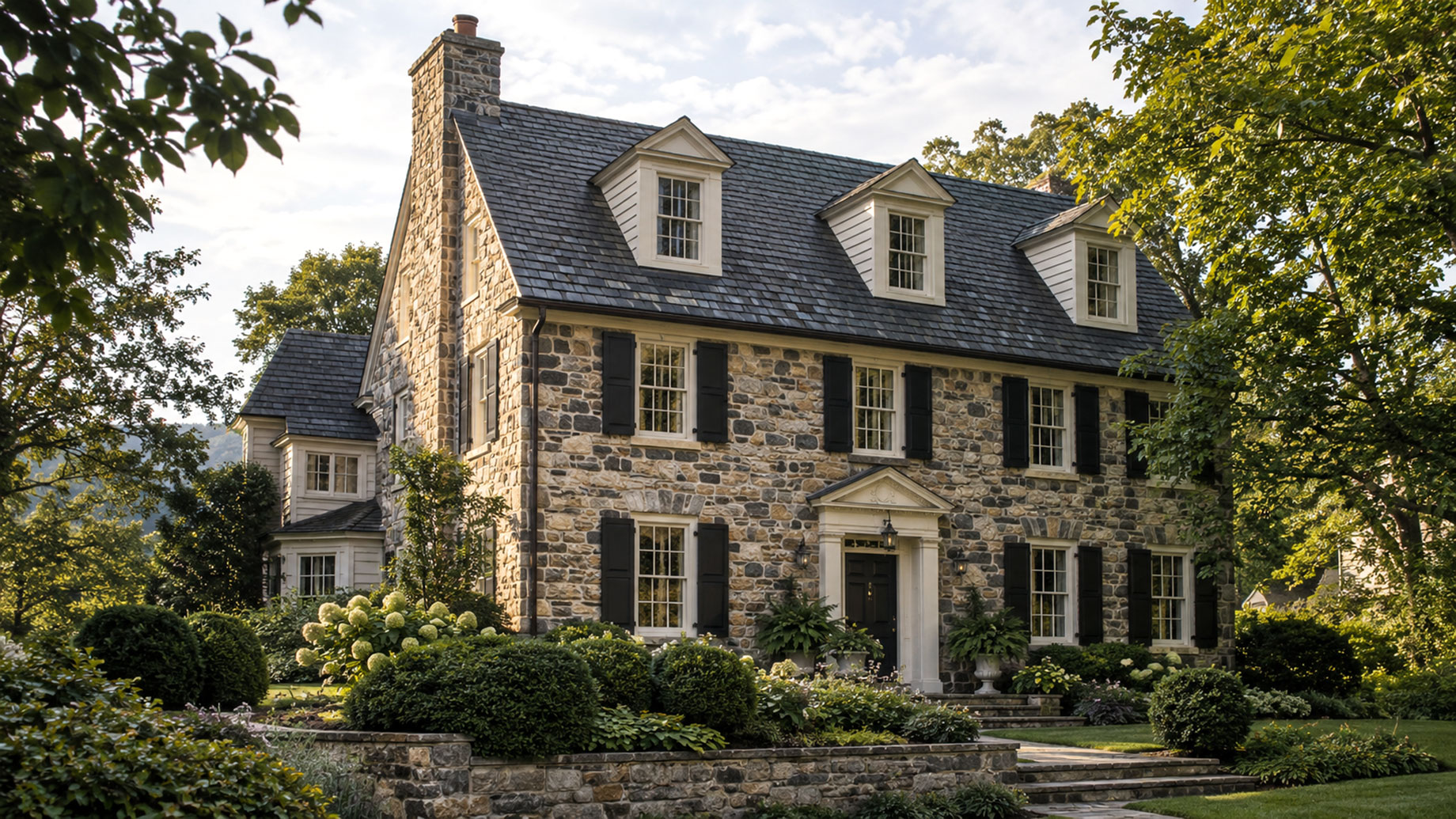
The roof belongs to the design
On a house with a steep pitch, the roof covers a large share of what anyone sees from the street, so replacing it changes the look of the whole elevation. It is easy to overlook next to the stonework and the original windows, right up until a tear-off is on the calendar and someone has to decide what goes back on. That decision will shape how the house reads for decades. Which material fits comes down mostly to the structure underneath and the era the house belongs to, with budget and length of ownership close behind.
Slate on the older houses around West Chester
Plenty of older homes around West Chester were built with slate, and on those houses nothing else quite matches its look or its longevity. Genuine slate can last a century.
It is heavy, though. The framing has to have been built to carry that weight, which is why slate is rarely a swap onto a house that was never designed for it. An owner who admires slate on a neighbor’s stone colonial should find out what their own rafters were sized for before getting attached to the idea.
Owners who already live under slate face a different job, which is finding someone qualified to work on it. A repair calls for a person who knows how to walk the roof and handle the material without cracking the tiles around the one they came to fix.
Cedar and what it asks of an owner
Cedar shakes give a warm, textured surface that suits certain older houses, and they hold up decently. They need more maintenance than asphalt, though, and good airflow underneath so the wood doesn’t rot. With cedar, and with slate for that matter, the choice is often as much about character and matching the home’s era as it is about practicality. Owners going that route should plan for the upkeep from the start.
Standing-seam metal for owners who plan to stay
Standing-seam metal roofing has moved from barns and farm buildings onto fine homes, and it deserves a look from anyone planning to stay put for decades. It sheds snow and stands up to wind. A metal roof can last 40 to 50 years or longer, and it reflects summer heat, which helps hold down attic temperatures through a humid southeastern Pennsylvania July.
It costs more up front, though for the right house and owner it can be the last roof they ever buy. Metal also needs an installer who knows the specific panel and fastener systems, because a poor job shows up later as oil-canning in the panels or leaks at the seams.
Architectural asphalt where slate won’t work
Most homes in the area have asphalt shingles, and modern architectural asphalt is far tougher than the old three-tab shingles many houses started with. It handles the freeze-thaw swings here well. It installs quickly, and it comes in colors that suit everything from a stone colonial to a newer build, which matters on an older house whose frame was never meant to carry slate. With decent ventilation and a little upkeep, a quality architectural shingle roof will run 25 years or more in this climate.
Asphalt is not a lifetime material. It also leans heavily on installation quality, since a good shingle put on badly will fail early, so with asphalt the crew counts as much as the product on the pallet.
What the GAF Master Elite designation means
Anyone collecting bids will run into manufacturer certifications. GAF is a major shingle maker, and it reserves its Master Elite designation for a small share of roofing contractors who meet its bar for licensing, insurance and proven experience. For a homeowner the practical difference is the warranty: certified installers can offer stronger, longer manufacturer-backed coverage than a non-certified contractor can, because the maker trusts the workmanship standing behind its product. The designation works as a filter, and a useful one when a warranty claim may not come up until years after the job.
Storm resilience and the FORTIFIED standard
Severe weather is part of owning a house in southeastern Pennsylvania, and FORTIFIED is a construction standard developed to help buildings stand up to it. The standard reaches past the shingle. It covers how the roof deck is sealed and how the edges are fastened, along with the small details that keep wind and water out when a storm hits hard. Building to it costs a little more in labor and materials. Clear Roofing & Exteriors, based in West Chester, is GAF Master Elite certified and builds and documents its roofs to the IBHS FORTIFIED Roof standard, which is why both come up in this article.
Installation decides how long any of it lasts
Whatever the material, the rated lifespan only holds if the details underneath are done properly: underlayment, correct nailing, well-sealed flashing and enough ventilation. When comparing bids from West Chester roofers, it helps to see proof of licensing and insurance and to find out who actually honors the warranty if something goes wrong. Chimneys and valleys deserve a direct question too, since those are where roofs usually start to fail. A contractor who can explain what standard they build to, and which certifications they carry, is giving a homeowner something concrete to compare. A full replacement happens maybe once every few decades on a given house. That gives owners of an older home good reason to match the material to the architecture and the structure first, then choose a crew whose certifications back up the work.