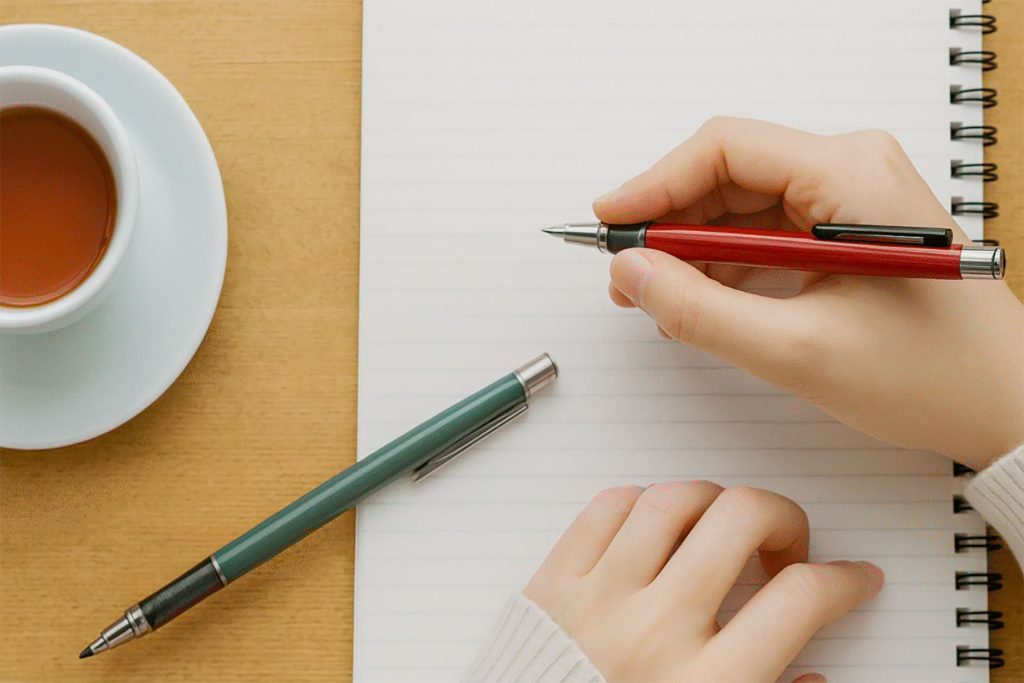
Something subtle has been happening in cafés, trains, study rooms, and offices: people are writing by hand again. Not for nostalgia, and not because they’re rejecting technology—but because writing does something typing can’t. It slows you down just enough to think clearly.
When I asked a few friends why they picked up pencils again, the answers were almost embarrassingly honest.
- “Typing feels too fast for my brain.”
- “I remember things better when I write them.”
- “Writing calms me in a way screens don’t.”
Mechanical pencils—simple, low-maintenance, and forgiving—have become the tool people reach for when they want to regain a bit of mental quiet. But what surprised me is that Japanese mechanical pencils, in particular, are the ones driving this comeback.
Why Mechanical Pencils Make Sense in a Fast Digital World
Handwriting slows your thoughts in just the right way. Psychology research often points to this: writing by hand improves memory retention, concept understanding, and focus compared to typing, which is faster but more automatic. The slight friction of pencil lead actually engages different parts of the brain.
Mechanical pencils fit perfectly into this “intentional slowdown” because:
- They start instantly—no syncing, no charging.
- The lines are light and low-pressure, ideal for rough ideas.
- Mistakes erase cleanly, encouraging exploration instead of perfection.
For people overwhelmed by constant notifications, the act of writing feels like a small reset button.
Why Japanese Mechanical Pencils Truly Stand Out in Real Use
My first experience with a Japanese mechanical pencil was almost embarrassing—I borrowed a colleague’s during a meeting and instantly felt the difference. The line moved the way I hoped it would: steady, clean, and surprisingly controlled. It was the kind of smoothness that doesn’t call attention to itself; the pencil simply disappears so your thoughts can move without friction.
It didn’t take long to understand why so many stationery fans specifically search for Japanese mechanical pencils when they want something reliable for everyday writing. Their advantages aren’t marketing exaggerations—they’re the result of decades of quiet engineering decisions.
Consistent lead advancement
Cheaper pencils often push out too much or too little lead, forcing you to adjust your grip. Japanese pencils, in contrast, are tuned to advance lead in ultra-consistent increments—even fractions of a millimeter matter.
Balanced weight toward the tip
Because the center of gravity sits low, your fingers don’t need to work as hard. This makes a surprising difference during long writing sessions.
Rigid, non-wobbling metal tips
A slight wobble may seem trivial, but it translates directly into shaky or uneven handwriting. Japanese pencils avoid this with strong, precisely fitted tips that stay still.
Thoughtful micro-details everywhere
The quieter click mechanisms, grip textures that prevent slipping, durable metal clips, and barrels that feel stable without being heavy—all add up to a writing experience that feels quietly refined.
These differences are subtle, but once you get used to them, it’s hard to go back. Writing feels smoother, steadier, and more focused—not because you changed your handwriting, but because the tool finally keeps up with you.
Why the Uni Kuru Toga Mechanism Became a Modern Icon
If there’s one pencil that represents the mechanical-pencil revival, it’s the Kuru Toga—and not because of branding, but because it solved a problem every pencil user has felt, even if they’ve never put words to it.
The first time I tried one, I didn’t immediately think “technology.”
What I noticed was the effect:
Half a page later, my handwriting still looked clean and even. No thick edges. No flat sides of the lead scratching the paper. No need to constantly rotate my wrist to correct the angle.
Only afterward did I learn the reason.
The Uni Kuru Toga mechanism rotates the lead in tiny, controlled increments every time it touches the page. The rotation is subtle—almost invisible—but it prevents the lead from wearing unevenly. The result is surprisingly practical: you get steady, predictable lines with far fewer interruptions.
This is why so many people who want to understand what makes the model special start with a Uni Kuru Toga pencil. Not to buy something fancy, but because it’s the clearest demonstration of how a small mechanical innovation can transform everyday writing. One short writing session is usually enough for the difference to show itself: less adjusting, fewer breaks in flow, and cleaner notes from start to finish.
Why Japan Ended Up Leading the Comeback
The resurgence isn’t accidental. Japan has a long cultural relationship with precise writing tools—think of calligraphy, drafting, manga, and academic note-taking traditions. Mechanical pencils are used widely in schools and creative fields, which pushed Japanese brands to innovate for decades.
The result?
A market where “good enough” isn’t enough, and where even entry-level pencils feel engineered rather than mass-produced.
If You’re Curious, These Models Are Great Starting Points
Below isn’t a technical list—it’s a simple guide to help you choose based on how you write.
Kuru Toga Advance — Best for everyday notes
Clean, consistent lines; no fuss; ideal for students and fast writers.
Kuru Toga Metal — Best for long writing sessions
Heavier body, lower center of gravity, noticeably easier on the fingers.
Kuru Toga Dive — Best for a premium experience
Smooth first stroke, elegant mechanism; perfect if you enjoy good tools.
Orenz Nero — Best for tiny handwriting
Legendary unbreakable fine lead. Great for formulas, dense notes, and precision.
Tombow Mono Graph — Best affordable first step
Lightweight, reliable, and equipped with a genuinely excellent eraser.
No exaggeration: any of these will feel different from the mechanical pencils most people grew up with.
How to Choose the Right One (Quick Buyer Guide)
Even without specs, a few rules help:
- Write fast? Choose a pencil with auto-rotation (like Kuru Toga).
- Write small? Go for 0.3mm or a model designed to protect fine lead (Orenz Nero).
- Get hand fatigue easily? A metal body or low-balance pencil works best.
- Just testing the waters? Mono Graph or Kuru Toga Advance are safe starters.
This section alone helps readers make a decision—without feeling sold to.
Why Writing Still Matters
The value of writing isn’t the output—it’s the moment your thoughts slow enough for clarity. Mechanical pencils make that moment accessible. And Japanese ones, with their quiet engineering and thoughtful design, make it smoother.
Maybe that’s why they’re inspiring people to write again. Not because they’re old-fashioned, but because they give us something our digital tools rarely offer anymore a small, steady place to think.
