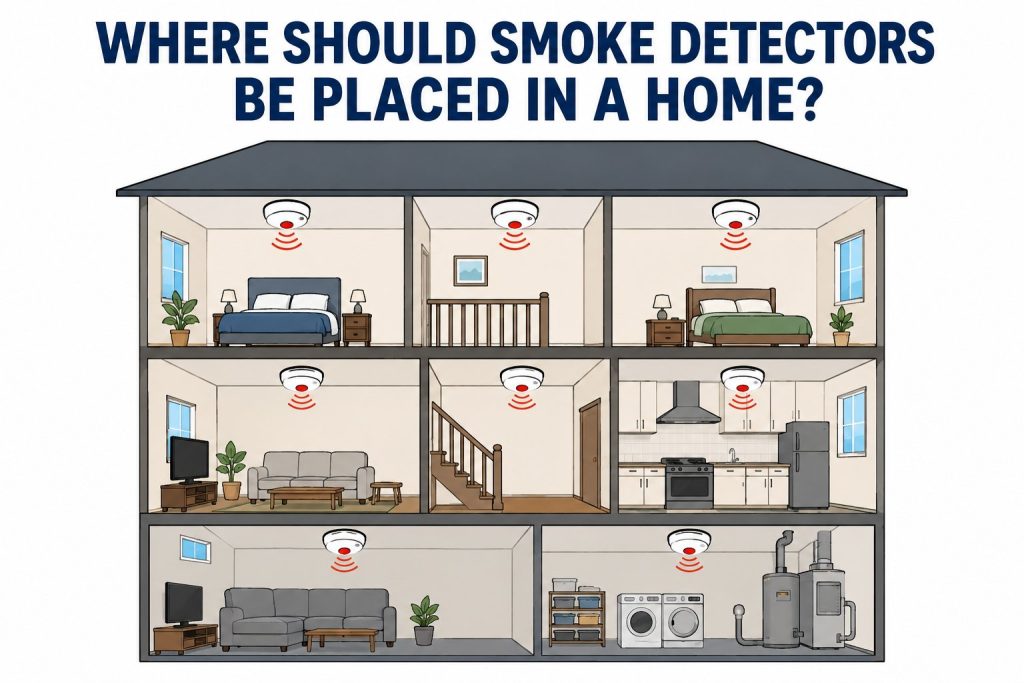
Knowing where to place smoke detectors is one of the simplest ways to make a home safer. A smoke alarm can only help if it detects smoke early enough and if people in the home can hear it in time to escape. That is why smoke detector placement in a home should be planned by room, floor, and sleeping area. A single alarm in a hallway is usually not enough for today’s homes, especially if bedrooms are separated, doors are closed at night, or the home has multiple levels. The goal is to create coverage that gives every person the earliest possible warning.
Why Smoke Detector Placement Matters
Smoke spreads quickly, and the first few minutes of a fire are critical. When smoke detectors are placed correctly, they can detect danger before smoke reaches sleeping areas or blocks escape routes. Poor placement can delay warning, create nuisance alarms, or cause residents to remove batteries out of frustration. Placement matters just as much as the type of alarm you buy, because even a high-quality smoke detector cannot work well from the wrong location. A good layout protects bedrooms, hallways, living spaces, basements, and the paths people would use to leave the home.
Place Smoke Detectors Inside Every Bedroom
Every bedroom should have its own smoke detector. This is especially important because people often sleep with the door closed, which can slow the spread of smoke but also muffle the sound of an alarm outside the room. A detector inside the bedroom helps wake the person closest to the danger, even if the fire starts nearby or smoke enters the room first. This rule applies to primary bedrooms, children’s rooms, guest rooms, and any room regularly used for sleeping. If a den, office, or finished attic is used as a sleeping space, it should be treated like a bedroom.
Place Smoke Detectors Outside Sleeping Areas
In addition to placing alarms inside bedrooms, install smoke detectors outside each separate sleeping area. In many homes, this means placing one in the hallway near bedroom doors. If bedrooms are located in different parts of the house, each sleeping zone should have its own nearby alarm. For example, a home with a primary suite on one side and children’s bedrooms on the other should not rely on one hallway detector. The alarm should be close enough to sleeping rooms that it can be heard clearly when people are asleep.
Install Smoke Detectors on Every Level
Smoke detectors should be installed on every level of the home, including the basement. Fires can start in lower levels, utility areas, living rooms, kitchens, garages, or near electrical equipment, so every floor needs protection. In a two-story home, this usually means alarms on the first floor, second floor, and basement. In a split-level home, each distinct level should be considered when planning coverage. If a floor does not have bedrooms, place an alarm in a main living area, near a stairway, or both, depending on the layout.
Best Rooms and Areas for Smoke Detectors
Some locations are especially important because they help detect smoke along common escape routes. Hallways, stairways, living rooms, family rooms, and finished basements are all strong candidates for smoke detector placement. In open-concept homes, place alarms high and centrally enough to cover the main living space without being too close to cooking appliances. Larger homes may need more alarms than the minimum recommendations to prevent gaps in coverage. Good placement should match the way your home is actually used, not just the number of rooms it has.
Key areas to consider include:
- Inside every bedroom
- Outside each sleeping area
- On every floor, including the basement
- Near stairways between levels
- In living rooms, dens, or family rooms on levels without bedrooms
- Along likely escape paths
Ceiling vs. Wall Placement
Ceiling placement is often preferred because smoke rises. When mounting a smoke detector on the ceiling, choose a location away from corners, vents, fans, and areas where air may not circulate well. If wall placement is allowed by the manufacturer and local code, the alarm should be mounted high on the wall, close to the ceiling. Always follow the instructions that come with the specific alarm, because spacing requirements can vary by model. Avoid placing alarms too low on a wall, where smoke may take longer to reach the sensor.
Where Not to Place Smoke Detectors
Correct placement also means knowing which spots to avoid. Smoke detectors should not be installed directly next to cooking appliances, bathrooms, windows, ceiling fans, or HVAC vents. Steam, cooking particles, and moving air can cause false alarms or prevent smoke from reaching the alarm properly. Garages and unfinished attics are also usually poor locations for standard smoke alarms because dust, temperature swings, and exhaust can interfere with performance. In these areas, a heat alarm may be more appropriate, depending on local code and the home’s design.
Avoid these common problem spots:
- Too close to stoves, ovens, or toasters
- Directly outside bathrooms with showers
- Near ceiling fans, supply vents, or return vents
- Beside windows or exterior doors
- In dusty, greasy, damp, or very hot areas
- In dead-air spaces near wall and ceiling corners
Smoke Detector Placement in Kitchens
Kitchens need careful planning because they are common sources of nuisance alarms. You want the alarm close enough to warn of a real fire but not so close that everyday cooking sets it off. Avoid placing a smoke detector directly above a stove, oven, toaster, or air fryer. In many homes, the better choice is to place the alarm just outside the kitchen or in an adjacent hallway or living area. If alarms go off frequently while cooking, do not remove the battery; instead, review the placement and consider whether the alarm type is appropriate for that location.
Smoke Detectors in Basements and Stairways
Basements should have smoke detectors because fires can start near furnaces, water heaters, electrical panels, laundry equipment, or stored items. A basement alarm should be placed on the ceiling near the stairway leading to the main level when possible. This helps detect smoke before it travels upstairs and blocks an escape route. Finished basements with bedrooms, recreation rooms, or offices may need more than one alarm. If the basement has a sleeping area, place an alarm inside that room and outside it, just as you would on any other level.
Interconnected Smoke Detectors
Interconnected smoke detectors provide stronger protection because when one alarm sounds, all connected alarms sound. This is valuable in larger homes, multi-story homes, and homes where bedrooms are far from kitchens, garages, or basements. If a fire starts in the basement at night, an interconnected system can alert people sleeping upstairs sooner than a single basement alarm might. Interconnection can be hardwired or wireless, depending on the system and home. When replacing alarms, check compatibility and follow the manufacturer’s instructions so the system works correctly.
FAQ
How many smoke detectors should a home have?
A home should have smoke detectors inside every bedroom, outside each sleeping area, and on every level, including the basement. Larger homes, split layouts, and long hallways may need additional alarms for full coverage.
Should smoke detectors be on the wall or the ceiling?
Ceiling placement is generally best because smoke rises. If wall mounting is allowed, place the alarm high on the wall according to the manufacturer’s instructions and local code.
Can I put a smoke detector in the kitchen?
You can place one near a kitchen, but avoid installing it directly next to cooking appliances. Poor placement near stoves or ovens can cause frequent nuisance alarms.
Should smoke detectors be inside bedrooms?
Yes. Each bedroom should have its own smoke detector, especially because closed doors can reduce how quickly smoke and sound travel.
How often should smoke detectors be tested?
Test smoke detectors monthly. Replace batteries as needed, and replace the entire alarm according to the manufacturer’s expiration date, commonly around 10 years.
Are smoke detectors needed in the basement?
Yes. Basements should have smoke detectors because fires can start near heating equipment, electrical systems, laundry areas, or stored materials.
Make Smoke Detector Placement Part of a Complete Safety Plan
Placing smoke detectors correctly is only one part of home fire safety. Test alarms regularly, replace old units, and make sure everyone in the home recognizes the sound. Create a fire escape plan with two ways out of each room whenever possible, then practice it with everyone who lives there. Keep bedroom doors closed at night when practical, because closed doors can help slow the spread of smoke and heat. With the right alarms in the right locations, your home has a stronger first line of defense against fire.