The call usually comes in the dark. Wind has been hammering the house for an hour, there is a sound from upstairs that should not be there, and now there is water — through a ceiling, down a wall, somewhere it has never been before. What a homeowner does in the next twelve hours, and who they allow onto their roof, will shape the cost and the outcome of everything that follows.
We asked Rodney Eldik, manager of Armour Shield Roofing’s Toronto Roofing team, to walk us through the anatomy of a roofing emergency in a recent interview: what to do first, what a professional response actually looks like, and the mistakes — by homeowners and contractors alike — that turn a bad night into a bad month.
The first hour
Eldik’s guidance for the moments after a strike or blow-off follows a strict order. People before property: if there is any question of structural damage, or the roof can be heard moving, everyone leaves the affected rooms. Then manage the water indoors — buckets under drips, furniture and electronics moved clear, and if water is coming through a light fixture, power to that circuit gets cut before anyone touches it. Then document: photos and video of the interior damage and whatever is visible of the roof from ground level. Only then, the phone call. Conspicuously absent from his list is any trip outside with a ladder mid-storm; nothing on a roof, he stressed, is worth more than the person climbing toward it.
As for what his crew’s first visit is meant to accomplish, Eldik answered with the standard he holds his own company to:
“When a limb comes through during a storm, the priority is a proper temporary dry-in, not a rushed permanent repair in the dark. A tarp done badly causes more water damage than the original hole did. An emergency roof repair service in Mississauga, Ontario should secure the roof the same day and come back to do the real work once conditions allow.”
What separates a good tarp from a bad one
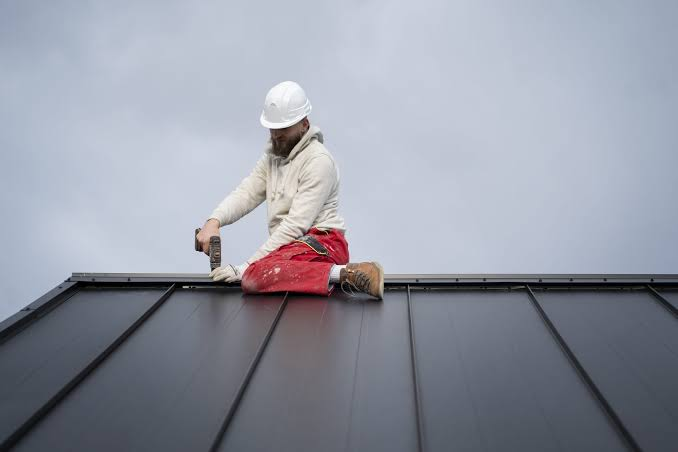
A tarp sounds like a simple thing, and Eldik’s crews are called to redo failed ones constantly. A proper dry-in, as he described it, begins well above the damage — the covering must extend over the ridge, or far enough upslope that water sheets across it rather than sneaking beneath it. It is fastened with wood strapping screwed through the tarp into sound structure, not a handful of nails through loose plastic. The edges are lapped so wind cannot get underneath, because a tarp that catches wind becomes a sail capable of tearing itself, and more of the roof, away. A bad tarp funnels water straight into the hole while looking like protection from the street. Done correctly, a temporary dry-in can hold for weeks, which removes the panic from scheduling the permanent repair.
That two-visit sequence is deliberate, Eldik explained, because permanent work performed in wind, rain, or darkness is usually bad work. A wet deck cannot be properly assessed, shingle adhesives and sealants do not behave in a storm, and a crew rushing across a slick roof at night is how people get hurt. There are insurance reasons as well: an adjuster may need to see the damage before permanent repairs erase the evidence. The professional order of operations — stabilize immediately, assess and photograph in daylight, coordinate with the insurer where there is a claim, then repair in decent conditions — is not slower service. It is the version where the repair actually lasts.
Insurance, and the knock at the door
On the insurance side, Eldik urged early contact and obsessive documentation. Most policies expect prompt notice and expect the homeowner to take reasonable steps to prevent further damage — which is precisely what the emergency dry-in is — so every photo and every invoice, including the tarping bill, belongs in the file, since mitigation costs are often claimable. He recommends getting the contractor’s damage assessment in writing with photographs, and keeping the account accurate rather than theatrical: adjusters see the whole region after a storm and know what the wind actually did that night. Clean files settle faster than dramatic ones.
Then there is the knock at the door. After major storms, canvassers appear in damaged neighbourhoods, and Eldik’s warning was simple: if they found you before you went looking for them, slow down. The playbook is pressure — the roof is worse than it looks, the price is only good today, sign here and the insurance will be handled for you. Legitimate local companies, he noted, are swamped after a storm serving their existing client base and are not out canvassing. His checklist: confirm a physical local address, ask for local references and proof of insurance, and never sign over an insurance claim on a doorstep. The storm damages a roof once; the wrong contractor can damage the finances for far longer.
What should homeowners expect from a good emergency operator? Honest triage, in Eldik’s view — open holes and active leaks first, cosmetic damage after — with same-day securing of an exposed roof as the standard, and straight communication throughout: arrival time, dry-in cost, findings, and the date of the permanent repair. In an emergency, he said, the contractor’s real job is to remove uncertainty. The water is stressful enough.
Our thanks to Rodney Eldik and the crews at Armour Shield Roofing.
Disclaimer: This article is general information, not insurance, safety, or claims advice. Insurance coverage for storm damage differs by policy and circumstance, and readers should direct all coverage questions to their own insurer or broker. Emergency situations involving structural damage, standing water, or electrical hazards can be life-threatening — prioritize personal safety and rely on qualified professionals rather than attempting rooftop measures yourself.