A commercial property can look successful on paper and still have operational problems that are difficult to see from the leasing plan alone. One corridor may carry most of the daily movement, a secondary entrance may be underused, and a public area designed for gathering may become congested at particular times.
These patterns matter to the people responsible for operating shopping centers, mixed-use developments, retail destinations, and other shared commercial environments. They influence staffing, maintenance, wayfinding, tenant exposure, and the way visitors experience a building.
Visitor analytics gives property teams another way to understand these patterns. Instead of relying only on occasional observation, managers can use consistent measurements to investigate how people enter and move through a property.
The important question is not how much traffic a building generates. It is whether the available space is serving its intended purpose.
A Building’s Floor Plan Does Not Tell the Whole Story
Architectural plans describe where people can move. They do not necessarily reveal where people choose to go once a property is in use.
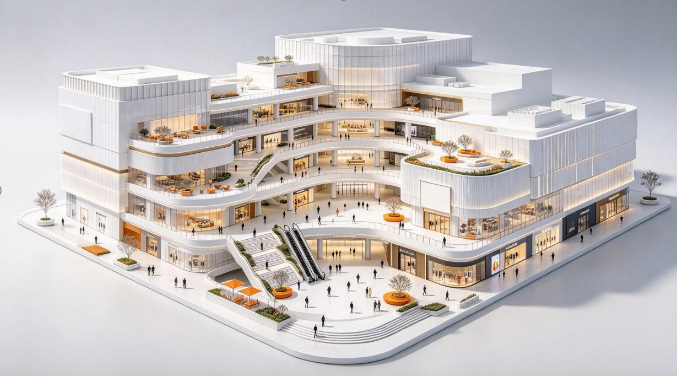
A shopping center may have several entrances, multiple levels, and a central atrium intended to distribute visitors across surrounding retail areas. Yet the actual flow may concentrate around a transit connection, a popular anchor tenant, or an entrance closest to parking.
The result can be uneven exposure across the property. Some corridors become busy, while other areas receive less movement than the design team anticipated.
Without reliable measurements, management may respond by adding signage, changing the layout, or adjusting tenant placement based on incomplete observations. Such changes can be expensive, and the underlying cause may not be obvious.
Visitor analytics can help establish where and when these patterns occur. Entrance counts describe traffic entering the property, while zone-level measurements can reveal differences between monitored areas. Occupancy estimates and dwell-time measurements may provide additional context when the selected technology supports them.
No single metric explains why visitors behave in a particular way. The value comes from combining measurements with site knowledge and investigating the differences that matter.
The Operational Value of Understanding Visitor Flow
Visitor patterns can change the practical requirements of a property throughout the day.
An entrance may experience heavy traffic during the morning, while food and beverage areas become busier around lunchtime. Event spaces may create short periods of concentrated activity, and weekend traffic may differ considerably from weekday patterns.
These changes affect cleaning schedules, security coverage, customer assistance, and the management of shared facilities.
Historical traffic measurements can help managers identify recurring peaks and plan resources accordingly. The data does not replace staff judgment or operational procedures, but it can provide a more consistent basis for deciding where attention is needed.
The same principle applies to congestion. If a particular entrance or connecting corridor repeatedly experiences concentrated movement, the property team can investigate whether the issue relates to wayfinding, queue formation, access arrangements, or the placement of nearby activities.
A count alone will not identify the cause. It can, however, show where further observation is likely to be useful.
When Low Traffic Becomes a Space-Planning Question
Low traffic is not automatically evidence of a poorly designed space.
A quiet corridor may serve as an alternative accessible route. A seating area may be intended to provide a calmer environment rather than maximize movement. A section of a mixed-use building may have lower activity because its tenants operate at different hours.
The first task is to understand the function of the area. Only then can its observed traffic be interpreted meaningfully.
Suppose a retail corridor receives less traffic than adjacent walkways. Before considering a redesign, the property team could examine whether visitors can see the route clearly, whether signs provide sufficient direction, and whether the destinations beyond it give people a reason to continue.
Tenant mix and the location of major attractions may also influence circulation. So can construction work, temporary closures, and changes in access.
Comparing traffic by time of day and examining neighboring zones can help narrow the possibilities. If the measurement system supports it, movement between monitored areas may provide additional context.
This is where visitor analytics becomes useful for property management: it helps turn a vague concern about underused space into a specific question that can be investigated.
Traffic Data Can Inform Leasing, but It Cannot Replace Commercial Judgment
For landlords and leasing teams, visitor distribution can help describe the exposure available in different parts of a property.
A retailer positioned beside a major entrance may experience a different volume of passing traffic from one located on an upper floor or in a less frequently used corridor. Reliable measurements can help property teams understand these differences and provide context for discussions about space allocation.
However, passing traffic is not the same as purchasing demand.
A high-traffic location may attract many people who have little interest in a particular store’s products. A specialist retailer in a quieter area may perform well because visitors arrive with a clear intention to buy.
Commercial performance also depends on rent, product selection, pricing, store presentation, opening hours, and the needs of the target audience.
For that reason, visitor analytics is best treated as one input into leasing and asset-management decisions. Where appropriate, it can be considered alongside tenant sales information, occupancy costs, customer feedback, and the intended role of each location.
The objective is to understand the relationship between space and activity, not to assume that every square meter should produce the same traffic.
Measuring the Effect of Events and Changes
Commercial properties often host seasonal campaigns, exhibitions, public gatherings, and other activities intended to attract visitors.
A higher entrance count during an event may indicate increased traffic, but it does not establish whether the event improved the performance of nearby retail areas or simply concentrated people in one location.
A more useful assessment compares several measures. Did entrance traffic change? Which monitored zones experienced greater activity? Did the pattern persist after the event? Were the property’s opening hours and access arrangements comparable with the reference period?
These questions help distinguish a temporary concentration of visitors from a broader change in how the property is used.
The same approach can be applied to changes in signage, circulation routes, or public-area configuration. A before-and-after comparison may help identify whether traffic patterns changed following an intervention, provided that measurement methods remain consistent and other relevant factors are considered.
Such comparisons should not automatically be interpreted as proof of causation. Weather, tenant changes, holidays, and nearby events may influence the outcome. Traffic data is most informative when these factors are recorded alongside the measurements.
Choosing Technology That Fits the Property
The right visitor analytics system depends on the decisions the property team needs to make.
A simple entrance counter may be sufficient when the objective is to measure directional traffic at a single doorway. A larger property may require monitoring across several entrances and selected internal zones. Three-dimensional people counting can provide spatial information about movement, while AI-based recognition may support functions such as repeat-visitor deduplication or employee filtering when those capabilities are available.
These features should not be assumed to come as a single package. Property managers should verify the specific functions, measurement boundaries, and reporting capabilities of any proposed system.
Installation conditions also deserve attention. Entrance width, mounting height, lighting, obstructions, crowd density, and the arrangement of monitored areas can affect performance. Testing should reflect normal operating conditions rather than a single quiet period.
Privacy is another part of the design decision. Managers should understand what information is collected, whether images are retained, where processing takes place, who can access the data, and how long records are kept. Data collection should be proportionate to the operational purpose and consistent with applicable legal requirements.
For retail-oriented commercial properties, a retail people counting solution can be considered as part of a wider approach to understanding physical traffic. The required configuration should follow the property’s objectives and layout, rather than the assumption that more data will always produce better decisions.
From Occupancy Reports to Better Property Management
Collecting traffic data is only useful when the property team has a clear process for acting on it.
A practical starting point is to select a few indicators tied to real operational questions. These might include entrance traffic for staffing plans, zone-level movement for circulation reviews, or peak occupancy estimates for managing shared spaces.
The team can establish a baseline, identify a recurring issue, and investigate its likely causes before changing the property. After an intervention, the same indicators can be reviewed again to see whether the observed pattern changed.
Consistency is essential. If the counting method or monitored area changes, the resulting figures may no longer be directly comparable. Property teams should document such changes and avoid treating a difference in reported traffic as proof of a difference in visitor behavior.
This approach makes analytics part of an ongoing management process rather than another dashboard that is reviewed without leading to action.
Efficient Commercial Spaces Are Not Simply the Busiest Ones
A successful commercial environment must balance movement, accessibility, comfort, tenant needs, and operating costs. The busiest route is not necessarily the best route, and the area with the highest traffic is not automatically the most valuable use of space.
Visitor analytics can help property managers see how a building functions in practice. Used carefully, it can inform staffing, circulation planning, tenant discussions, event evaluation, and the allocation of shared facilities.
The final decision still requires an understanding of the property’s purpose and the people who use it. Data can reveal patterns that deserve attention; design expertise and operational judgment determine what to do about them.
The strongest approach combines a well-planned physical environment with reliable measurements and a willingness to test assumptions. That is how visitor analytics can contribute to more informed, efficient commercial property management.