Commercial office construction sits in a different cost universe from almost every other building type. A single-family home has predictable parameters. A warehouse has simple bones. A commercial office building, whether a single-story suburban professional park or a glass-clad high-rise in a major metro, combines structural complexity, sophisticated building systems, and code requirements that can push costs across a range wide enough to make a single national average almost useless without context.
In 2026, commercial office construction costs range from roughly $240 per square foot on the low end for simple single-story structures, up to $1,000 or more per square foot for high-rise buildings in major markets. A small 3,000 square foot single-story office might cost $720,000 to $1.3 million to build. A mid-size 50,000 square foot mid-rise project could run $16 million to $43 million or more. And at the large end, multi-story office towers in gateway cities regularly exceed $100 million.
This guide breaks down what drives those numbers, how building height and location affect cost, what the single biggest cost categories are, what code requirements add to the budget, how new construction compares to fit-out work on existing space, and how to get a reliable project-specific estimate. ACON Engineering is a construction cost estimation and preconstruction consulting firm that produces trade-level cost estimates for commercial office and mixed-use projects of any scale.
What Does Commercial Office Construction Cost Per Square Foot in 2026?
The most useful framework for understanding commercial office construction costs starts with building height, since it is the strongest predictor of where a project falls within the overall range.
Single-story office buildings are the most affordable to build, typically running $240 to $440 per square foot in 2026. These are simpler structural systems, require no elevator, and typically have lower mechanical and electrical complexity than multi-story buildings.
Mid-rise office buildings of several floors run $330 to $870 per square foot, depending on location, design complexity, and finish level. The added cost reflects the structural demands of building upward, the elevator systems required by code for multi-story occupancy, and the more complex mechanical systems needed to serve multiple floors efficiently.
High-rise office buildings are the most expensive category, typically running $430 to $1,000 or more per square foot. Advanced structural engineering, curtain-wall facade systems, complex fire suppression and life safety infrastructure, and premium finishes in client-facing spaces all contribute to a cost structure that bears little resemblance to low-rise construction.
At the total project level, the range is equally wide. Data from RSMeans, one of the most widely cited construction cost databases, puts the total project cost range at approximately $460,000 for a small single-story building up to just over $364 million for an 11 to 20 story office tower.
How Does Building Height Affect Cost?
The cost jump from single-story to mid-rise to high-rise is not linear, and understanding why helps make sense of the numbers.
A single-story office building sits on a simple foundation, uses a straightforward structural system, and requires only the building systems needed for one floor of occupancy. The foundation alone accounts for up to 10.5% of a total commercial construction budget on average, but for a single-story building, everything above it is relatively uncomplicated.
Mid-rise buildings introduce structural demands that do not exist at the single-story level. Load-bearing systems have to carry the cumulative weight of multiple floors, shear walls or moment frames may be required to resist lateral forces from wind and seismic loads, and the mechanical, electrical, and plumbing infrastructure has to serve multiple floors rather than one, which means vertical distribution systems, additional equipment, and more complex coordination between trades.
High-rise construction compounds all of these factors further. The structural engineering required to build a stable, safe tall building is fundamentally different from low-rise work, requiring specialized engineering analysis and construction methods. Fire suppression, egress, and life safety systems must meet a more demanding regulatory framework as building height increases. And the facade systems on tall buildings, curtain wall, unitized glazing, and high-performance cladding, are both technically demanding and expensive relative to the cladding used on low-rise construction.
What Are the Biggest Cost Drivers in Commercial Office Construction?
When commercial construction professionals identify what moves the needle most on an office building budget, three categories come up consistently across industry sources: structural framing, interior finishes, and mechanical, electrical, and plumbing systems.
Of these three, MEP systems are specifically and repeatedly identified as a major cost driver in office construction, and for good reason. An office building’s mechanical systems, the HVAC infrastructure that keeps the space comfortable, the electrical distribution that powers workstations, data systems, and lighting throughout the building, and the plumbing that serves restrooms, break rooms, and any specialty wet applications, are not small line items. They are complex, trade-intensive systems whose cost scales directly with building size, occupancy type, and the sophistication of the systems specified. MEP Estimating Services from ACON Engineering produce trade-level cost breakdowns specifically for the mechanical, electrical, and plumbing scope of a commercial project, quantifying equipment, distribution systems, labor, and connections from engineering drawings before the project goes to bid. For developers and owners trying to understand where in their budget the MEP scope lands, and whether a general contractor’s lump-sum number reflects it accurately, a dedicated MEP estimate from ACON Engineering provides exactly that visibility before contracts are signed.
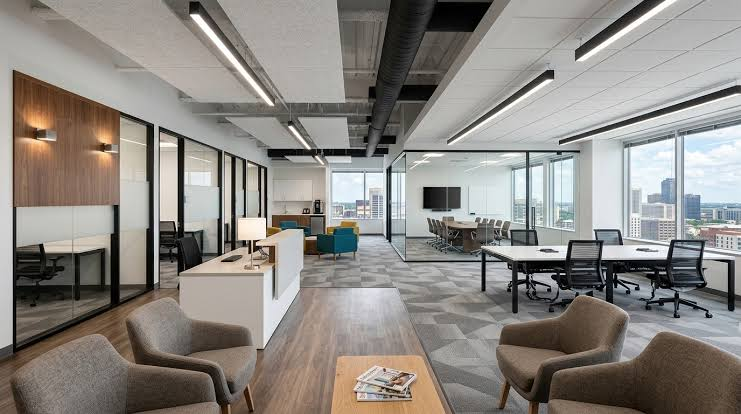
Interior finishes are the third major category, and they represent the widest point of discretion in the entire budget. A building with polished concrete floors, standard ceiling grids, and basic lighting costs meaningfully less than one with engineered hardwood, custom millwork, premium fixtures, and a high-end reception suite, even if the square footage is identical.
What Code and Safety Requirements Add to the Budget?
Commercial office buildings, particularly multi-story ones, face code requirements that residential construction rarely encounters at the same scale, and these requirements represent real, quantifiable cost that belongs in any honest project budget.
The most significant for structural steel construction is fire-resistance rating. Multi-story office buildings frequently use structural steel framing for the efficiency it offers in span distances and design flexibility, but structural steel loses load-bearing strength at elevated temperatures. Building codes require fire-resistance-rated protection on structural steel members in commercial occupancy buildings, typically achieved through spray-applied fire-resistive material or intumescent coatings that insulate the steel against heat during a fire. The required coverage area, product type, and applied thickness all depend on the specific fire-resistance rating required for the building’s occupancy classification and construction type.
This fireproofing scope is a dedicated cost category separate from the structural steel procurement and erection budget. It has its own surface area calculations by member type, its own material specifications, and its own trade labor. Fireproofing Estimating Services from ACON Engineering calculate exactly this scope from structural drawings, identifying the required fire-resistance assemblies for each member type in a commercial office building and producing a complete cost estimate for that fireproofing scope before the project is bid. For developers whose structural steel projects have been surprised by fireproofing costs discovered late in the permitting or construction phase, having this scope estimated at the preconstruction stage removes one of the more reliably expensive late surprises in commercial office budgeting.
How Does Location Affect Commercial Office Construction Costs?
Location is one of the two or three variables that most dramatically shift where a project falls within the cost ranges above, sometimes by a factor of two between the cheapest and most expensive markets in the country.
Construction costs in western states, particularly coastal California, the Pacific Northwest, and major Southwest metros, average $380 to $850 per square foot for commercial office work, reflecting higher labor costs, more stringent local codes, and in many coastal markets, limited buildable land that increases site preparation complexity. The San Francisco Bay Area and New York City consistently rank among the most expensive markets in the country for commercial construction, with projects there regularly exceeding the upper end of national ranges.
The Midwest and South typically offer meaningfully lower base costs, often $240 to $400 per square foot for comparable office projects, driven by lower prevailing labor rates, less complex site conditions in many markets, and more competitive subcontractor environments. This regional spread is large enough that a project feasibility analysis based on national average figures, rather than location-adjusted data, can produce a meaningfully misleading picture of actual project economics.
One planning-stage consideration that spans all markets: waste management and site logistics. For any significant demolition or construction project, having a clear plan for construction debris from day one avoids mid-project complications. A dumpster size reference guide can help teams determine the right waste management setup for different project scales during early site planning.
What Is the Difference Between New Construction and Office Fit-Out Costs?
This distinction matters because the two categories are frequently conflated in casual cost discussions, and they represent genuinely different scopes and cost structures.
New construction refers to building an office building from the ground up: site acquisition, foundation, structural framing, envelope, core and shell systems, and base building MEP. This is the full project budget covered by the per-square-foot ranges discussed throughout this guide.
Office fit-out, also called tenant improvement or build-out, is the work done within an already-built shell to make the interior functional for a specific occupant. This includes partitioning, finishes, lighting, supplemental HVAC, technology infrastructure, and all the elements that make a generic commercial shell into a usable workplace. Cushman & Wakefield’s 2026 Office Fit Out Cost Guide, which evaluates current fit-out costs across 42 US cities, specifically notes that moderating inflation and sluggish broader construction activity have eased some pressures on fit-out budgets, while skilled labor shortages and rising material costs continue to push project budgets upward in many markets.
For developers and tenants alike, the distinction matters because a landlord quoting “core and shell rent” is offering a different product than one quoting “turnkey” space, and the cost to complete an interior from a base shell can add meaningfully to the total occupancy cost even when the raw per-square-foot lease rate looks competitive.
How Do You Get an Accurate Cost Estimate for a Commercial Office Project?
Every number in this guide represents either a national average or a range built from many different projects across different markets, building types, and finish levels. A developer planning a specific project in a specific location with a specific program cannot rely on these ranges for project financing or go/no-go decisions without translating them into project-specific numbers.
The gap between a national average and a project-specific estimate is real, and in commercial office construction, it is often large enough to determine whether a project pencils out financially. ACON Engineering’s construction estimating services produce trade-level cost breakdowns from actual project drawings and specifications, covering structural, MEP, envelope, and interior scope as designed for the specific building, at current market pricing for the project’s location. For developers, investors, and owners planning commercial office projects of any scale, this kind of project-specific estimate is what separates a development pro forma built on real numbers from one built on ranges that may or may not reflect the actual project.
Conclusion
Commercial office construction in 2026 costs $240 to $1,000 or more per square foot depending on building height, location, and finish level. Single-story offices fall at the lower end, high-rise buildings at the upper end, and the jump between tiers reflects genuine increases in structural complexity, MEP system sophistication, fire-safety code requirements, and engineering intensity.
MEP systems and structural fireproofing are two of the most significant cost categories that get underestimated in early-stage budgeting, and both deserve dedicated, trade-level cost estimates rather than rough percentages applied to a total budget. Location adjustments matter enormously: a project in coastal California or New York will cost significantly more than the same project in the Midwest, and project economics built on unadjusted national averages can mislead development decisions. ACON Engineering’s MEP estimating and fireproofing estimating services, alongside its broader commercial construction estimating capabilities, exist to close the gap between national averages and the actual cost of your specific project.