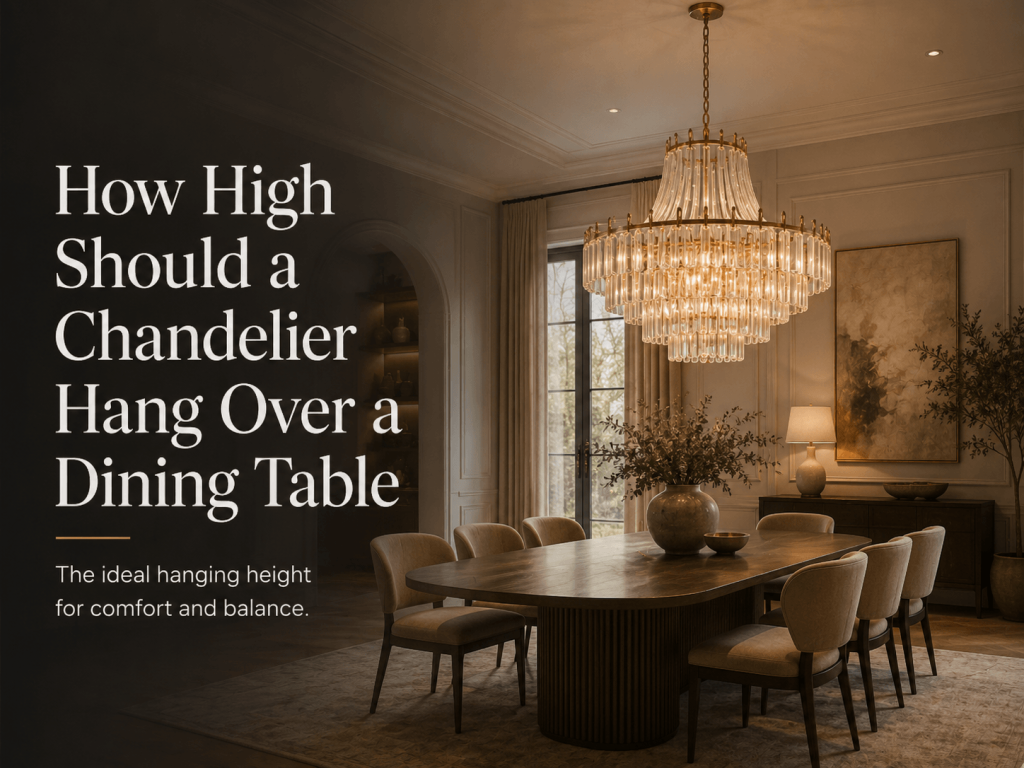
The hanging height of a dining room chandelier affects three things simultaneously: the quality and distribution of light on the table surface, the visual balance of the fixture within the room, and the comfort of people seated beneath it. Get this measurement wrong and even a beautiful chandelier feels oppressive, dark, or disconnected. This guide gives you the exact numbers, explains the variables that change them, and shows you how to apply them to your specific room.
The Standard Hanging Height Rule
The most widely accepted guideline for dining room chandelier height places the bottom of the fixture 30 to 36 inches above the tabletop surface. This range has been established through both functional testing and design convention — it puts the light source close enough to illuminate the table effectively, while keeping it high enough that seated and standing diners experience no obstruction to sightlines or circulation.
Within this 30-to-36-inch range, the lower end (30 to 32 inches) works better for smaller fixtures with compact profiles and for tables that seat four to six people. The upper end (34 to 36 inches) works better for larger fixtures, tables that seat eight or more, and rooms with ceilings above 9 feet where the increased height helps the fixture feel visually grounded rather than floating too high above the table.
The 30-to-36-inch guideline assumes a standard 9-foot ceiling. When the ceiling height changes, the hanging height adjusts with it — and this adjustment is the most commonly misapplied part of the formula.
Adjusting for Ceiling Height
For every foot of ceiling height above 8 feet, the chandelier can be raised approximately 3 inches while maintaining correct visual proportion. This adjustment keeps the fixture in the right visual relationship with both the ceiling and the table surface as room height increases.
The practical application: in a room with a 9-foot ceiling, the starting height is 30 to 36 inches above the table. In a 10-foot ceiling room, add 3 inches — making the range 33 to 39 inches. In a 12-foot ceiling room, add 12 inches — making the range 42 to 48 inches above the table. The table surface remains the reference point throughout; the adjustment moves the fixture up relative to the table rather than down from the ceiling.
| Ceiling Height | Height Above Table | Adjustment from 8 ft | Notes |
| 8 ft (standard) | 28 – 32 in | Baseline | Compact fixture preferred |
| 9 ft | 30 – 36 in | +3 in | Standard recommendation |
| 10 ft | 33 – 39 in | +6 in | Slightly taller fixture works well |
| 11 ft | 36 – 42 in | +9 in | Tiered or elongated form recommended |
| 12 ft | 42 – 48 in | +12 in | Layered fixture, confirm drop length |
| 14 ft+ | 48 – 60 in | +18 in+ | Confirm extended rod availability |
Why the 30-to-36-Inch Range Exists
The 30-to-36-inch range is not arbitrary. It emerged from the practical requirements of dining room lighting: the chandelier must illuminate the table surface and the food and people on it, while remaining high enough that seated diners can see across the table without the fixture blocking sightlines between the people on opposite sides.
A chandelier hung at 24 inches above a dining table is aesthetically interesting but functionally problematic — it breaks the sightline between diners on opposite ends of a long table and creates an oppressive overhead presence for people seated directly beneath it. A chandelier hung at 48 inches above a standard table in a 9-foot room leaves a 4-foot gap between the fixture and the ceiling, which creates a disconnected, floating effect and delivers less light to the table surface.
Light distribution is the functional key. A chandelier at 30 to 36 inches above the table produces a well-defined pool of light on the table surface with a warm penumbra that illuminates the surrounding chairs and diners without spilling excessively into adjacent areas. This focused quality is part of what makes dining rooms with properly placed chandeliers feel intimate and considered rather than generically lit.
Table Size and Shape: How They Affect Hanging Height
Table dimensions influence both the appropriate chandelier diameter and — to a lesser extent — the ideal hanging height. A long rectangular table with eight or ten seats is typically lit more effectively with a fixture hung toward the middle of the 30-to-36-inch range (or with two fixtures hung in a linear arrangement) rather than a single chandelier at the lower end of the range. The additional height gives the light a wider cone of coverage, which better serves the full table length.
Round and square tables typically allow the chandelier to hang at the lower end of the range because the shorter table dimensions mean the single fixture’s light cone covers the full table surface even at 30 inches. The concentrated light at lower height also reinforces the intimate, gathered quality that round table arrangements tend to create.
| Table Shape & Size | Recommended Chandelier Diameter | Preferred Height Above Table | Single or Multiple Fixtures |
| Round, up to 48 in | 24 – 30 in | 30 – 33 in | Single |
| Round, 48 – 60 in | 28 – 36 in | 30 – 34 in | Single |
| Square, up to 54 in | 24 – 32 in | 30 – 34 in | Single |
| Rectangular, 60 – 84 in | 36 – 48 in wide / 12 – 18 in shorter than table | 32 – 36 in | Single (linear) or two pendants |
| Rectangular, 84 – 120 in | Linear fixture: table length minus 24 in | 34 – 38 in | Two pendants or long linear |
| Oval, up to 72 in | 30 – 40 in | 30 – 34 in | Single (round or oval fixture) |
The Centering Question: Table vs. Room
One of the most commonly overlooked decisions in dining room chandelier placement is whether to center the fixture over the table or over the room. In most dining rooms, these two reference points are the same — the table is centered in the room. But in open-plan spaces, rooms with offset doors, or dining areas adjacent to kitchens without clear walls, the table position and the room center often diverge.
The correct answer is almost always to center the chandelier over the table rather than the room. The chandelier’s primary relationship is with the table and the diners around it. A fixture centered on the room but offset from the table creates an uncomfortable and visually illogical arrangement — the light does not land where the activity is, and the fixture appears displaced from every seated perspective.
The practical implication: if the dining table is not centered in the room, the chandelier wiring should be run to the table position rather than the room center. This is straightforward in new construction but requires an electrician and some ceiling patching in retrofit situations.
The Height Adjustment Test
Before permanently setting the chandelier height, use a temporary suspension arrangement — tape a lightweight reference object to a cord at the planned height — and sit at the dining table. Confirm that you can see all other diners across the table without obstruction. Confirm that the light level on the table surface is sufficient for dining without being harsh. Confirm that the fixture bottom is not so low that standing guests or family members risk brushing it when leaning across the table. This test takes fifteen minutes and can prevent an expensive rehang.
Chain, Rod, and Cable Adjustment
Most dining room chandeliers are suspended on chain, rod, or cable, and the length of this suspension element determines the final hanging height. Before installing any fixture, calculate the required chain or rod length by subtracting the desired bottom height above the floor from the ceiling height, then subtracting the fixture body height itself.
Example: 9-foot ceiling (108 inches), target bottom height 84 inches above floor (30 inches above a standard 30-inch-high dining table), fixture body height 18 inches. Required rod/chain: 108 − 84 − 18 = 6 inches of rod or chain above the canopy. Most fixtures ship with more chain or rod than this — the excess simply needs to be removed or looped before installation.
For fixtures with fixed rod lengths that cannot be cut or extended, confirm the total suspended length before ordering. A fixture designed to hang in an 8-foot room will often have a combined height (body plus rod) that places it too high in a 9-foot room without modification, or too low if the included rod is not sufficient for a taller ceiling.
Finding the Right Dining Room Fixture
With hanging height calculated, table diameter requirements confirmed, and ceiling height adjustment accounted for, you can filter fixtures effectively by the specifications that matter. The dining room chandeliers collection includes options by table size, ceiling height compatibility, and style — which makes narrowing to the right fixture straightforward once you have your measurements in hand.
Frequently Asked Questions
Can a chandelier hang too low over a dining table?
Yes. Below 28 inches, a chandelier begins to obstruct sightlines between seated diners and creates an uncomfortable overhead presence. Some very compact or open-frame designs can work at 28 inches, but anything below that is generally too low for comfortable dining unless the fixture has an extremely open profile with no solid elements at eye level across the table.
What if my dining table is not a standard height?
The hanging height measurement is always taken from the tabletop surface — not the floor. If your table is 28 inches, 32 inches, or any non-standard height, measure from its surface and apply the 30-to-36-inch range from there. The floor-to-fixture height will vary, but the table-to-fixture relationship stays consistent.
How do I hang a chandelier if the electrical box is not centered over the table?
An electrician can extend a conduit or run a new circuit to the correct position over the table. This is the cleanest solution. Alternatively, a swag hook system can be used to hang the chandelier from a ceiling hook positioned over the table, with the cord running back to the existing outlet — but this approach is less clean and not suitable for very heavy fixtures.
Should I center the chandelier over the table or the room?
Always center it over the table. The fixture’s relationship is with the dining surface and the people around it, not with the room’s geometric center. When the table is not centered in the room, the electrical work should be adjusted to bring the fixture above the table rather than the room center.
Does the chandelier need to match the dining table shape?
Not strictly — but there are strong conventions that tend to work. Round fixtures over round tables and linear fixtures over rectangular tables are the most visually settled combinations. Round fixtures over rectangular tables can work if the fixture is large enough. Linear fixtures over round tables tend to look mismatched and are generally avoided.