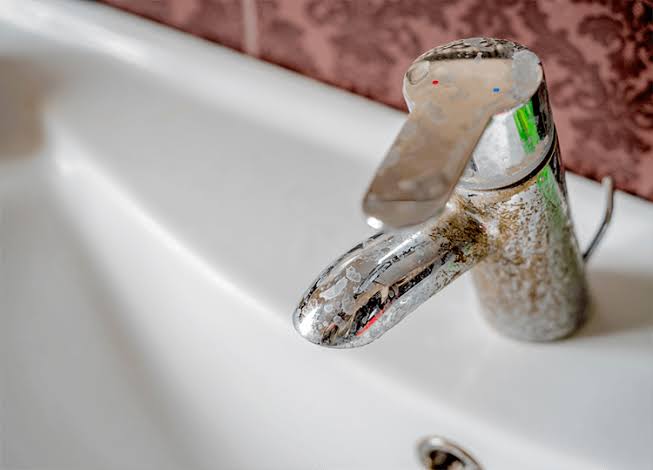
There is a particular kind of disappointment that arrives about eighteen months after a bathroom is finished.
The unlacquered brass has gone cloudy in a way that is not the patina anyone was promised. The frameless glass has a permanent haze across the lower third. The thermostatic valve that cost more than the vanity has started drifting two or three degrees mid-shower. Nothing has broken. Everything looks tired.
The specification was not the problem. The water was.
Hard water is the most consequential variable in a residential building that almost never appears in a design conversation. It is invisible, it is not in the FF&E schedule, and by the time its effects are visible on a finish, they are usually permanent. For properties at the upper end of the market — where a single shower enclosure can represent a five-figure line item — that is an expensive blind spot.
The Number Almost No One Checks Before Specifying a Bathroom
Water hardness is a measurement of dissolved calcium and magnesium, expressed either as milligrams per litre of calcium carbonate or, in North America, as grains per gallon. One grain per gallon is roughly 17 mg/L.
The commonly used classification is straightforward. Below 60 mg/L is soft. Between 60 and 120 mg/L is moderately hard. Between 120 and 180 is hard. Anything above 180 mg/L — around 10.5 grains per gallon — is classed as very hard, and a great many desirable addresses sit well above that line. Large parts of the American Southwest, southern England, the Mediterranean coast, and the Gulf are supplied with water in the 15 to 25 grain range.
Those minerals stay dissolved while the water is cold and moving. They come out of solution when water is heated, when it evaporates, and when pressure drops. That is the entire mechanism. Every place in a house where warm water sits still, or where a droplet dries on a surface, is a place where calcium carbonate is being deposited.
Where the Damage Actually Shows Up
Most homeowners associate hard water with spotting on a shower screen — a cosmetic annoyance, handled by the housekeeper. The more expensive failures are elsewhere.
Living finishes. Unlacquered brass, aged bronze, and hand-applied patinas are designed to develop character. Mineral deposition interrupts that process unevenly, producing blotching rather than patina. Worse is what happens next: the standard response is an acidic descaler, which attacks the finish itself. The cleaning becomes the second damage vector.
Frameless glass. This is the one that genuinely cannot be undone. Repeated deposition and evaporation on a glass surface produces bonding between mineral deposits and the glass that, past a certain point, is not removable by cleaning. The panel is replaced, not restored. Protective coatings help, but they are consumable and rarely maintained on schedule.
Calcareous stone. Marble, limestone, and travertine cannot be cleaned with the acidic products that remove scale, because those products dissolve the stone. On a marble vanity or a limestone wet room floor, hard water leaves you with no good options.
Thermostatic cartridges and outlets. Scale accumulating inside a thermostatic mixing valve is the usual cause of temperature drift in an expensive shower system. Rain heads and body jets block nozzle by nozzle, which degrades the spray pattern long before anyone identifies a fault.
Water heating. Calcium carbonate has a thermal conductivity on the order of 2 to 3 W/m·K. Copper is roughly 400. A scale layer measured in millimetres therefore behaves like insulation on the exact surface that is supposed to transfer heat, and the burner or element compensates by running longer. Instantaneous and tankless heaters, with their narrow heat exchanger passages, are the most vulnerable equipment in the house.
Extend this across an estate — a lap pool, a spa, irrigation, a wine cellar humidification system, a commercial-specification laundry handling table linen — and the compounding cost stops being trivial.
What Softening Actually Does — and What It Definitely Doesn’t
A water softener is not a filter. This is the single most common misunderstanding, and it matters.
Softening works by ion exchange. Water passes through a bed of resin beads carrying loosely held sodium ions. Calcium and magnesium have a stronger affinity for the resin than sodium does, so they attach to the beads and release sodium into the water in their place. Nothing is strained out. One set of dissolved ions is traded for another.
When the resin is saturated, it is regenerated: a concentrated brine solution is drawn through the bed, reversing the exchange by sheer concentration, and the accumulated hardness is flushed to drain. The resin returns to service. That cycle is the whole operating principle.
What softening does not do is equally important to understand before it is specified:
- It does not remove chlorine, chloramine, or taste and odour compounds. That is activated carbon.
- It does not remove sediment or turbidity. That is upstream filtration.
- It does not reduce total dissolved solids, nitrate, or emerging contaminants. That is reverse osmosis.
- It does not disinfect.
- It does not remove scale that has already formed, though it stops new deposition and will slowly dissolve some existing buildup.
There is also a trade to acknowledge. Every grain per gallon of hardness removed adds roughly 8 mg/L of sodium to the water. On a 15-grain supply, that is around 120 mg/L. It is not a concern for washing, but it is the reason well-designed systems leave the kitchen cold tap and exterior hose bibs unsoftened — sodium does no favours to a garden — and place a separate drinking water point at the sink.
The Specification Detail That Separates a Working System From a Compromise
Here is the part that gets decided by default rather than by design, and then quietly disappoints.
A single-vessel softener has to stop softening in order to regenerate. During that window — typically scheduled for the small hours — the property is either receiving untreated hard water or no water at all, depending on the valve arrangement. In an ordinary house, nobody notices.
In a large residence, that assumption breaks. Recirculating hot water loops run continuously. Irrigation and pool fill are frequently scheduled overnight, precisely when the softener has chosen to regenerate. Guest wings, staff accommodation, and spa plant do not observe a quiet period. A boutique property or a serviced estate has no window at all.
The answer is a duplex arrangement: two vessels, alternating, so one is always in service while the other regenerates. There is no hardness breakthrough, because there is never a moment when the system is offline. Larger properties and mixed-use buildings move to multi-vessel configurations that also carry the peak flow a house with a dozen outlets can generate. The practical differences between single-tank, twin-tank, and multi-tank water softener systems come down to valve arrangement, continuous-duty capability, and the floor area the plant room has to give up — and they are worth resolving before anything is ordered.
Get this wrong and the correction is expensive. Retrofitting a second vessel into a finished plant room is a substantially different exercise from allowing for it at first fix, and it is one of the few water treatment decisions that is genuinely difficult to reverse.
The Questions to Answer Before Anyone Quotes a System
A credible proposal starts from measured values, not from a postcode.
- Test the supply. Hardness, iron, manganese, pH, and total dissolved solids. Clear-water iron much above 0.3 mg/L will progressively foul softening resin, and resin fouled by iron does not fully recover — which is why manufacturers such as Hiju Water Treatment treat a full water analysis as a precondition for sizing rather than a formality, and specify dedicated iron and manganese removal upstream where the numbers call for it.
- Establish peak flow, not average. A single luxury shower with a rain head and body jets can draw more than a typical whole-house design assumption. Size for simultaneous demand.
- Calculate daily grain load. Daily volume multiplied by hardness gives the grains to be removed per day, which determines resin volume and regeneration frequency.
- Confirm the plant room can support it. A softener needs a drain capable of taking the regeneration discharge, a power supply, and physical access for salt delivery. These are the items most often missing from a residential mechanical layout.
- Decide what stays unsoftened. Kitchen cold, exterior irrigation, and any point of use where sodium is undesirable.
- Specify a bypass. Service should not require shutting down the house.
Why This Belongs in the Drawings, Not the Punch List
Water treatment sits in the same category as plumbing rough-in and structural provision for a lift: a decision that is inexpensive when made early and disproportionately expensive when made late.
The finishes chosen for a high-end property are selected to last decades. The water passing through them, several hundred litres a day, every day, determines whether they actually do. Specifying the finish and ignoring the water is a half-completed decision — and it is the half that shows.