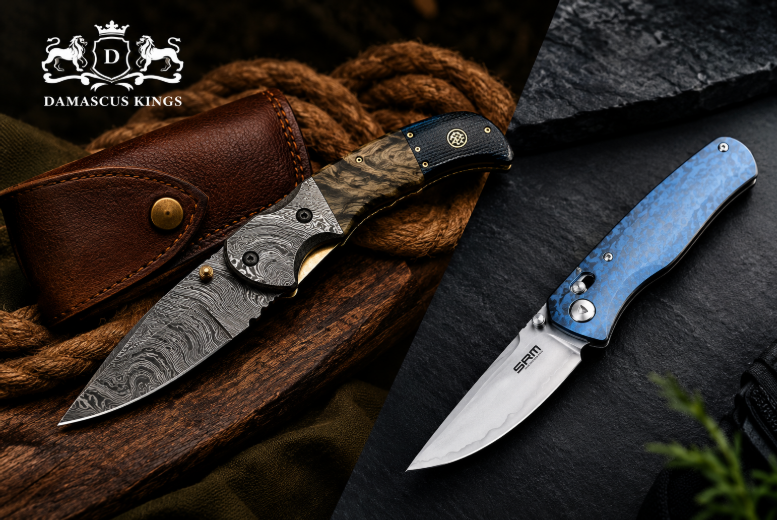
You find two folding knives you like. One has a patterned Damascus blade and costs more. The other has a plain blade and seems to do the same job. Which one belongs in your pocket? If you want to explore different Damascus designs, you can browse the selection at Damascus Kings before making your choice.
Choose the Damascus knife if you like its appearance and its size, grip, lock and care requirements work for you. Choose the regular pocket knife if it offers a better fit or better value for the cutting you do. The pattern alone does not tell you which blade will stay sharp longer.
For this comparison, a regular pocket knife means a folding knife with a plain-finish blade. Both types come in a range of prices and qualities. The seven differences below will help you compare actual knives instead of judging them by the blade pattern.
What Is a Damascus Folding Knife?
A modern Damascus folding knife usually gets its visible pattern from different steels joined and worked together. Finishing and etching bring out waves, swirls or other designs. Depending on how the blade is made, the cutting edge may run through the patterned steel or through a separate core steel between patterned outer layers.
That is why the pattern cannot tell you everything about performance. If you are comparing two models, look for information about the steel at the cutting edge, along with the blade’s size, lock, handle and care instructions.
A plain-finish pocket knife may look simpler, but its appearance tells you just as little about how carefully it was made.
Seven Differences Between Damascus and Regular Pocket Knives
1. Blade Appearance and Construction
The visible pattern is the reason many people first consider a Damascus knife. It gives the blade character and slight differences in the pattern can make one knife feel more personal than another.
A regular pocket knife may have a polished, brushed, stonewashed or coated blade. You might prefer that quieter look, especially for a knife you expect to use and mark up.
Neither finish proves that a knife was ground well or assembled carefully. Be cautious when a listing makes a lot of its layer count but says little about the cutting steel. Layer count describes part of the construction; it is not a quality score.
2. Sharpness and Edge Retention
How sharp a knife feels when you first use it depends on its sharpening and edge shape. How long it stays sharp also depends on the steel, heat treatment and what you cut. A Damascus pattern does not settle either question.
Imagine cutting down several cardboard boxes. A thin, well-sharpened plain blade may move through them more easily than a thicker Damascus blade. With different blade shapes and steels, the result could change. You need details about the particular knives to compare them fairly.
Look for the steel used at the edge and feedback from people who have used that model over time. It also helps to consider whether you can sharpen it with the tools you own.
3. Toughness and Appropriate Use
You may see claims that a Damascus blade is exceptionally tough because it has many layers. That is too broad to be useful when shopping. Steel choice, heat treatment, blade design and build quality all affect how a knife holds up.
Either type can be useful for ordinary cutting tasks, such as opening packages or cutting cord. Neither folding knife should be used as a pry bar, screwdriver or wire cutter. Those jobs can damage the blade and put stress on the pivot or lock.
If your work regularly takes considerable force, look for a tool made for that work. A more striking blade pattern will not make a folder suited to every job.
4. Rust Resistance and Maintenance
“Damascus” does not mean “stainless,” and “plain blade” does not mean “rust resistant.” The steels used in each knife determine how much care it needs.
Some patterned blades need prompt cleaning and drying after use. Others use more corrosion-resistant steels. Plain-finish blades also vary, so check the materials and the maker’s instructions for the model you want.
As a basic habit, wipe the blade after use and dry it before closing the knife. Pay attention to moisture and grit around the pivot. If the maker recommends oil for storage, use a product suited to how you use the knife. If the blade will touch food, check that anything applied to it is appropriate for food contact.
If you often carry a knife in wet conditions, choose a model whose materials and upkeep fit that routine.
5. Pocket Comfort, Handle and Blade Shape
A knife can look compact online and still feel bulky when you carry it. Compare its closed length, weight and handle thickness. Check whether it has a clip, comes with a sheath or sits loose in a pocket.
Think about your grip, too. Wood or bone may be part of what attracts you to a Damascus folder. A textured synthetic handle may appeal more if you often use a knife with damp hands. Material matters, but the handle’s shape and size matter just as much.
If you can hold the knife before buying, try a normal cutting grip. If you are shopping online, compare its measurements with a knife you already find comfortable. Look at the blade shape as well: choose one that suits the cuts you make most often.
6. Lock and Overall Build Quality
A Damascus blade does not make a folding knife safer and a plain blade does not make one safer either. The lock and the quality of the whole knife deserve their own attention.
Folding knives use different mechanisms, including liner locks, frame locks, back locks and crossbar locks. Some traditional pocket knives do not lock. Learn how the model you choose opens and closes and keep your fingers clear of the blade’s path.
When a knife arrives, check that its lock engages as intended and that the blade does not have concerning side-to-side play. Look at the pivot, handle fit and how the blade sits when closed. If the lock seems faulty, stop using the knife and contact the seller.
A beautiful blade will not make up for a folder that feels poorly assembled.
7. Price and Long-Term Value
A Damascus folding knife may cost more because making and finishing its patterned blade takes additional work. Handle materials, engraving and other details can also affect the price. If you enjoy those features, the extra cost may be worthwhile to you.
If cutting performance is your main priority, compare knives of a similar size and purpose. Check the blade information, handle, lock, care needs and return policy. A less expensive plain-finish knife with clear specifications may be the better working purchase. A well-made Damascus knife may be the one you enjoy carrying and caring for.
You can browse Damascus folding knives to see how much their handles and designs vary. Compare the details of individual models rather than assuming every knife in a collection is built the same way.
Three Tips for Choosing the Right Folding Knife
1. Start With the Jobs You Actually Do
Think about the last few times you needed a knife. Were you opening packages, cutting rope or using it on a camping trip? A compact knife that feels good in your hand may serve you better than a larger one you rarely carry.
If a task needs heavy force, consider a different tool instead of choosing a bigger folding knife by default.
2. Check the Details Behind the Photos
Before buying, look for the blade or core steel, blade length, closed length, weight, handle material, locking mechanism and care instructions. Read feedback about the exact model and check the return policy.
If a detail that matters to you is missing, ask the seller. Words such as “handmade” or “premium” do not replace specifications.
3. Be Honest About Upkeep
A knife that needs a little care can be satisfying to own. It is less satisfying if that care never fits your routine. If you frequently use a knife outdoors or around moisture, pay particular attention to its materials and maintenance instructions. Buy the knife you will comfortably carry, use and look after.
Common Questions About Damascus Folding Knives
Is Damascus Steel Better Than Stainless Steel?
Those terms describe different things. Damascus refers to a patterned blade construction, while stainless refers to corrosion resistance. A Damascus blade can use stainless steels. To compare two knives, find out what materials each one uses rather than relying on either label.
Does a Higher Layer Count Make a Better Knife?
Not necessarily. Layer count can affect how a pattern is produced, but it does not tell you how sharp the finished knife is, how long its edge will last or how well its lock works.
Can You Use a Damascus Folding Knife Every Day?
Yes, if its size, grip, lock, edge and care requirements suit your daily tasks. Use it for appropriate cutting work, clean it when needed and dry it before putting it away.
Is a Damascus Folding Knife Worth the Extra Money?
It can be if you value the pattern and like the whole knife, including its handle and build quality. If your main goal is a practical cutting tool at the lowest suitable price, a plain-finish model may make more sense. Compare specific knives before deciding.
Which One Should You Choose?
For a knife you plan to use often, start with comfort, blade details, lock quality and maintenance. Then decide whether the Damascus pattern is something you want to pay for.
If you are drawn to a particular design, use its product page as a starting point for questions. For example, the Damascus folding knife with an exotic wood handle lists dimensions and materials you can compare with a plain-finish knife. The listing currently marks that model sold out, so check availability before treating it as a purchase option.
The better knife is the one that fits your hand, suits your usual cutting tasks and receives the care it needs.