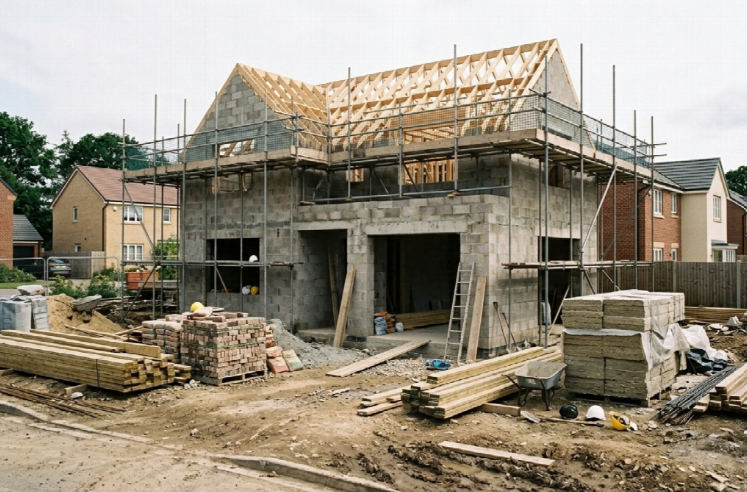
Most people approach the eco-friendly house from the wrong end. The conversation starts with solar panels, heat pumps and triple glazing, because that hardware is visible, priceable and easy to photograph. The materials holding the whole thing up get chosen quickly, often by whoever is cheapest that month.
This article will cover what actually makes a building material sustainable, how the common ones compare, and a six-step process for working through the decision without relying on the wording on the packaging.
What Lasts Longer Pollutes Less
The idea behind that heading is simple. Every time a material gets made, something is dug up, heated, processed and driven across the country, and all of that happens before it reaches the site. A wall built from something that lasts eighty years puts the planet through that process once. The same wall finished in something rated for twenty years puts it through four times over, and throws the old one into a skip on three of those occasions.
Nothing about the second wall looks wasteful on the day it goes up. The waste is spread out across sixty years, arriving in instalments nobody connects back to the original choice. That is why durability belongs in the environmental column rather than the comfort one. A material that stays put is not just less trouble to own. It is the version of that wall that gets manufactured, delivered and thrown away the fewest times.
What Is a Sustainable Building Material?
What makes a material sustainable over the long run comes down to a balance between what it costs the environment to produce and how long it stays useful once it is in place. There is no official definition setting that line, which is a fair part of the problem. Get the balance right and the label means something. Get it wrong and it is just a word on a brochure.
Where things get confusing is the vocabulary around it. Sustainable, natural and recycled are used as though they are interchangeable, and they are not. Here is what each one actually covers, and why two products that sound equally responsible can behave nothing alike once they are in a wall.
Natural
describes origin only. It says a material came out of the ground or grew, and nothing about what happened next. Quarried stone is natural, and so is the diesel that hauled it.
Recycled
describes input. It means a portion of the product was made from something already used, which is genuinely useful, though recycled content and low impact are not automatically the same, reprocessing steel or glass takes significant energy.
Sustainable
is the broader judgement, and the only one of the three that accounts for what happens over the material’s entire life. A natural, locally quarried, fully recyclable product that fails in twelve years is not a sustainable choice, however good the first three adjectives look together.
Why Materials Matter More Than Equipment
Dense, heavy materials absorb heat slowly and release it slowly. In a room, that flattens the temperature curve instead of letting it track the weather outside, shifting demand away from the hours when heating and cooling cost the most. In shoulder seasons it can carry a space overnight without the mechanical system starting up.
The effect is easier to see at small scale than in a wall. Anyone who has looked into indoor pizza oven construction will recognise the principle immediately, the dome is built from refractory brick precisely because it holds heat for hours after the fire has died, and that is the same mechanism a mass wall applies across a day-night cycle at a far lower temperature. One difference matters in practice: the mass has to sit inside the insulation. Placed outside it, the material stores the outdoor climate and contributes nothing.
Six Steps to Choosing Materials
The steps below run roughly in the order the questions come up, from the impact already baked into a product to the paperwork that verifies it. None of them require specialist knowledge, most are just a matter of asking a supplier something specific enough that a vague answer becomes obvious.
1. Count the Carbon Already Spent
Every material arrives on site carrying a debt. Extraction, processing, firing and haulage all happen before installation, and none of it is recoverable through careful living afterward. Cement is the clearest example, it accounts for roughly eight percent of global carbon dioxide emissions, partly from fuel and partly from a chemical reaction that releases carbon regardless of how the kiln is powered.
This is the number to ask for first, because an efficient furnace earns its footprint back over twenty winters and a wall never does.
2. Ask How Long It Lasts Here
Service life figures are usually quoted as national averages, and climate makes a mess of them. Freeze-thaw cycling, ultraviolet exposure and moisture load are all local, so a product that performs well in a temperate market can fall short elsewhere.
Southern Alberta is a useful illustration. Chinook winds can push temperatures back and forth across the freezing point several times in a single week, exposing masonry, mortar and sealants to a cycle count that milder regions never reach. Regional performance data is worth more here than any manufacturer’s average.
3. Repair Before Replacing
The material with the lowest impact is nearly always the one already standing. Repair keeps that original investment in service, avoids manufacturing a replacement, and keeps debris out of the waste stream.
Masonry is unusually good at this, because it fails in parts rather than all at once. A chimney shows it clearly that the mortar goes long before the brick does. So understanding chimney restoration makes it far easier to tell a repair job from a replacement job, and most of the time it turns out to be a repair. Repointing or a new crown fixes the part that failed. Rebuilding means throwing out sound brick to put up the same thing again.
4. Look at How Far It Travelled
Buying regionally shortens supply chains and tends to produce materials suited to the conditions they came from. It also removes some guesswork, since anything that has weathered locally for a century has run its own field trial.
Honest accounting complicates it, though. Transport is usually a modest share of total impact next to manufacturing, so a local but energy-hungry product can still outweigh a lower-impact one shipped further. Distance registers most for heavy, low-value materials, stone, brick, sand and aggregate, where weight dominates the equation.
5. Use Less of It
Reducing the quantity is a lever available almost everywhere, and it rarely costs performance. Engineered lumber does more with smaller sections. Post-tensioned slabs need less concrete.
Stone has its own version. Full-bed stone weighs around fifty pounds per square foot and has to stand on its own footing, which is why it was historically decided before a house existed. Sawn to roughly an inch, the same stone drops under fifteen pounds per square foot, at which point building codes treat it as cladding rather than structure. One quarried block covers several times the area, and the footing disappears along with the concrete that went into it.
The catch is that thin systems depend entirely on the wall behind them. Without a properly detailed drainage plane, the saving is cancelled by a shorter service life.
6. Read the Labels Properly
Certifications measure different things and are not interchangeable. Forest Stewardship Council certification tracks chain of custody for timber. Cradle to Cradle assesses material health and recyclability. An Environmental Product Declaration reports third-party-verified impact figures for one specific product.
The Environmental Product Declaration is the most practical of the three for comparison work, because it produces numbers rather than a pass or fail. Unverified language deserves more scepticism, green, natural and eco carry no definition and no obligation. Their absence is not damning either, since smaller regional producers often skip certification on cost.
Frequently Asked Questions
Is a sustainable house more expensive to build?
Often at the outset, and less often across the full period of ownership. The gap narrows considerably once replacement cycles, maintenance and energy use are counted rather than compared on installed price alone.
Which material has the lowest impact overall?
None of them, in every category. Timber stores carbon and is vulnerable to fire and rot. Concrete and masonry are durable and thermally useful with a heavy production footprint. Recycled steel is endlessly recyclable and energy-hungry to reprocess. The choice depends on what that part of the building has to do.
Does a sustainable material have to be new technology?
No. Some of the most durable approaches are old ones, and the material efficiency of thin-profile stone or engineered timber comes from better processing rather than new invention.
How should priorities be ranked?
By how hard the element is to replace. Structure and envelope are judged on service life and maintenance, because changing them is disruptive. Interior finishes can be judged on recyclability, since they will be changed anyway.
Building Something That Stays Built
The whole argument comes back to one measure: how long the material stays where it was put. Service life multiplies or divides everything else, the carbon, the freight, the waste, the cost, which is why a mediocre footprint that lasts eighty years regularly beats a low-impact one replaced three times in the same period.
That reframes what an eco-friendly house is. Not a building assembled from a list of approved products, but one specified carefully enough that it does not need to be built twice.