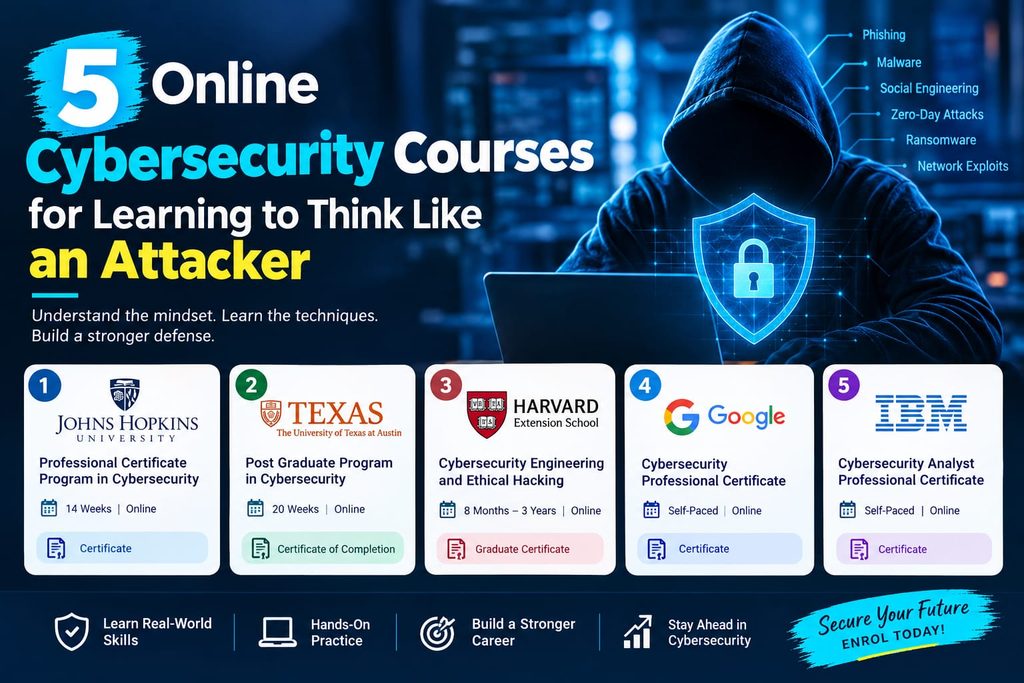
Cybersecurity no longer means just protecting computers with passwords and antivirus software. Businesses today should be smart enough to check security gaps, know how attackers operate, and protect sensitive information from cyber threats. As a result, they look for professionals who can help keep their data safe from such attacks.
This has also increased online cybersecurity courses, as they let beginners and working professionals build these skills while continuing their studies or jobs.
1. Professional Certificate Program in Cybersecurity – Johns Hopkins University
The Johns Hopkins University cybersecurity certificate is ideal for professionals looking to strengthen their cybersecurity skills. This course covers key areas such as information security, network protection, risk management, and modern cyber threats.
Students gain theoretical knowledge and practical skills, making them more employable. Learners can learn how attackers operate and how to deploy security measures to reduce such attacks.
- Delivery and Duration: Online, 14 weeks.
- Credentials: Certificate from Johns Hopkins, as specified by the program.
- Program USPs: Information security, network security, cyberattack ways, vulnerability management, and incident response.
- Learning Outcomes: The course lays the foundation in cybersecurity. Students can identify risks and implement effective security solutions.
Why It Stands Out
- The course includes important concepts.
- It features practical methods, hands-on learning, and industry-related projects.
- Students can learn about various cyber threats and how to address them.
- It is suitable for professionals looking to develop cybersecurity expertise.
- Dedicated Modules on AI for Cybersecurity
2. Post Graduate Program in Cybersecurity – The University of Texas at Austin
The University of Texas at Austin’s Post Graduate Program in Cybersecurity is an online program. It is designed in collaboration with Great Learning. Through this cybersecurity program, professionals can identify, assess, and safeguard data against cyber risks.
A key aspect of this program is helping learners understand the reasons behind cyberattacks. Learners can check attack ways, network security, risk management, and security controls. The course curriculum includes Case Studies, 8 lab sessions and 12+ projects that help implement concepts, which help security teams understand attacker behaviour and the different stages of an attack.
- Delivery and Duration: Online, 20 weeks.
- Credentials: Certificate of Completion from the university.
- Program USPs: Network security, firewalls, modern cyberattacks, cryptography, risk management, etc.
- Learning outcomes: Learners can gain a practical understanding. They can check vulnerabilities, attack methods, and focus on security systems.
Key USPs of the Course
- The course focuses on modern cyberattacks.
- Includes network security and defensive strategies.
- Offers hands-on labs and industry projects.
- Suitable for professionals seeking structured cybersecurity training.
3. Cybersecurity Engineering and Ethical Hacking Graduate Certificate – Harvard Extension School
The Cybersecurity Engineering and Ethical Hacking graduate certificate is best for learners who want to learn the latest hacking techniques from a defensive perspective. This course helps learners understand how cyberattacks happen and how security professionals can identify and address weaknesses before attackers exploit them.
- Delivery and Duration: Online, 8 months- 3 years
- Credentials: Graduate Certificate
- Program USPs: Ethical hacking, cybersecurity fundamentals, network threats, security vulnerabilities, and Network and cloud security.
- Learning Potential: Learners can learn common attack methods. They can also learn various ways to identify and address security weaknesses.
Why It Stands Out
- Focuses on ethical hacking and attacker behavior.
- Includes practical activities and video walkthroughs.
- Covers both vulnerabilities and defensive strategies.
- Offers a structured learning path for aspiring ethical hackers.
4. Google Cybersecurity Professional Certificate – Google
For beginners, the Google Cybersecurity Professional Certificate is an ideal course. It improves graduates’ employability by building strong cybersecurity skills. Despite coming from a different field with no cybersecurity experience, learners can boost their skills and knowledge.
This course covers security risks, network protection, vulnerabilities, and incident response. Learners also gain skills in Linux, Python, SQL, and security information and event management (SIEM).
- Delivery and Duration: This.
- Credence covers the Google Cybersecurity Certificate.
- Program Highlights: Network security, threat detection, Linux, Python, SQL, vulnerability management, and incident response.
- Learning Outcomes: Learners can build foundational skills for entry-level cybersecurity analyst roles.
Why It Stands Out
- Beginner-friendly with no prior experience required.
- Includes practical exercises and security tools.
- Covers threat detection and incident response.
- Provides a foundation for starting a cybersecurity career.
5. IBM Cybersecurity Analyst Professional Certificate – IBM
The IBM Cybersecurity Analyst Professional Certificate is another good option. Learners can learn about cybersecurity threats and build practical security skills. Some of the important concepts related to security operations, threat analysis, and vulnerability management are also explained.
If you want to learn how cybersecurity teams monitor systems, investigate incidents, and reduce risk, you can enroll. It also covers key concepts.
Duration: Online, self-paced; check the course platform for the current estimated time.
- Program USPs: Cybersecurity fundamentals, threat analysis, security operations, vulnerability management, and incident response.
- Learning Results: Learners can develop foundational knowledge of cybersecurity analysis and defensive practices.
Why It Stands Out
- Includes many cybersecurity areas.
- Allows learners to learn security analysis and threat investigation.
- Best for beginners starting a career in cybersecurity.
- Provides a foundation for further technical learning.
Final Words
Hope all those looking for the best cyber security courses can make the right selection now. Whether you want to know about ethical hacking, attacker techniques, vulnerability assessment, or incident response, doing a cybersecurity course serves the purpose.
So don’t wait any longer; enrol in a cybersecurity program now to make a stronger career choice