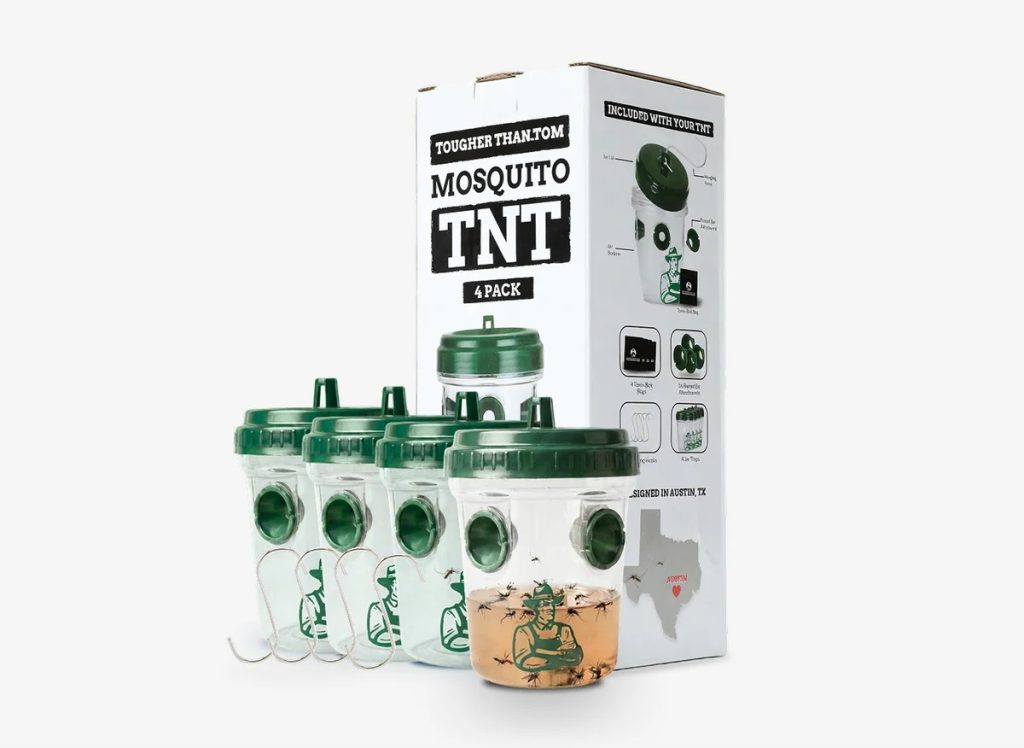
Mosquito traps do catch mosquitoes and can bring the numbers down around a house, but no trap will make a yard bite-free on its own. CO2 traps generally do better than light-based ones. Bug zappers are the weakest choice: in one University of Delaware study, only 31 of nearly 14,000 insects they killed were biting flies.
You can put a lot into the outdoor side of a home, from the pool and pool house to the outdoor kitchen, fire pit, and landscape lighting, and still end up eating indoors once the sun goes down. Mosquitoes have a way of deciding when an outdoor space actually gets used. If you’re thinking about buying a trap, here’s what one can realistically do and where it falls short.
Do mosquito traps actually work?
Mosquito traps help, but only up to a point. A trap lowers the number of mosquitoes in an area, yet you can still get bitten. That’s the bottom line of a mosquito guide from the University of Arizona Cooperative Extension, which also notes that traps producing CO2 generally work better than ones that don’t.
The guide’s bigger point is that a trap should be one part of a plan. Get rid of the places where mosquitoes breed, treat any water you can’t drain, and cover up when mosquitoes are out. The trap then runs in the background, and how much it helps depends on where you hang it and what else is going on around the property.
What kind of mosquito trap works best?
Of the traps sold for yards, the ones that produce CO2 generally do best, according to that same Arizona guide. Light-based traps, it says, aren’t effective on mosquitoes. CO2 traps get their gas in one of two ways. Some burn propane, which means storing and swapping out tanks. Others make it from a bait mixed with water, which is handy around pool decks, pergolas, and courtyards with no outdoor outlet.
Tougher Than Tom’s Mosquito TNT 2.0, a CO2 mosquito trap that runs on a bait pouch mixed with warm water, is one example of the second kind. The bait gives off CO2, and a surfactant in the liquid means mosquitoes that land can’t fly back out. Each bait lasts up to 30 days, and the trap needs no batteries or electricity, so there’s no cord to hide in the landscaping.
Where should you put a mosquito trap?
Between the spots where mosquitoes rest and the spots where people sit. During the day, adult mosquitoes shelter somewhere cool and shady: thick hedges, dense shrubs, ivy, overgrown corners, and the edges of standing water.
Hang the trap near those areas, from a post, a fence, or a sturdy branch, so it sits between them and the terrace or outdoor kitchen. Keep it out of reach of kids and pets.
Do bug zappers kill mosquitoes?
Bug zappers kill hardly any mosquitoes. In a study led by University of Delaware entomologist Doug Tallamy, researchers collected nearly 14,000 insects killed by zappers at six suburban sites in Newark, Delaware, over one summer. Only 31 were biting flies, less than a quarter of one percent. The rest came from more than 100 families of insects the zappers weren’t meant for, and almost half were aquatic insects such as caddisflies and midges.
That matters if your garden was planted with birds and wildlife in mind. Midges are a food source for nesting birds, frogs, and fish, so a zapper next to the pond or the herb bed is mostly killing insects that were never a problem.
How do mosquitoes find people?
Mostly by sensing the carbon dioxide in our breath. A mosquito picks up that CO2 from a distance and flies upwind along the plume. Closer in, it switches to other cues, such as sight, body heat, and skin odor, to decide where to land. A glowing light isn’t really part of that process, which helps explain why zappers do so little against mosquitoes.
Can a swimming pool breed mosquitoes?
Only if it’s neglected. San Diego County’s vector control program says well-maintained pools won’t breed mosquitoes, but the Los Angeles County Department of Public Health warns that an unmaintained one can produce thousands a week. That’s worth keeping in mind for a second home or vacation property that sits empty for weeks at a time. Los Angeles County’s advice for keeping a pool in shape:
- Keep the water clean and chlorinated, and test it regularly.
- Hold the pH between 7.2 and 7.8.
- Run the filter 4 to 8 hours a day and keep the pump in good repair.
- If the pool isn’t in use, cover it tightly and don’t let rainwater collect on the cover.
How do I keep mosquitoes out of fountains and ponds?
Keep the water moving. San Diego County’s vector control program recommends making sure ponds and fountains circulate. Where they don’t, it suggests mosquitofish or a bacterial larvicide, which the county says doesn’t harm people, pets, plants, or wildlife.
The small stuff counts too. Planter saucers, birdbaths, decorative urns and the trays under potted citrus can all hold enough water for mosquitoes to lay eggs, so empty or refill them at least once a week.
FAQ
Should I drain my pool to get rid of mosquitoes?
Usually not. Keeping the water clean, filtered, and treated is the better route.
Can a pool cover cause mosquito problems?
It can if rain or sprinkler water sits on top. Pump or sweep the water off after a storm and make sure the cover fits tightly.
A trap is worth having, but it works best as the last step, not the only one. Keep the water features in shape, hang the trap between the hedges and the seating area, and you’ll get a lot more use out of the pool and the outdoor kitchen after dark.