You signed the contract on Monday. By Friday you’ve searched your main keyword on Google three times, and nothing has moved. Is something wrong?
Almost certainly not. The first 90 days with an SEO agency are mostly groundwork, and groundwork doesn’t look like much from the outside. This guide covers what happens month by month, what you’ll see (and won’t), and how you can speed things up.
What Happens in the First 90 Days with an SEO Agency?
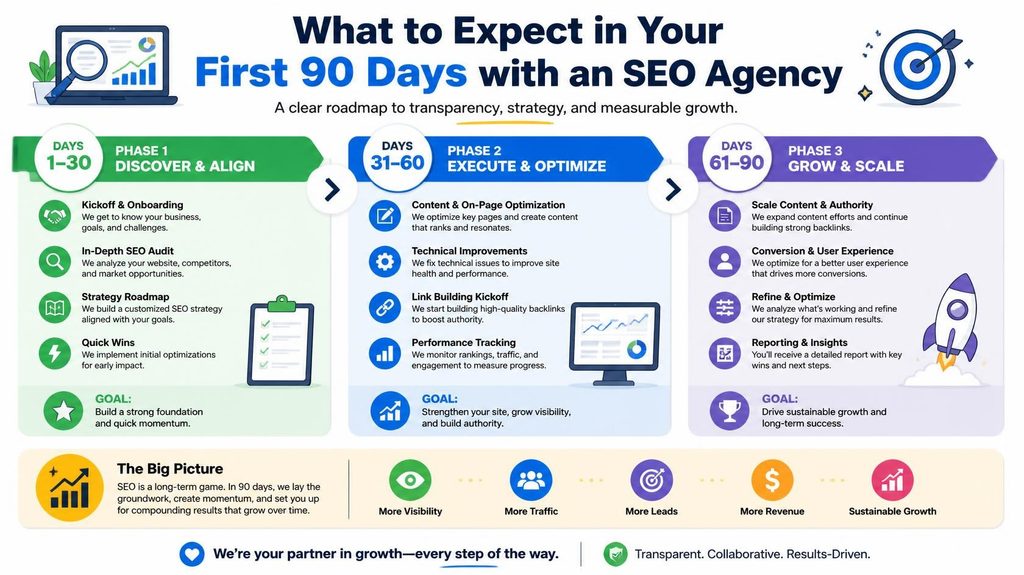
In the first 90 days, a good SEO agency audits your website, researches keywords, fixes technical and on-page issues, starts publishing content and begins building links. Early signs like more impressions and better indexing usually appear in months two and three. Stronger ranking and lead gains typically take three to six months.
Here’s the short version before we go deeper:
| Phase | Main work | What you’ll likely notice |
| Days 1-30 | Onboarding, site audit, keyword research, tracking setup | Reports and a roadmap, but no ranking changes yet |
| Days 31-60 | Technical fixes, on-page updates, first content | Better indexing, small movement on long-tail keywords |
| Days 61-90 | New content live, link building starts, first review | Rising impressions in Google Search Console, early ranking gains |
Why the First 90 Days Feel Slow (and Why That’s Normal)
Google doesn’t re-rank your site the moment a title tag changes. Pages have to be recrawled, reindexed and compared against competitors who may have been investing in SEO for years. New content and new links also take time to build any weight.
That’s why agencies that promise page-one rankings in two weeks should make you nervous. Fast wins do happen, usually on pages that were already close to ranking, but a sustainable result is built in layers.
Days 1-30: Onboarding, Audit and Keyword Research
The first month is about understanding your business and your site before touching anything.
The Kickoff Conversation
Expect a proper strategy session. Your agency should ask about your products, your best customers, your margins and what a “good lead” looks like. If nobody asks you these questions, the strategy will be generic.
The Site Audit
An audit covers technical health (speed, mobile usability, HTTPS, crawl and indexing problems), on-page basics (titles, headings, internal links), content quality and your backlink profile. Agencies commonly use Google Search Console, Semrush or Ahrefs for this. The output should be a prioritised list, not a 60-page PDF of every minor warning.
Keyword Research With Local Context
In Malaysia, search behaviour is rarely one-language. People search in English, Bahasa Malaysia and Chinese, and often mix them. A KL accounting firm and a Penang clinic may need very different keyword sets, including “near me” and area-based terms. Good research maps keywords to buying stages, so you’re not just chasing high-volume terms that never convert.
Tracking Setup
Before any optimisation starts, make sure Google Analytics, Search Console and conversion tracking are working. For many Malaysian businesses, a WhatsApp click or a phone call is the real conversion. If those aren’t tracked, you can’t tell whether SEO is paying off.
Days 31-60: Fixes, On-Page Work and First Content
Month two is where visible work begins.
- Technical fixes: broken links, slow pages, duplicate pages, indexing problems, missing structured data.
- On-page updates: rewritten titles and meta descriptions, cleaner heading structure, better internal linking between related pages.
- Content planning and publishing: a mix of improving existing pages and creating new ones around the keywords from month one.
A common mistake is rewriting everything at once. A sensible agency starts with pages closest to ranking or revenue, then expands.
If your agency asks for developer access or site edits, respond quickly. Technical SEO often stalls for weeks because one approval sits in someone’s inbox.
Days 61-90: Authority, Early Signals and Your First Review
By month three, new content is indexed, and link building typically begins in earnest. Quality matters far more than quantity here. A handful of relevant, reputable links beats hundreds from low-quality directories, which can do more harm than good.
At the 90-day mark you should get a proper review. Look for these early signals:
- Impressions and clicks rising in Google Search Console
- More keywords appearing on pages two and three of the results
- Improved click-through rate after title and description changes
- Pages being indexed faster than before
- Small but real increases in enquiries from organic search
Notice that “number one for your main keyword” isn’t on that list. For competitive terms, that usually takes longer.
A first-quarter review should explain the numbers, including the ones that do not rise together.
Rankpage Case Study: READ: A Website Build with Content, Tools and Measurable Search Progress
Rankpage built READ’s full website and developed localised content and useful tools for its users. This is the kind of concrete delivery a client should be able to discuss in a project review: what was built, who it serves and what visitors can do with it.
The value lies in combining the site itself with material and features people can use. A progress review can then examine how the website is being found, rather than treating the launch or a fresh visual design as the final measure of success.
READ’s Google Search Console comparison recorded clicks rising from approximately 1,830 in 18 April–17 July 2026 to 2,150 in 18 July–17 October: around 320 additional clicks, or 17%, across equal 92-day periods. Reported CTR increased from 0.2% to 0.3%, while impressions fell from 901,000 to 830,000. This comparison is a quarterly performance snapshot, not a claim about the project’s first 90 days.
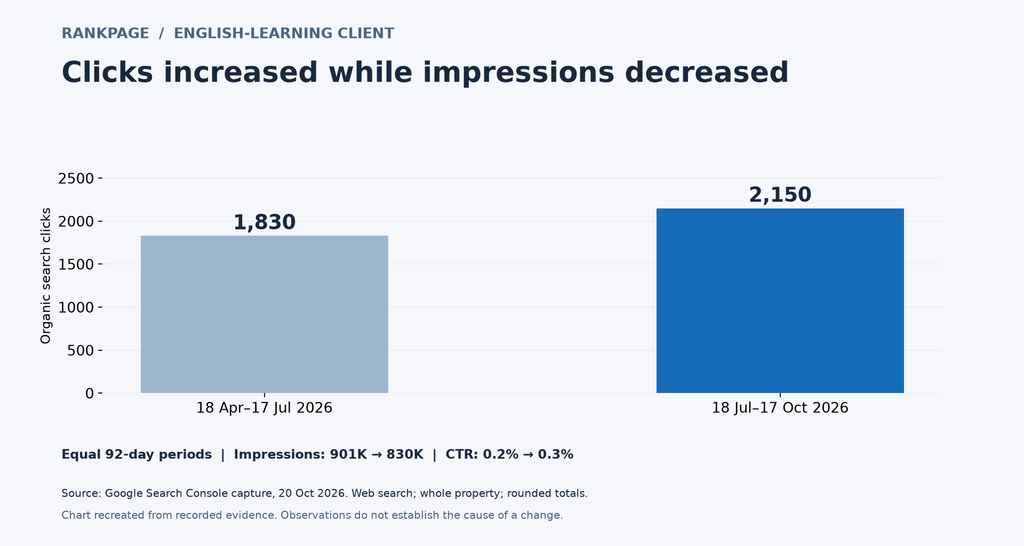
Figure: Whole-property GSC clicks across two equal 92-day periods; impressions moved in the opposite direction.
Source: GSC captured 20 October 2026; 18 April–17 July versus 18 July–17 October 2026; rounded totals.
What Results Can You Realistically Expect?
Most businesses see measurable improvement within three to six months, though this depends heavily on your industry, how competitive your keywords are, and the starting health of your site. A brand-new domain in a crowded market will move slower than an established site with a few fixable problems.
Be wary of any guarantee, because nobody controls Google’s results. A good agency can promise a clear process, honest reporting and steady progress on what it controls.
What You Should Do on Your Side
SEO is a partnership, and clients who engage tend to get more from it. In the first 90 days, aim to:
- Approve things quickly: Delays on content or website changes slow everything down.
- Share real business knowledge: Your sales team knows which questions customers ask. That’s gold for content.
- Keep your team informed: Don’t let someone redesign the site or change URLs without telling your agency.
- Judge on business outcomes: Rankings matter, but leads and sales matter more.
Red Flags in the First Quarter
Watch for these:
- Reports full of vanity metrics but no explanation of what they mean
- No audit, or an audit that looks copy-pasted from another site
- Pressure to buy bulk links or mass-produced articles
- Vague answers when you ask what was done last month
- No single point of contact
How to Choose the Right Partner
If you’re still deciding who to hire, look for a team that explains its process in plain language and shows you how your site will be measured. The real benefit of working with an experienced SEO agency is getting a proper mix of technical, content and link-building support rather than just one of them.
As one example, Rankpage MY describes a process that starts with a one-on-one strategy session, moves into technical and on-page fixes, then content and link building, and finishes with monthly monitoring. It also assigns each client a dedicated SEO manager. Whichever agency you choose, that kind of structure, with a named contact and regular reporting, is what you want to see.
FAQs
How long does it take to see results from SEO?
Most businesses notice measurable improvements within three to six months. Early signals like higher impressions and better indexing can appear sooner. Competitive keywords may take longer, depending on your industry, site history and how strong the competition is.
What should an SEO agency do in the first month?
It should run a site audit, research keywords, set up tracking and agree on a roadmap with you. Very little should change on your live site in the first few weeks, because the priority is planning the right work in the right order.
Is it normal to see no ranking changes in the first 30 days?
Yes. Rankings rarely move this early because changes haven’t been implemented, recrawled and reindexed yet. Judge month one on the quality of the audit, strategy and reporting, not on position changes.
What reports should I receive from my SEO agency?
You should receive regular reports covering rankings, organic traffic, clicks and impressions, conversions, and completed work. Good reports explain what the numbers mean and what happens next, rather than just showing graphs.
Do I need to do anything during the first 90 days?
Yes. Approve content and technical changes promptly, share customer insights and keep your agency informed about website updates. Quick feedback often saves weeks.
When should I worry that SEO isn’t working?
If you’ve seen no improvement in impressions, indexing or rankings after four to six months, and the agency can’t explain why, ask for a detailed review. Unclear reporting or a lack of completed work are bigger warning signs than slow rankings alone.
Final Thoughts
The first 90 days with an SEO agency are about building the foundation: understanding your market, fixing what holds your site back and putting the first pieces of content and authority in place. It won’t feel dramatic, but it sets up everything that follows.
If you’re weighing up your options, ask for a clear plan, insist on transparent reporting and judge progress by real business outcomes. And if you’d like to see what a structured first quarter could look like for your business, you can start with a conversation and a site audit.