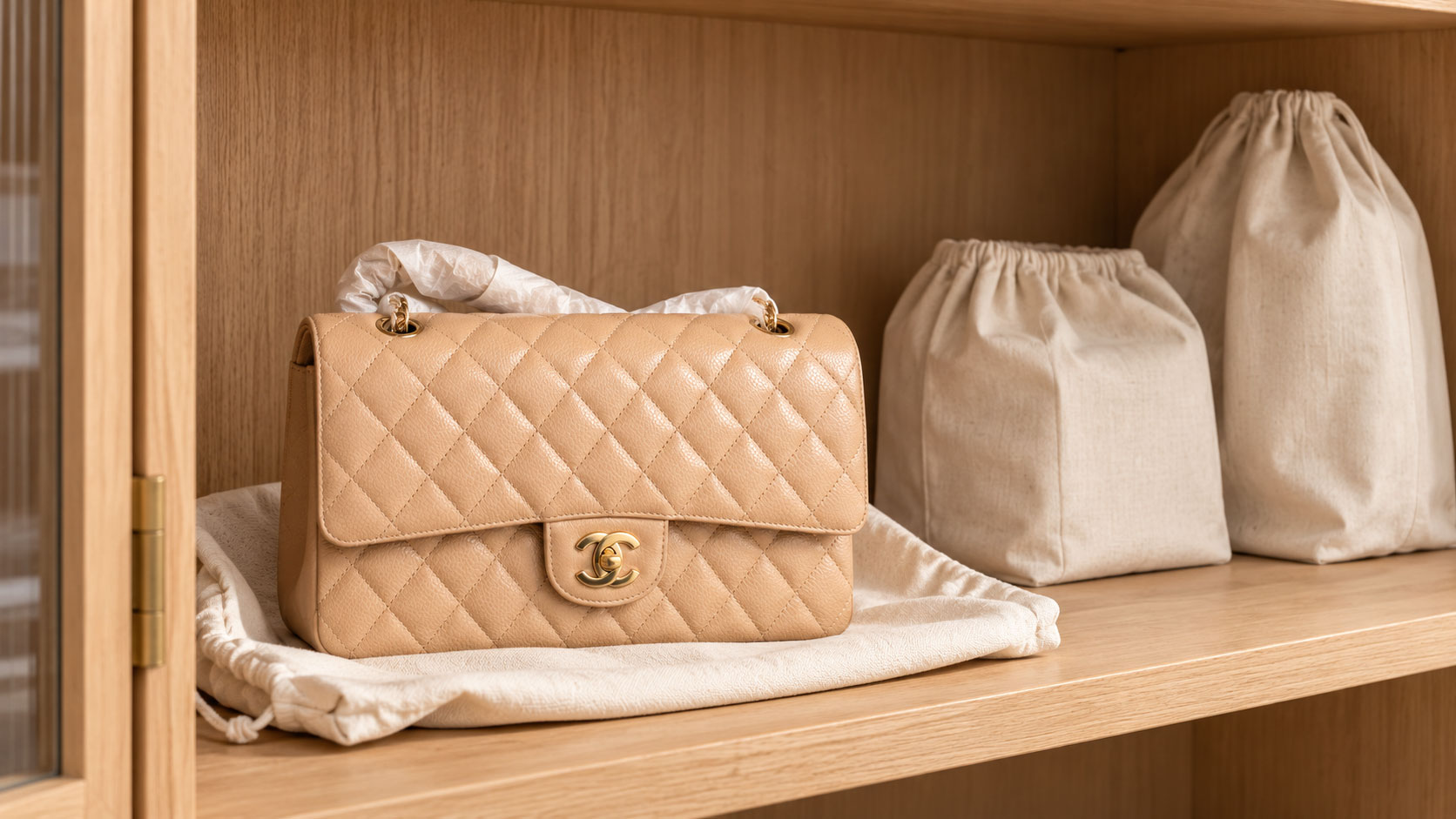
A handbag cabinet can look beautifully arranged while making everyday care difficult. Bags may be crowded together, a chain may rest against a neighboring surface and the favorite piece may sit directly beneath a light. Learning how to store handbags starts with those ordinary details, before choosing a display that treats them as decorative objects.
For a collection that includes a Chanel Classic Flap, a Coco Handle or a soft lambskin piece, storage space and easy retrieval need to work together. A sensible arrangement protects each bag between outings and lets you put it away properly without dismantling the shelf. The most attractive cabinet is not necessarily the most suitable home for the actual items you own.
Choose a location before choosing the display
Chanel’s official bag care instructions advise avoiding prolonged exposure to sunlight, artificial light and humidity. That makes the location of a shelf or cabinet a care decision, not simply a question of where your collection will look best against the room’s furniture.
Watch how the proposed location is used through the day, including whether sunlight falls across it, whether display lighting remains on for long periods and whether the space feels damp, instead of assuming that a cabinet is protective merely because it has doors. Look beyond the evening photograph. The room changes while the bags stay there.
The official guidance does not provide a universal temperature or humidity setting for your home. Avoid inventing one or treating an attractive display as a controlled environment. Choose a suitable location under the maker’s advice, and seek advice about your particular situation when moisture or storage conditions are a concern.
Give each shape enough room to stand properly
Luxury Evermore’s Chanel assortment includes Classic Flap, Coco Handle and Boy styles, with listings across caviar, lambskin and calfskin. Those different pieces should not be treated as interchangeable shelf units. Plan around the shape and condition of each bag you own or are considering.
Chanel recommends upright storage in the original bag. Make sure the intended space allows the item to stand that way without being squeezed between other possessions. A Coco Handle needs room for its actual outline; a Classic Flap needs somewhere its chain can be managed without being pressed against the leather.
Test the shelf with the bag in its proper storage arrangement, rather than measuring only the bare item, because a layout that looks roomy when everything is uncovered may become awkward once the protective bag and strap arrangement are included. Leave practical clearance. Storage space must support the care routine you will actually follow.
Keep chains and neighboring objects from becoming pressure points
Chanel advises wrapping chains or straps in tissue paper for storage. Apply that instruction to the particular bag rather than dropping the chain across a leather panel or letting it rest against the next item on the shelf. The surrounding objects matter as well as the bag’s own parts.
Look at a stored Classic Flap from the side, where an arrangement that appears tidy from the front may reveal a chain tucked under another object or a neighboring bag leaning against its surface. Correct the contact rather than hiding it. Front-facing symmetry is not the measure of suitable storage.
Do not assume caviar texture makes these details irrelevant, or that a lambskin bag will recover from pressure because its surface feels soft. The useful habit is to keep the arrangement consistent with the maker’s guidance, without inventing a universal rule about how every leather or construction responds to being compressed.
Empty the bag instead of storing yesterday’s load
Make unloading part of putting a bag away. Remove the things that do not belong in storage and check the interior for an overlooked item before returning the bag to its place. A wallet, glasses case or loose set of keys should not quietly become the default contents because you were tired after an outing.
Chanel advises against overfilling its bags. That instruction matters when a Classic Flap is put away with its everyday contents still inside or when a Coco Handle is packed with belongings simply because there appears to be room. Comfortable closure is not an invitation to store everything indefinitely.
Separate the bag’s storage needs from your desire to keep small items organized, using another appropriate place for the things you removed rather than filling unused handbag space with accessories, because doing so makes it harder to notice what is inside and to prepare the bag for its next outing. Keep the routine short. A repeatable habit is more useful than an elaborate occasional reorganization.
Make easy retrieval part of the shelf plan
A protected bag that is inconvenient to reach can become inconvenient to use. Arrange storage so you can remove the item you want without dragging it past other bags or moving a stack of unrelated belongings. The arrangement should make putting it back just as simple.
Keep track of which piece belongs in each position. Similar protective pouches can make you open several before finding the bag you want, adding avoidable handling to a rushed morning. A simple note on the shelf or a personal inventory can help, without attaching a label or adhesive directly to the leather.
For a frequently used Classic Flap, consider whether you can manage the chain and its wrapping comfortably where the bag is stored; for a Coco Handle, check that the hand movement needed to lift it is unobstructed. Try the action. A shelf that is accessible only in theory needs adjustment.
When considering another purchase from Luxury Evermore’s pre-owned Chanel range, decide where that specific piece would go before adding it to the collection, taking account of its shape and the storage accessories included with the listing. A vacant-looking gap is not automatically suitable. Adding a bag should not require pressing existing ones together.
Check condition before routine care becomes guesswork
Notice how the bag looks when you put it away and when you take it out. This is a simple observation habit rather than a need to inspect the collection constantly. An unexpected mark, damp area or change in appearance deserves appropriate attention instead of being covered up by rearranging the shelf.
For wet leather, Chanel recommends gentle use of an absorbent cloth that does not shed lint, and its guidance cautions against products that may change the finish. For lambskin, the brand recommends limiting handling to preserve softness. Those instructions argue for restraint when deciding how to respond to a concern.
Do not experiment with an unfamiliar treatment on a lambskin or caviar bag simply because you are already reorganizing the cabinet, and do not assume that a storage change will undo an existing mark whose cause you do not understand. Pause and seek suitable advice. General care guidance does not diagnose every surface problem.
Build a routine the display can accommodate
Before buying more shelving or adding a bag, walk through the complete sequence with a piece you use often. Bring it home, empty it, check its condition, manage the chain and return it to its storage position. The practical requirements become clearer during that sequence than in a photograph of the finished room.
- Choose a location consistent with the maker’s guidance on light and moisture.
- Leave enough space for upright storage and the appropriate protective bag.
- Arrange wrapped chains or straps so they do not become pressure points.
- Keep retrieval and replacement straightforward for the pieces you use most.
The cabinet can still be attractive. Its proportions and finish simply need to follow the care requirements
