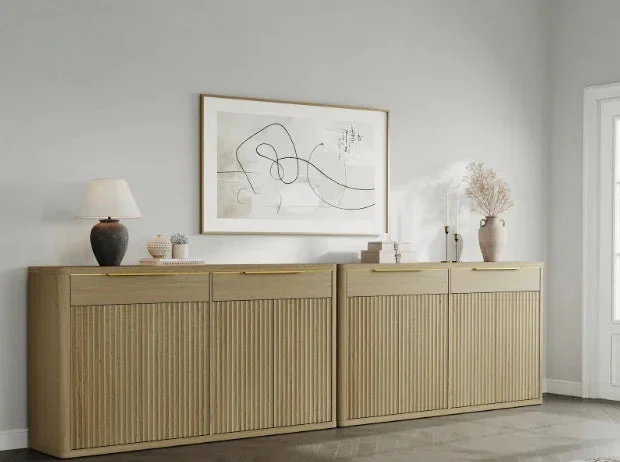
A sideboard can look beautifully proportioned in a photograph and still leave you with a platter that won’t fit or a drawer that meets the sofa halfway out. Choosing one means imagining the room in use, including the changes you might want later. Gather a tape measure, the dimensions of your largest stored items, and the specification sheet for the exact cabinet you’re considering. Use them to narrow your shortlist before you settle on a favorite finish.
Measure the space and what needs to go inside
Record the maximum width, height, and depth your room can accommodate. Check baseboards and outlets, then mark the proposed footprint with painter’s tape suitable for your floor. Walk past it, pull out nearby dining chairs, and allow for the cabinet’s doors or drawers to open fully.
For a hypothetical example, a 60-inch-wide cabinet on a 72-inch clear wall leaves 12 inches altogether, or 6 inches on each side when centered. That calculation tells you about width alone. It says nothing about walking space or whether a door can swing open; check depth and access separately.
Now measure what you want to put away. Compare your largest serving platter, storage box, or stack of books with the usable interior dimensions and the opening through which it must pass. Exterior measurements won’t settle that question. Ask for compartment widths, shelf heights, and interior depth for your chosen layout.
Rehearse reaching for the things you’ll use daily. If access feels awkward, change the cabinet’s dimensions, interior arrangement, or location before settling on it. Finally, measure the delivery route through doorways, hallways, and turns, using the seller’s packed or assembled dimensions as appropriate.
Find out what can actually change later
Decide what you want “modular” to mean in your home. Moving a shelf to accommodate a taller vase is one kind of flexibility. Choosing doors and drawers when you order is another. Adding a whole section, or bay, after a move requires a system whose structure can be changed after purchase.
For example, USM’s service information describes reconfiguring its Haller ball-and-tube frame and getting specialist help with additions or restructuring. That support applies to USM’s own system; it doesn’t establish what a similar-looking cabinet can do.
Give the seller a specific future scenario: “Could this two-bay cabinet become three bays?” Ask which components that requires, whether compatible parts are available, and who would carry out the work. Get the tool or service requirements and an estimate of the cost, too.
If the answer stops at “it’s modular,” leave future expansion out of your buying calculation. The current layout may still suit you perfectly. You just need to judge it on the storage it provides today, with any later changes treated as unconfirmed.
Read the material specification beyond the finish name
Choose a finish you want to live with, then look underneath its name. “Walnut finish” leaves questions about the panel construction; “metal” leaves questions about the frame and surface treatment. Ask what each part is made from, including the panels, supporting frame, any underlying core, and the visible finish.
If a cabinet uses wood veneer, that’s a thin surface layer of wood over a core. Ask what the core is. A color name or the word “premium” cannot answer those construction questions.
For everyday use, read the exact model’s care instructions and stated load limits. If you plan to store heavy books or dishes, check the limits for the relevant shelves. Avoid assuming that one broad material category guarantees durability.
Bring the choice back to the room: compare an available finish sample with your flooring and upholstery. Decide whether you want the sideboard to echo those tones or provide a deliberate contrast.
Compare the buying routes against the same needs
If the USM Haller look appeals to you, there are several routes to consider: a new genuine piece, a used genuine cabinet, or an independent system or design-inspired alternative. Carry the same room measurements and storage requirements into each comparison.
For new genuine USM, confirm the proposed configuration and any service needed for the changes you have in mind. With a used piece, request evidence of authenticity, clear condition photographs, and details of included components. Check transport arrangements and price any changes needed to make that particular cabinet work for you.
For independent alternatives, establish who makes the piece and what support comes with that model. A replica is a design-inspired product, not genuine USM. A resemblance alone doesn’t establish affiliation, equivalent construction, or interchangeable parts.
For a fuller look at that route, Daedalus Designs’ USM Haller dupe guide covers USM-inspired alternatives. Daedalus sells replicas itself, so read the guide with that retail perspective in mind. Use it to identify options, then check each exact configuration against the requirements you’ve gathered.
Confirm the full cost before choosing
Set a delivered-cost limit and request a quote for the configuration you actually want. Check whether it includes delivery to the intended room, assembly, and every shelf, door, or other component shown. Include documented future work in your budget if that work is central to the purchase.
Read the return conditions before ordering, including eligibility, collection arrangements, and any costs you would bear. Clarify those terms with the seller if anything is missing.
Finish with a short check: the cabinet and its contents fit, doors and drawers can open, the exact layout is documented, and you understand the delivered cost. Resolve any consequential gap with the seller. You can then enjoy choosing the finish, knowing where the cabinet will go and how you’ll use it.