The average U.S. electricity customer lost 11 hours of power in 2024, well above the roughly eight hours customers experienced in 2020. That figure is a national average pulled across a grid full of apartments, tract homes, and small commercial accounts.
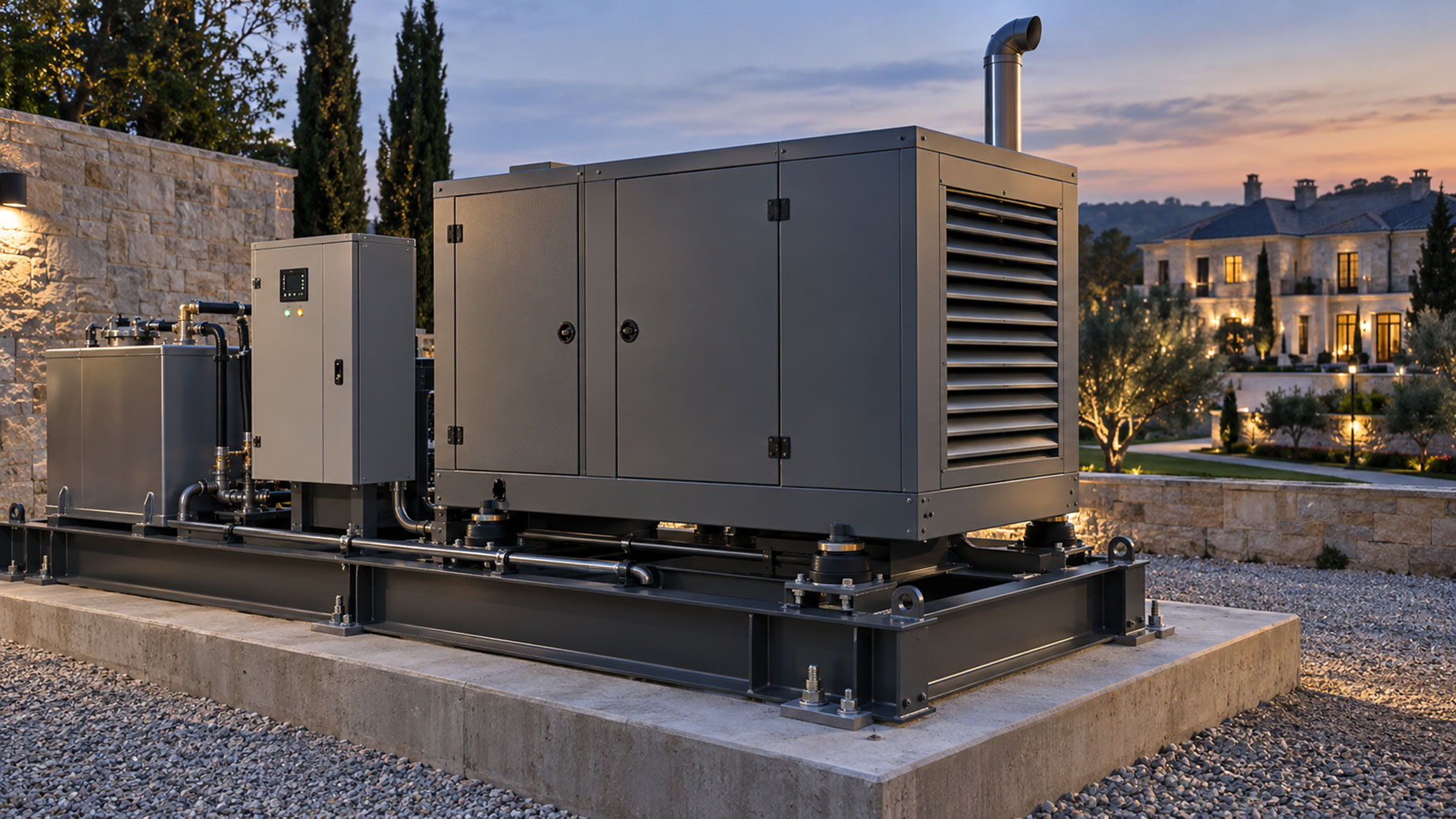
What’s replacing it looks nothing like a residential install. The generator, its fuel system, the day tank, the switchgear, and the controls all show up on a single welded steel frame, pre-wired and factory-tested, from a modular skid builder that spends most of its year doing industrial work rather than custom homes.
For the builder, that moves where the risk sits and when the decisions get made.
The Catalog Genset Was Sized for a Different House
A standard air-cooled residential unit was engineered around a load profile that doesn’t exist on an estate. One HVAC compressor, a refrigerator, a well pump, a few lights. The retail sizing worksheets assume the owner will accept load-shedding for anything past that.
On an estate, no load has been agreed to as sheddable. The second kitchen runs during a storm because the family is cooking in it. The elevator has to work because someone’s grandmother is upstairs.
The sump pumps and the dehumidifiers in the lower level cannot cycle off during the exact event they were installed to protect against. Add those loads up honestly and the required output walks right past where catalog residential products stop, into territory that looks a lot like light commercial.
Case One: The Compound With Multiple Service Entrances
Many estates aren’t a single building. They’re a main house, a guest house, a pool house, a barn or garage block, sometimes a staff residence, each with its own meter and its own panel. A catalog standby unit per structure means five transfer switches, five service contracts, five fuel decisions, and five sets of fault codes to manage during the one week a year any of it matters.
A pre-built package collapses that. One larger generator, paralleling gear, and a programmed transfer scheme sit on a single skid at a central location, with the switching logic worked out at the factory. The builder gets one pad, one fuel tie-in, one commissioning visit, and one phone number when something trips.
Case Two: The Property Where the Fuel System Is the Project
On remote or large-acreage estates, there’s often no gas main at the lot line. The fuel is diesel or propane, in a tank the owner has to permit, bury or berm, and keep full. Sizing it isn’t a round number anyone can guess at.
The reference most engineers point to, NFPA 110, sets fuel storage at 133% of the volume needed to run the generator through its class interval. That math drives a tank considerably larger than the one the local propane supplier will quote by default. Factory-built packages ship with the day tank, the transfer pump, the leak detection, and the piping already integrated and tested, so the on-site question becomes where the bulk tank goes, not whether the fuel system works.
Case Three: The Estate Where EV Charging Rewrote the Load Sheet
A pair of 48-amp Level 2 chargers in the garage can draw more continuous power than the rest of the house combined. Owners who installed them two years ago often never mentioned it to the generator contractor, because the generator was already in.
The result is a standby unit that trips the moment the chargers wake up. The fix the industry has settled on for new builds is specific:
- Real load calculation. The design starts with a measured or metered load study across a representative week, not a bedroom-count rule of thumb.
- EV charging on its own branch. Chargers get wired through load-management relays so the generator can throttle or shed them without tripping, instead of fighting them.
- Headroom for what’s coming. Battery storage, a heat pump retrofit, or a third charger will land inside a decade. The skid is sized and the switchgear specified with that in mind.
What Arrives on the Flatbed Changes the Builder’s Schedule
The practical difference on the jobsite is where the integration work happens. A loose generator, a separately bought transfer switch, a field-plumbed fuel line, and a stick-built sub-panel all land on the electrician and the mechanical contractor during the same weeks they’re trying to close the house. Change orders cluster there; so do the delays.
A pre-built package pulls that work months upstream, into a factory, where it gets tested as an assembly before anyone pours the pad. The site crew lands the skid, ties in fuel and conduit, and runs an acceptance test. The builder’s exposure shrinks to concrete, trenching, and a known crane pick, and the owner’s warranty conversation has one address on it instead of four.
On an estate project where the generator sits on the critical path to the certificate of occupancy, that’s usually the right trade.
