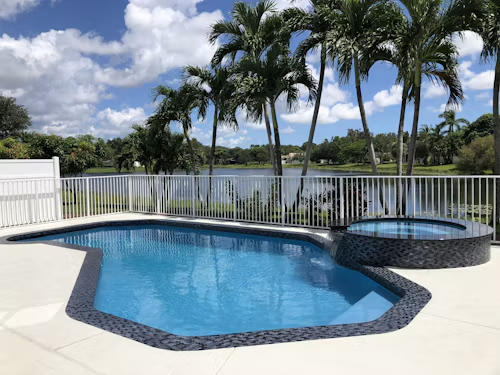
Every waterfront and hillside property with a pool faces the same unresolved argument. The view is the asset. The barrier is the law. And for most of the last three decades, satisfying the second meant degrading the first.
Anyone who has specified a high-end pool surround knows the sequence. The architecture is resolved, the infinity edge is set to read against the horizon, the terrace levels are worked out to the millimetre, and then the safety barrier arrives as a condition of occupancy and draws a 1.2-metre line straight across the thing everyone paid for. The usual response is to treat it as damage control: pick the least intrusive compliant option, position it where it obstructs least, and accept the loss.
That framing is now out of date. Frameless glass, properly specified and properly engineered, has reached the point where the barrier can be genuinely close to invisible, and where the better projects use it as a design element rather than tolerating it as an imposition. The difference between the two outcomes is almost entirely in the specification.
Framed, Semi-Frameless and Frameless Glass Pool Fencing Compared
The terminology in this market is loose, and the distinctions have real consequences for both appearance and cost.
Framed glass sets each panel into a metal frame on all four sides, with posts between panels. It is the cheapest glass option and the most visually present. You are looking at a metal grid that happens to be filled with glass rather than at glass.
Semi-frameless removes the top and side framing, retaining posts between panels. The glass reads more cleanly but the post rhythm is still legible, and on a long run those posts become the dominant visual element.
Frameless eliminates posts entirely. Each panel is structural, fixed at the base by spigots or channel, with the panels standing free and a small gap between them. There is nothing above the base fixing except glass. This is the configuration that disappears, and it is the only one worth considering if the view is the point.
Spigot-Fixed vs Channel-Fixed Frameless Glass
Within frameless there is a further distinction that affects the result more than most people expect: spigot-fixed versus channel-fixed. Spigots are individual base clamps, typically two per panel, usually in stainless or aluminium. They are cheaper, faster to install, more forgiving of substrate tolerance, and they leave visible hardware at the base. Channel systems set the glass into a continuous recessed base channel, which is then dressed flush with the surrounding finish. The glass appears to rise directly out of the stone.
Channel fixing costs significantly more, demands far tighter substrate tolerances, and requires the drainage to be designed around it. It also produces the only version of this that genuinely reads as no barrier at all. On projects where the pool surround is the primary outdoor space, it is routinely worth the premium.
Engineering Requirements for Frameless Glass Pool Fencing
Frameless glass balustrade is a structural element doing a safety job with no redundancy. Each panel carries its own load to the base fixing. This has a few consequences that should be settled before anything is ordered.
Glass specification. Pool barriers use toughened safety glass, typically 12mm for frameless residential applications, with 15mm used on taller panels, wider spans or exposed sites. Toughened glass fails completely rather than partially when it fails, which is why the base fixing and the panel geometry have to be right rather than approximately right.
Spontaneous breakage. Toughened glass carries a small but real risk of spontaneous failure from nickel sulfide inclusions. The industry response is heat-soak testing, which identifies susceptible panels before installation. On a pool barrier where a failed panel means both a safety breach and an immediate replacement cost, heat-soaked glass should be a specification requirement, not an upgrade. Ask for the certification.
Wind load. An exposed clifftop or waterfront site imposes loads an inland courtyard does not. Panel thickness, spigot spacing and base fixing design all follow from the wind classification, and this is an engineering calculation rather than a catalogue selection.
Substrate. Spigots and channels transfer substantial moment into whatever they are bolted to. Fixing into a thin topping slab, an unreinforced edge, or stone over an inadequate bed is the most common serious failure in this category. The structural design of the pool surround needs to anticipate the barrier, which means the barrier has to be decided during the structural design, not after the slab is poured.
Pool Barrier Compliance Rules That Shape the Design
Pool barrier codes vary by jurisdiction, but the underlying logic is consistent across most developed markets, and three requirements drive nearly all the design decisions.
Height, Gaps and the Non-Climbable Zone
Height. Generally a minimum of 1.2 metres measured from the finished surface on the outside of the barrier. The measurement point matters: a barrier that is compliant from the terrace may not be from a raised planter or retaining wall adjacent to it.
Gaps. Typically a maximum of 100mm at the base and between panels, sized so a small child cannot pass through. On frameless glass this is what sets the panel gap and the base clearance, and it is why the elegant hairline gap sometimes shown in renders is not always achievable.
The non-climbable zone. An area, commonly 900mm, on the outside of the barrier that must be free of anything a child could climb. This single requirement kills more designs than any other, because it governs where planters, furniture, walls, barbecues, water features and changes of level can sit. Glass helps enormously here, because the barrier itself offers no foothold, but the zone outside it still has to stay clear.
In Australia, these provisions sit under AS 1926.1 and are enforced through periodic mandatory inspection in most states, which makes compliance an ongoing obligation rather than a one-time sign-off. Elsewhere the inspection regime is lighter but the design requirements are broadly similar. The practical point for any high-value property is that a barrier which is compliant at handover must stay compliant as the landscape matures, a tree that grows into the non-climbable zone is a breach.
Why Frameless Glass Pool Fencing Fails on Expensive Projects
The failures cluster in a small number of places, and none of them are about the glass.
Hardware corrosion. Spigots and fittings near saltwater or heavily chlorinated water face an aggressive environment. Standard 304 stainless will stain and eventually pit in marine conditions; 316 marine grade is the baseline, and even that needs rinsing. On a frameless barrier, corroded hardware is both the structural weak point and the only visible component. It fails in the two places you can least afford.
Substrate movement. Glass has no tolerance for differential movement. A base channel set into a surround that settles, or spigots fixed either side of an unaccounted-for movement joint, will crack panels. Recurring unexplained panel breakage is almost always a substrate problem being blamed on the glass.
Unresolved drainage. A continuous base channel is a trough. Without a drainage path it holds water, which accelerates hardware corrosion and leaves a permanent tide line at the base of the glass, the detail that most reliably ruins the invisible effect.
Maintenance reality. Frameless glass shows everything: hard water spotting, salt residue, fingerprints, sunscreen. On an infinity-edge pool in a coastal setting it needs cleaning on a schedule, and the water chemistry determines how often. This is worth saying out loud to clients during specification rather than discovering at the first site visit after handover.
How to Choose a Glass Pool Fencing Installer
Frameless glass is sold both as a modular product and as a measured, fabricated installation, and the difference shows immediately on any site that is not perfectly rectangular and perfectly level.
Modular systems work from standard panel widths, which means irregular runs get resolved with a narrow filler panel, and curves are approximated with facets. A measured installation sizes every panel to the actual set-out, which is what allows a barrier to follow a curved pool edge, step cleanly with a terrace level change, or run to an exact dimension between two fixed points.
On properties where the pool surround is the principal outdoor space, measured fabrication is effectively a requirement. Specialist installers working this way will typically survey the finished substrate before fabricating, which is the step that eliminates filler panels and visible tolerance corrections. In Perth, Western Australia, where coastal exposure and salt load make hardware grade and substrate detailing especially consequential, FencrGatr handles frameless glass pool fencing as a measured and engineered installation rather than a panel-count exercise. The questions worth asking any supplier: do you template from the finished surface, is your glass heat-soaked, what grade is the hardware, and who carries the engineering certification.
Pool Gate Hardware: Where Compliance Is Usually Lost
If a pool barrier fails an inspection, the odds are heavily that the gate is the reason rather than the barrier. The glass is static and either compliant or not. The gate is a mechanism, and mechanisms drift.
The requirements are broadly consistent across jurisdictions: the gate must be self-closing from any position, self-latching, and must open outward away from the pool. The latch must sit at a height a small child cannot reach, or be shielded so it cannot be operated through or over the gate. In Australia these provisions sit within AS 1926.1 and are among the most frequently cited reasons for an inspection failure.
On frameless glass the hardware is also the entire visual event, because there is nothing else to look at. Which creates a genuine tension: the most discreet hardware is often not the most robust, and the most robust is rarely the most discreet.
What matters in practice:
Hinge quality over hinge invisibility. Self-closing glass gate hinges work by spring or hydraulic action, and they are a wear item. A cheap hinge loses its closing force within a couple of years, at which point the gate no longer self-closes from the critical near-closed position and the barrier is non-compliant without anyone noticing. Specify hinges with adjustable tension and expect to service them.
Marine-grade everything. The same corrosion logic that applies to spigots applies with more force to hardware with moving parts. Salt and chlorine attack the mechanism, not just the finish.
Test the near-closed position. The common failure mode is a gate that closes reliably from wide open and stalls at the last few degrees. That is the position that matters, and it is the one casual testing misses. Release the gate from 100mm open and watch it latch.
Keep the latch reachable for adults. A shielded latch at compliant height that adults find awkward is a latch that gets propped open, and a propped gate is the most common real-world cause of drowning incidents. Usability and compliance are not in opposition here, a gate that works smoothly is a gate that stays closed.
Combining Glass With Other Pool Barrier Types
The strongest projects rarely use glass everywhere. Glass earns its premium exactly where the view is, and spending it on boundaries nobody looks through is poor allocation.
A common and effective strategy runs frameless glass across the view elevation and a solid or screened barrier on the sides, where privacy from neighbours matters more than transparency. The transition between the two needs designing, a glass panel butting into a slat screen is a junction that either looks intentional or looks like two trades met in the middle.
Perforated and mesh panels occupy a useful middle ground. They offer partial transparency, carry wind load better than solid panels, and present no climbable face, which can solve a non-climbable-zone problem that defeats other options. They read as more present than glass and considerably lighter than solid.
Pool Barrier Compliance and Property Value
On a high-value property, barrier compliance is not only a safety matter. It surfaces at transaction time.
In most Australian states, pool barriers are subject to periodic mandatory inspection by the local government, and a non-compliant barrier can block or delay a sale, trigger rectification notices, and in some circumstances affect insurance response to a claim. Several states also require a compliance certificate or disclosure at the point of sale or lease.
The practical implication for anyone specifying a barrier on a significant property: keep the paperwork. The engineering certification, the glass certificates including heat-soak documentation, the hardware specification and the installer’s details should sit with the property records. A frameless barrier with no documentation is a barrier of unknown provenance, and the cost of re-establishing compliance retrospectively, potentially including replacing uncertified glass, is substantially higher than filing the certificates at the time.
Landscape maturation is the other ongoing risk. A barrier compliant at handover can quietly become non-compliant as a tree grows into the non-climbable zone, a planter is added, or outdoor furniture finds a permanent home against the glass. Worth a line in the maintenance schedule rather than a surprise at the next inspection.
Specify the Pool Barrier Early
The single highest-leverage change in how this gets specified is timing. The pool barrier belongs in the structural and landscape coordination from the beginning, because almost every good outcome depends on something that has to happen early: a substrate designed to take the fixing, a drainage strategy that accommodates a base channel, terrace levels set so the height measurement works from the right surface, and a non-climbable zone that the planting plan respects.
Arrive at the barrier late and the available options narrow to the ones that can be bolted to what already exists. Arrive early and the barrier can genuinely disappear, which, on a property where the view is the reason for the address, is the only acceptable result.