A property film can make every room look desirable while leaving the house impossible to understand. The camera glides over a kitchen island, cuts to a terrace, then finds a bedroom with the same pale stone floor. Does the terrace open from the kitchen? Is the bedroom on another level? Beautiful surfaces have carried the sequence, but the viewer has lost the building.
That matters when a film is meant to introduce a home, rather than simply establish its mood. A prospective visitor needs enough orientation to imagine moving through it. The useful question for the filmmaker is surprisingly ordinary: which doorway gets someone from this shot to the next?
A Mood Film And A Tour Make Different Promises
There is nothing wrong with a montage of light, materials and landscape. A short architectural portrait might deliberately move between details without explaining the floor plan. Trouble starts when its editing suggests a continuous journey that the property does not actually offer. The viewer sees an apparent connection; the filmmaker remembers a cut between unrelated rooms.
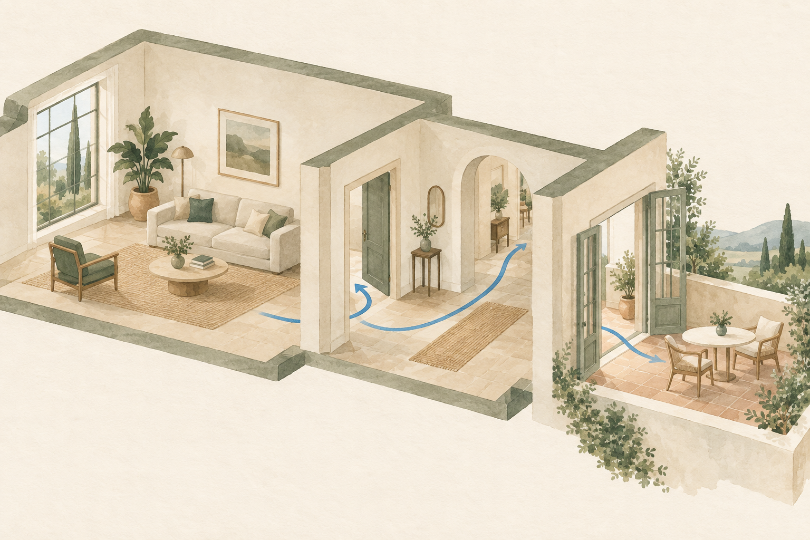
Consider an imaginary hillside house with a living room upstairs and a garden terrace reached through a lower hall. Cutting from the living room’s open doors directly to the terrace may suggest that both spaces share a level. Neither shot has to be altered for the sequence to create a misleading impression. The missing stairs do the work.
Decide which promise the sequence makes before writing narration. A mood-led opening can move freely, then hand over to an orientation section. A tour should establish its route early. This distinction also gives the editor permission to keep an attractive detail without pretending it explains the layout: place it within a room that the viewer already recognizes.
For a team developing both versions, Laper’s AI Screenwriting Software provides a place to organize script scenes and their associated locations. Its scene structure follows screenplay headings. The team still has to supply the real route through the property; a named location in a script is not evidence that two rooms connect.
A plain route note can be more useful than a paragraph of luxurious adjectives. In the imaginary house, it might read: entrance hall, stairs, living room, return to stairs, lower hall, terrace. That unglamorous return trip reveals the exact transition the film must handle. It need not appear at full walking length, but it cannot disappear without explanation.
Before the styled shoot, walk that route with an ordinary phone recording. Keep doors and turns in frame, including the awkward return to the stairs. Compare the recording with the route note while someone familiar with the property is available to answer questions. If the intended terrace door is locked or the route crosses a room that cannot be filmed, resolve that gap before scheduling the camera movement around it.
The Threshold Shot Carries More Than The Door
A doorway offers two pieces of information at once: the space being left and the space being entered. Hold a frame long enough to register both. A glimpse of the living room behind the camera’s movement can orient the next corridor better than another isolated wide shot. This is a filming choice, not an argument for recording every step.
In the hillside example, the transition could show the stair opening, a short descent and the lower hall’s terrace doors. Alternatively, a clearly separated exterior view could begin a new sequence, with narration explaining the change of level. What would be unhelpful is a seamless-looking movement that quietly substitutes a different doorway halfway through.
The transition belongs in the shooting script as an action: “The camera returns to the stair, descends to the lower hall, then faces the garden doors.” That sentence specifies a route the crew can check. A phrase such as “flows effortlessly outdoors” can wait until the footage demonstrates which indoor space actually opens to the garden.
Doors are not the only useful landmarks. A distinctive stair rail or a window at the end of a passage can recur in adjacent shots. Choose a feature that is genuinely present in both views. Repeating a vase that has been moved for styling would create a false landmark, particularly if several rooms otherwise look alike.
The relationship between rooms deserves equal attention. A terrace accessible from a bedroom tells a different story from one reached through a shared hall. Show the relevant entrance rather than relying on a label such as “private outdoor space.” The film should help a viewer understand that relationship before the visit, without making assumptions about how every household would use it.
Write The Route Before Polishing The Description
Once the route is clear, shorten the narration around it. The camera can carry visible finishes; the voice can explain a connection that would otherwise be missed. In this example, “From the lower hall, these doors lead onto the garden terrace” earns its place. It identifies a starting point and destination instead of repeating what the sunlight already shows.
A request to an AI Movie Script Writer can stay that specific: shorten the terrace introduction while preserving the lower-hall entrance and change of level. Ask for alternatives to that passage, not a new description of the whole house. Compare every proposed line against the actual route before choosing the one that sounds most natural aloud.
Laper also supports ordered shots within a screenplay scene, including descriptions of camera intent. That can help keep the stair transition beside the passage it explains. Any generated reference frame remains an illustration for discussion. It should never be used to settle the position of a door, the width of a corridor or the view through a real window.
It is worth leaving room for a pause after the transition. A rapid stair shot followed immediately by a moving terrace shot may technically include the connection without letting anyone grasp it. The rough cut needs enough time for the destination to register. Trim repeated countertop details before removing the only moment that explains where the terrace sits.
Review The Journey Without Filling In The Gaps
The person who walked the property all morning is a poor stand-in for a first-time viewer. Ask someone unfamiliar with it to describe the route after watching the rough cut. Where would they turn to reach the terrace? Which room appears to be above the garden? Their answers reveal the geography the edit actually communicates, rather than the geography the crew remembers.
When an answer is wrong, locate the cut that encouraged it. A brief establishing view may solve the problem; more narration may only make the same ambiguous sequence busier. In Laper, revise the affected passage and shot notes together so the next edit is working from the same correction. Then watch again without explaining the missing connection beforehand.
If the connecting shot was never recorded, either arrange a pickup or make the break explicit. End the upstairs sequence, establish the lower level and name it in the narration. A clear change of location is preferable to a continuous-looking journey assembled from footage that cannot support it.
A property film does not need to become a measured survey or replace a floor plan. It does need to be honest about the journey it appears to show. Keep the lovely terrace shot. Give the viewer the stairs that lead to it.