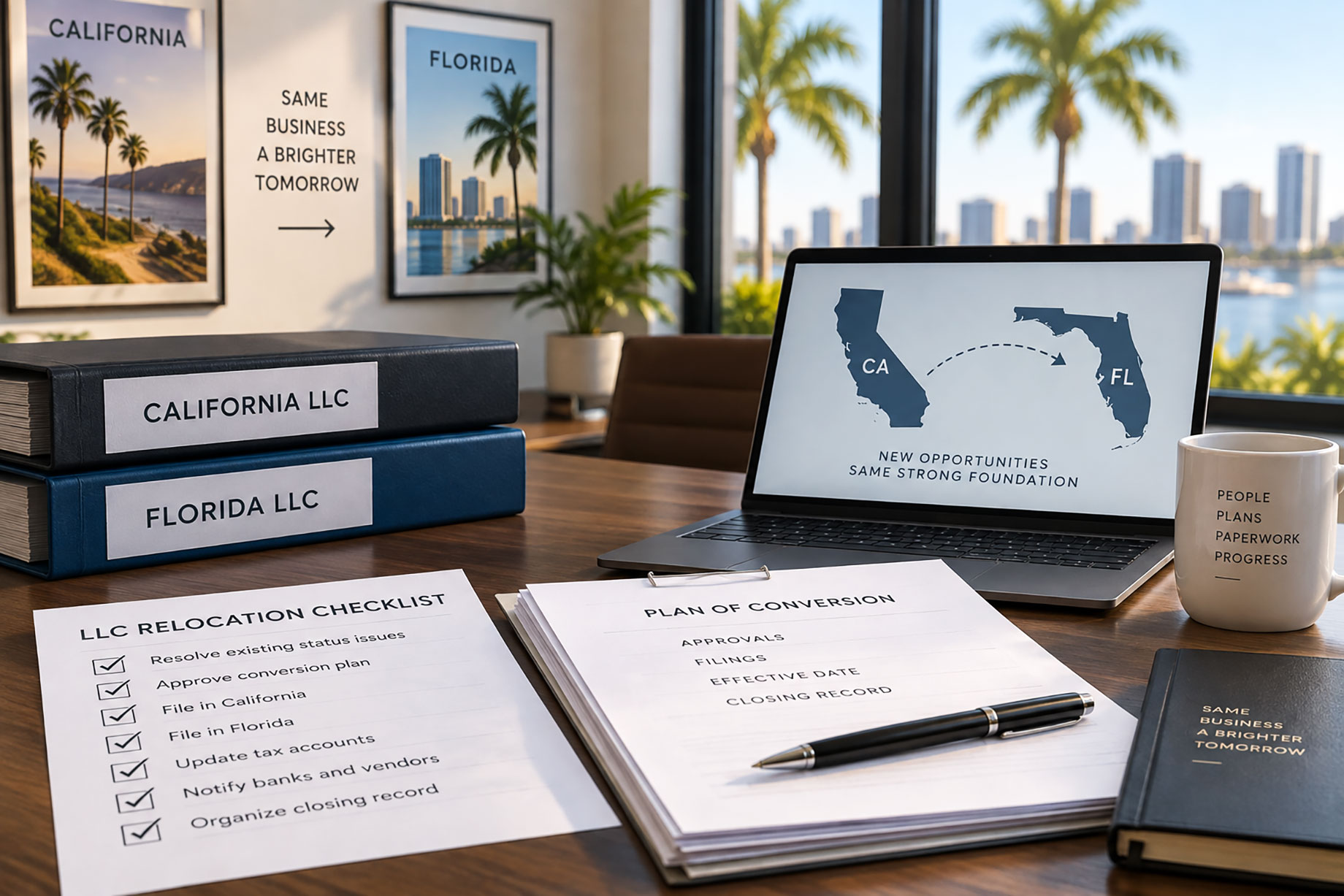
A Florida filing can look like the finish line for a California LLC’s relocation. For the person responsible for the company’s records, it is one event in a transaction that spans two jurisdictions. The approvals, filings, and account instructions must describe the same result. A confirmation email from one agency does not establish that the entire sequence is complete.
This is where an interstate move can fail without a dramatic legal dispute. A bookkeeper sees a Florida document and closes a California account. A manager uses a proposed date as though it were the effective date. An owner assumes a prior suspension disappeared with the address change. Each shortcut creates a gap between the transaction and the record that must support it.
Clear Existing Status Problems Before Scheduling the Move
A company should confirm its California status before committing to a closing calendar. The Franchise Tax Board explains that a suspended business loses its rights, powers, and privileges to do business in California. Its revival process requires delinquent returns, payment of outstanding balances, and a revivor request. Cal. Franchise Tax Bd., My Business Is Suspended.
Suspension by the Secretary of State and suspension by the Franchise Tax Board are separate matters that can coexist. The correction plan should identify the cause and evidence that the required cure has occurred. A company should not treat payment of one notice as proof that every status issue has been resolved.
Owners examining moving an LLC from California to Florida should disclose old notices and missing filings at intake. Those documents may affect the transaction’s readiness. Concealing an unresolved problem from the closing team does not remove it; it places the issue at the point when another person has begun relying on the proposed schedule.
Make the Ownership Record Match the Conversion Plan
California requires a plan of conversion stating the transaction’s terms and the treatment of membership interests, together with the converted entity’s governing documents. The statute also specifies approval requirements. Cal. Corp. Code § 17710.03. The working file should connect that plan to the current operating agreement and the actual owners, not an outdated membership list.
For a California LLC converting into a foreign LLC, the statute requires each member’s percentage interest in profits and capital to remain equal to that member’s pre-conversion percentage. Cal. Corp. Code § 17710.02(a)(1). A proposed ownership adjustment should therefore be identified as a separate issue, not hidden in replacement documents described as routine Florida paperwork.
Consider an LLC whose spreadsheet shows two equal owners, while a signed amendment gives one member a different capital interest. The team should resolve that discrepancy before preparing the approval package. Filing a document does not make the spreadsheet the governing record, and an apparent administrative inconsistency may represent a substantive ownership right.
Distinguish Approval, Submission, and Effectiveness
An approved plan, a submitted filing, and an effective conversion are different events. California provides that an LLC conversion into a foreign LLC becomes effective in accordance with the destination jurisdiction’s law. Cal. Corp. Code § 17710.05(a). Florida’s incoming conversion provisions require the appropriate articles and supporting organizational document. Fla. Stat. § 605.1045 (2026).
The closing instructions should identify which event controls the change and which evidence confirms it. A desired effective date should not be circulated to banks or customers as a completed fact before the responsible person verifies the legal result. The company should know what to do if an agency rejects a document or requests a correction.
Chad D. Cummings of Cummings & Cummings Law emphasizes continuity as the purpose of redomestication. That objective requires consistent implementation: a bank, payroll service, and contract administrator should not receive three different descriptions of when the company became a Florida LLC.
Complete the California Filing Without Ordering a Liquidation
California requires an outbound certificate of conversion for an LLC becoming a foreign LLC. The statute gives that filing the effect of a certificate of cancellation and does not require the converting LLC to undertake the dissolution procedures in Article 7 because of the conversion. Cal. Corp. Code § 17710.06(a)(4), (d). That is not an instruction to liquidate the operating business before moving it.
The distinction should be explicit in communications with the accountant and any filing service. An instruction to close the old company can describe several different acts, some inconsistent with the intended continuity. The closing file should identify the required conversion filing rather than rely on shorthand that invites an unrelated dissolution project.
Tax accounts need their own determination. A company with continuing California activity may retain filing obligations after the state-law conversion. The tax preparer should review those activities and the relevant reporting periods before treating an account or return as final.
Give the Business a Usable Completion File
The final package should contain the approved plan, executed consents, filed documents, and evidence of effectiveness. It should identify unresolved post-closing tasks and who owns them. An indexed electronic folder is more useful than scattered attachments that require a future accountant to reconstruct the transaction.
Account updates should follow that package. Personnel should use the confirmed name, jurisdiction, and tax-identification instructions when dealing with providers. The IRS’s When to Get a New EIN guidance distinguishes qualifying changes from transactions requiring a new identifier; an additional EIN should not be requested because a state issued a different filing number.
A California LLC’s Florida move succeeds when the paperwork supports the business’s continued operation and remains understandable years after closing. The strongest safeguard is a record that separates status cleanup, ownership approval, legal effectiveness, and post-closing administration. That discipline turns an accepted filing into a completed relocation rather than an unresolved collection of forms.
