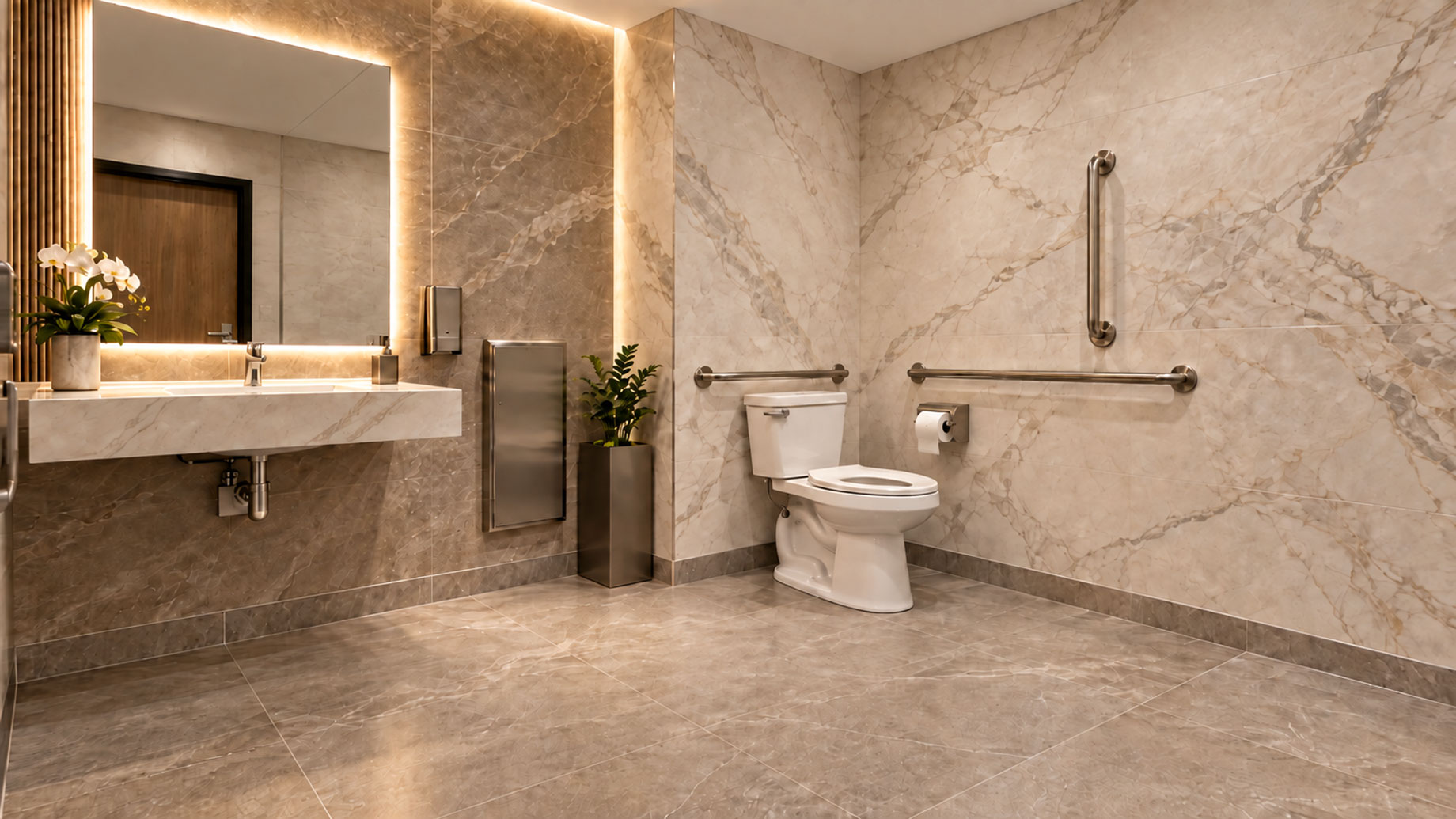
Bathroom surface renovations in commercial properties aren’t just about appearance. ADA requirements shape what’s possible and what’s required. Here’s what building owners need to know.
Commercial bathroom renovations involve a layer of complexity that residential projects don’t: compliance with the Americans with Disabilities Act, which sets specific requirements for accessible design that affect dimensions, hardware, and sometimes the surfaces themselves. Understanding where ADA requirements intersect with surface renovation decisions helps building owners plan projects that achieve their aesthetic goals without creating compliance exposure.
Refinishing is frequently a more attractive option in commercial settings than full replacement because it minimizes the operational disruption that comes with extensive demolition and construction. Many commercial bathrooms serve the public continuously and can’t accommodate prolonged renovation timelines. Getting the right outcome in less time is a real business consideration.
What ADA Requires in Bathroom Spaces
The ADA standards for accessible design specify requirements for turning radius, reach ranges, fixture height, grab bar placement, clear floor space, and more. When a bathroom renovation triggers ADA compliance requirements, the project needs to meet current standards rather than grandfather in older configurations. Surface refinishing that doesn’t alter dimensions, fixtures, or layout typically doesn’t trigger these requirements on its own. Structural changes are more likely to trigger full compliance review. Professional Commercial refinishing in Waco services understand how to work within existing layouts to achieve renovation goals without triggering unnecessary compliance burdens.
The distinction between readily achievable barrier removal and path-of-travel requirements matters for compliance planning. Readily achievable improvements are those that can be accomplished without much difficulty or expense. Alterations that trigger path-of-travel requirements mean the accessible path to the altered space must also be brought into compliance.
Non-Slip Surface Requirements
ADA guidance and general safety standards both address slip resistance in bathroom environments. Wet bathroom surfaces are a significant cause of falls, and the surface finish of floors, shower floors, and other wet areas affects how slip-resistant they are. Refinishing can actually improve slip resistance when appropriate textures or additives are incorporated into the finish.
Coefficient of friction is the technical measure of slip resistance. The ADA recommends a minimum coefficient of 0.6 for flat surfaces. Refinishing products can be applied with varying levels of texture, and anti-slip additives mixed into the finish provide a measurable and consistent slip resistance improvement over smooth surfaces.
Grab Bar Considerations
Grab bars in ADA-compliant restrooms are required at specific locations and must meet mounting requirements that ensure they can support significant force loads. Surface refinishing around existing grab bars requires careful masking and edge treatment to produce clean results at the bar mounting points. Adding grab bars to walls that weren’t designed to accommodate them requires blocking behind the wall surface for adequate support, which is a structural concern separate from surface refinishing.
Commercial building owners planning to add or reposition grab bars as part of a bathroom update should address the structural requirements first and coordinate the surface refinishing timing with the hardware installation. Doing them in the wrong sequence creates work that needs to be redone.
Minimizing Downtime in High-Use Facilities
Commercial facilities serving the public have a real operational interest in minimizing bathroom downtime during renovation. Refinishing is faster than replacement for most surfaces, but the cure time for coatings means the space still can’t be used immediately after work is completed. Scheduling work in low-use periods, doing individual fixtures sequentially rather than all at once, and using coatings with faster cure times where they’re appropriate all help minimize operational impact.
Communicating the schedule clearly to building occupants and staff, posting signage, and having a clear plan for when the space will be available again all make the disruption more manageable. Unplanned interruptions are more disruptive than planned ones, even when the total downtime is the same.
Durability Requirements in Commercial Settings
Commercial bathroom surfaces take significantly more abuse than residential ones. Higher traffic, more frequent cleaning with commercial cleaning products, and use by more people with varying care levels all mean that durability requirements are more demanding. Refinishing products appropriate for commercial applications are formulated differently than those used in residential settings.
Selecting products with appropriate chemical resistance for the cleaning protocols in the specific facility is important. Some cleaning agents used in commercial settings will degrade standard refinishing coatings over time. Confirming compatibility between the refinishing product and the facility’s cleaning products before committing to an approach avoids problems that show up six months after the work is done.
Documentation and Compliance Records
Commercial building owners benefit from maintaining documentation of renovation work that demonstrates compliance consideration. When changes are made that implicate ADA requirements, having records of the analysis done, the decisions made, and any approvals obtained creates a record that’s useful if questions come up later.
Working with contractors who understand the commercial regulatory environment and can provide documentation of the work performed, including the materials used and the conditions at time of application, gives building owners the records they need for their own compliance files.
Wrapping Up
Surface renovation in commercial bathrooms is a practical tool for refreshing facility appearance without the disruption and expense of full replacement, but it requires more planning than residential work because of compliance considerations, durability requirements, and operational constraints. Getting this right involves choosing the right products for the specific environment, understanding where ADA compliance intersects with the planned work, and coordinating the project timing to minimize the impact on building operations.
Frequently Asked Questions
How long does commercial refinishing typically take?
A standard commercial bathroom fixture refinishing, such as a bathtub or shower unit in a hotel or apartment complex, typically takes three to five hours for prep and application. Cure time before the fixture can be used again is usually 24 to 48 hours. For facilities with multiple bathrooms or many fixtures, scheduling the work across multiple days to keep some bathrooms available at all times is a common approach.
Is commercial refinishing cost-effective compared to replacement?
Generally yes, by a significant margin. Commercial fixture replacement involves not just the cost of the new fixture but also demolition, disposal, plumbing work, and potential tile or surround repair if the old fixture was built in. Refinishing avoids all of those costs and produces a result that, with appropriate products and application, holds up well under commercial use conditions.
