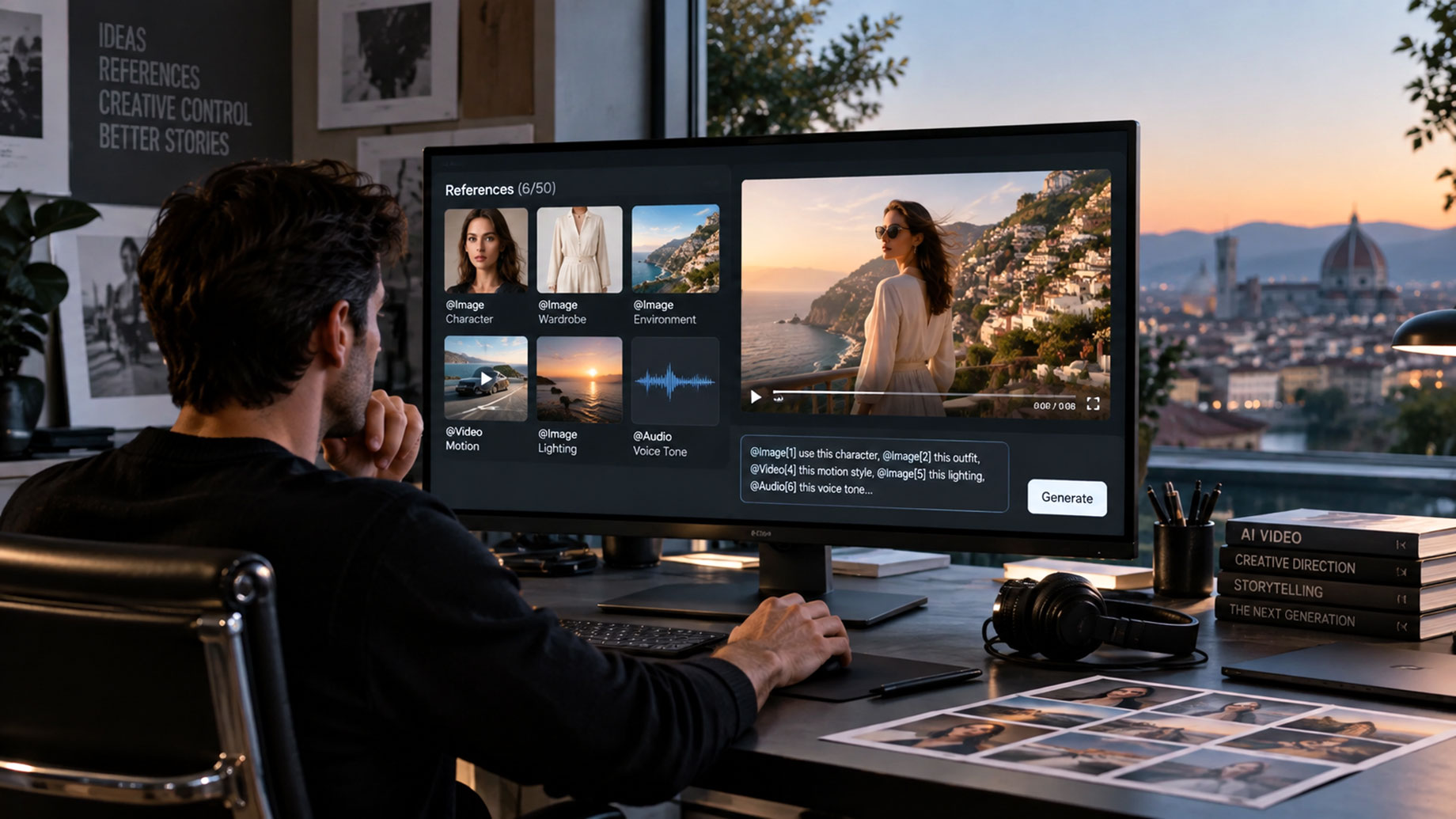
One of Seedance 2.5’s biggest jumps over prior versions is how it handles reference material. Instead of a single image prompt or a rigid character slot, the model accepts a stacked pool of up to 50 references — images, video clips, and audio samples — that can be routed through @Image, @Video, and @Audio tags directly inside the prompt. That’s the difference between “generate a video like this photo” and “use the outfit from clip 2, the lighting from image 7, and the voice tone from audio 3.”
The catch: the model supports 50 references, but most platforms hosting Seedance 2.5 don’t expose the full stack. Some cap it at 3–5. Some accept only images. Some skip the @-tag routing entirely and blend everything as one blurred input. This guide ranks ten platforms specifically on how completely they surface the multimodal reference system.
How We Tested
We evaluated each platform across five reference-focused criteria:
- Maximum reference count — how many assets can be loaded into a single generation
- Supported reference types — image only, image+video, or full image/video/audio
- Tag routing precision — whether @Image, @Video, @Audio tags actually influence the output where placed in the prompt
- Cross-reference coherence — how well the model blends multiple references without visible drift
- Workflow ergonomics — how the platform lets you manage, label, and reorder references
Our test brief used six references: two character images, one wardrobe image, one motion-reference video clip, one lighting-reference image, and one audio track for tonal cueing. Platforms that couldn’t accept the full set were tested at their maximum allowed configuration.
TL;DR: Multimodal Reference Support at a Glance
| Rank | Platform | Max References | Types Supported | @Tag Routing | Best For |
|---|---|---|---|---|---|
| 1 | Seedance Bingo | 50 | Image + Video + Audio | Yes | Full multimodal control |
| 2 | Higgsfield | ~10 | Image + Video | Partial | Cinematic reference stacking |
| 3 | Dreamina | 8 | Image + Video | Partial | Casual multimodal prompting |
| 4 | Topview AI | 6 | Image + Video | Partial | Ad-library reference flows |
| 5 | seevio.ai | 5 | Image + Video | Partial | Batch multimodal pipelines |
| 6 | OpenArt | 5 | Image + Video | Limited | Subscription-based reference work |
| 7 | JXP | 4 | Image + Video | Limited | Per-clip reference projects |
| 8 | seedance2ai | 4 | Image only | No | Simple image references |
| 9 | seadance.io | 3 | Image only | No | Annual light users |
| 10 | SeedGen | 3 | Image only | No | Occasional reference work |
The 10 Platforms
1. Seedance Bingo
Seedance Bingo is the only platform in this list that fully exposes Seedance 2.5’s native 50-reference stack, along with the complete @Image, @Video, @Audio tag routing system. That matters because at 15+ references, the difference between “blend everything” and “route each reference to a specific role in the prompt” becomes the difference between a usable output and mush.
For creators working in niche verticals, the platform also hosts dedicated generation tools like the AI bikini generator, which layers reference handling on top of a purpose-built interface for swimwear, fitness, and lifestyle content.
Capabilities:
- Full 50-slot reference stack per generation
- Image, video, and audio references all accepted
- @Image, @Video, @Audio tag routing directly in prompts
- Standard, Real, and Wild generation modes affect how strictly references are followed
- Prompt adherence tuned ~20% above base model
- Native 4K output, no watermark, private generation
Pricing:
- Subscription tiers plus one-time credit packs
- Ultra tier scales concurrency 1x–5x for heavy reference workflows
- Currently in Seedance 2.5 preview pricing
Strengths:
- No other platform surfaces the full 50-reference ceiling
- Audio references are rare in this space — most hosts skip them entirely
- @-tag routing gives per-reference control instead of blended influence
Trade-offs:
- Preview pricing may shift after full launch
- Managing 50 references takes intentional workflow habits
- Non-Seedance model catalog is narrower than aggregator platforms
Best for: Creators who build complex scenes from many source materials — combining character, wardrobe, environment, motion, and audio references in one shot.
2. Higgsfield
Higgsfield accepts around 10 references per generation and supports both image and video inputs. Tag routing is partial: video references are recognized, but the platform blends references more than it isolates them by role.
Capabilities:
- Up to ~10 references per generation
- Image and video reference types
- Partial @-tag recognition
- Cinematic camera and motion presets that interact with motion references
- 1080p output ceiling
Pricing:
- Credit-based system across all features
- Unified credit pool across the platform’s model catalog
Strengths:
- Motion references pair well with the platform’s camera controls
- Higher reference count than most aggregator platforms
- Good coherence when references are stylistically similar
Trade-offs:
- No audio reference support
- Tag routing is imprecise compared to native Seedance behavior
- Credit-metered cost varies with reference-heavy generations
Best for: Directors using video motion references alongside image style references, particularly for cinematic-look projects.
3. Dreamina
Dreamina supports up to 8 references and allows both image and video inputs. It’s a familiar entry point for casual creators, with daily free credits that make experimenting with multiple references low-cost.
Capabilities:
- Up to 8 references per generation
- Image and video reference types
- Partial tag routing
- Daily free credit refresh
- Selectable Seedance model versions
Pricing:
- Monthly subscription with daily free credits
- Additional credit tiers available
Strengths:
- Free daily credits make reference testing affordable
- Straightforward reference-upload UI
- Reasonable coherence at 5–8 reference counts
Trade-offs:
- No audio reference support
- Tag routing is looser than native model behavior
- 1080p output ceiling
Best for: Casual creators exploring multi-reference prompting without committing to a heavy workflow.
4. Topview AI
Topview AI supports up to 6 references and pairs the reference system with ad-library ingestion — you can pull assets from TikTok Ad Library or a URL directly into your reference stack. That’s uncommon and useful for creators making derivative ad content.
Capabilities:
- Up to 6 references per generation
- Image and video reference types
- Partial tag routing
- URL and ad-library ingestion for reference material
- Multi-model catalog beyond Seedance 2.5
Pricing:
- Tiered plans including an unlimited-generation option
- Multi-model access under one account
Strengths:
- Ingestion tools shorten the reference-gathering step
- Unlimited tier removes cost concerns during reference iteration
- Multi-model fallback when Seedance 2.5 isn’t ideal
Trade-offs:
- Reference count lower than the model can natively handle
- No audio references
- Interface complexity from broader tool set
Best for: Ad creatives building derivative content who want to pull references directly from ad libraries into Seedance 2.5.
5. seevio.ai
seevio.ai supports 5 references per generation with image and video inputs. Its distinguishing feature is that references carry across batch generations — you can run 10 videos with the same reference set in one queue.
Capabilities:
- Up to 5 references per generation
- Image and video reference types
- Batch generation of up to 10 videos sharing references
- Per-second pricing transparency
- 1080p output
Pricing:
- Subscription plus credit packs
- Predictable per-second billing
Strengths:
- Reference reuse across batches saves setup time
- Good fit for episodic content with shared visual identity
- Cost predictability helps when iterating references
Trade-offs:
- 5-reference cap limits scene complexity
- No audio references
- No @-tag routing
Best for: Content teams producing series or episodic pieces where a consistent reference set drives multiple outputs.
6. OpenArt
OpenArt allows 5 references and covers image plus video inputs. Tag routing is limited — the platform treats references as blended influences rather than role-assigned inputs.
Capabilities:
- Up to 5 references per generation
- Image and video reference types
- Limited tag routing
- Broader model catalog beyond Seedance 2.5
- 1080p output
Pricing:
- Subscription-only, no à la carte credit packs
- Tiered by monthly volume
Strengths:
- Predictable monthly cost for reference-heavy workflows
- Broad model access consolidates tools
- Clean upload and management UI
Trade-offs:
- Reference count well below the model ceiling
- No pay-as-you-go for occasional users
- Blended reference influence rather than routed
Best for: Teams on flat monthly plans running moderate reference workflows across multiple models.
7. JXP
JXP supports up to 4 references with image and video inputs. Its per-clip pricing spans a wide range, which lets creators scale reference complexity on a per-project basis rather than committing to a fixed tier.
Capabilities:
- Up to 4 references per generation
- Image and video reference types
- Limited tag routing
- Subscription and one-time purchase paths
- 1080p output
Pricing:
- Per-clip cost varies with configuration
- One-time purchase option available
Strengths:
- Rare one-time-buy pricing for reference-based work
- Flexible spend per project
- No forced subscription
Trade-offs:
- Reference count on the low end
- Wide price range takes planning
- Fewer coherence tools than higher-ranked platforms
Best for: Freelancers running project-based reference work with variable scope.
8. seedance2ai
seedance2ai supports 4 image references but doesn’t accept video or audio inputs. It’s a lightweight option focused on the core Seedance 2.5 experience without deeper multimodal layering.
Capabilities:
- Up to 4 image references
- No video or audio reference support
- No @-tag routing
- Subscription plus credit packs
- 1080p output
Pricing:
- Mid-range per-clip cost
- Credit packs on top of monthly plans
Strengths:
- Clean, focused UI for image-driven prompting
- Flexible pricing structure
- Reliable execution within the image-reference range
Trade-offs:
- No video or audio references
- No tag routing
- Limited to simpler scenes
Best for: Creators whose reference workflow only involves still images and who want a lightweight platform.
9. seadance.io
seadance.io accepts up to 3 image references. It’s aimed at annual subscribers who want front-loaded credit access rather than heavy multimodal tooling.
Capabilities:
- Up to 3 image references
- No video or audio support
- No tag routing
- Annual subscription with immediate full-credit release
- 1080p output
Pricing:
- Annual commitment
- All credits available from day one
Strengths:
- Front-loaded credit release for sprint-based work
- Annual rate lowers effective per-clip cost
- Straightforward reference workflow
Trade-offs:
- Reference count is minimal
- No video or audio references
- Annual commitment isn’t for casual users
Best for: Annual subscribers running light image-reference workloads.
10. SeedGen
SeedGen (seedance2ai.net) supports up to 3 image references and skips subscription pricing entirely — every credit is a one-time purchase with no expiration. For reference-based work that spans months of intermittent use, that structure prevents credit waste.
Capabilities:
- Up to 3 image references
- No video or audio support
- No tag routing
- Pay-as-you-go credits, non-expiring
- 1080p output
Pricing:
- One-time credit purchases only
- No monthly commitment
Strengths:
- Non-expiring credits suit intermittent projects
- No subscription burn during quiet periods
- Simple purchase decisions
Trade-offs:
- Minimal reference support
- No advanced multimodal features
- Fewer team collaboration tools
Best for: Solo creators running occasional reference-based generations with unpredictable timing.
Key Takeaways
- Only one platform surfaces the full 50-reference ceiling. Most cap between 3 and 10, which fundamentally limits how much source material a single generation can pull from.
- Audio references are rare. Nearly every platform in this list skips audio inputs entirely, even though the underlying model accepts them.
- @-tag routing is the biggest quality differentiator. Platforms that blend references without role assignment produce noticeably less predictable outputs at higher reference counts.
- Reference count doesn’t scale linearly with quality. Five well-routed references often beat ten blended ones; the platform’s handling matters as much as the raw cap.
- Batch and ingestion features change reference economics. seevio.ai’s shared-batch references and Topview AI’s ad-library ingestion reduce per-generation setup cost.
Conclusion
Seedance 2.5’s reference system is one of the most capable in the AI video space, but platform decisions determine whether creators actually see that capability. Most hosts expose a fraction of the 50-slot ceiling and skip audio inputs, leaving multimodal prompting closer to how earlier models worked.
For casual multi-reference prompting, Dreamina’s 8-slot stack with free daily credits is a low-cost entry point. For motion-reference-driven cinematic work, Higgsfield’s larger stack pairs well with its camera controls. For ad-derived content, Topview AI’s ingestion tools remove a step from the reference workflow. For teams running batched pipelines, seevio.ai reuses references across multi-clip queues. And for creators who need the full 50-reference stack with image, video, and audio routing through native @-tags, Seedance Bingo remains the only complete expression of the model’s multimodal design.
