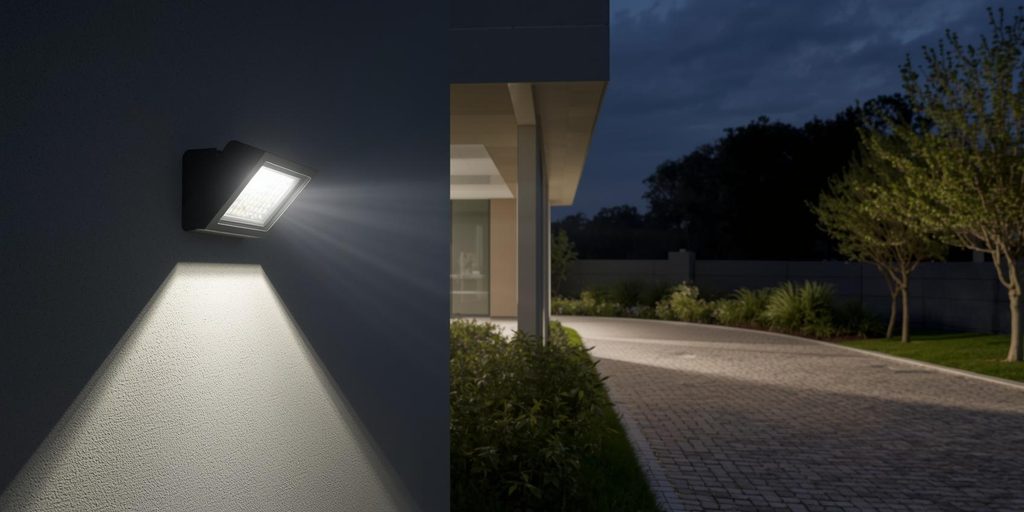
Lighting decisions for commercial properties don’t happen in a vacuum. There are budget conversations, maintenance schedules, utility rebate paperwork, and at least one person on the team who still thinks the old fixtures “work just fine.” If you’re the one tasked with actually improving the situation, this guide is written for you.
Why Commercial Properties Need to Think Differently
Residential LED flood lights and commercial-grade outdoor LED flood lights are not the same product category. A homeowner swapping out a fixture on their garage has different needs than a property manager overseeing a distribution warehouse, a retail strip center, or a municipal parking lot.
At the commercial level, you’re thinking about fixture hours (these lights may run 10–12 hours every night), weather resilience, lumen maintenance over time, and — critically — whether the product qualifies for utility rebates through programs like DLC. Commercial environments also tend to have more demanding photometric requirements. Hot spots and dark zones in a commercial parking lot create liability concerns. Coverage calculations need to account for mounting height, beam angle, and the spacing between fixtures.
Understanding Wattage and Output
Wattage is consumption. Lumens are output. A 100W LED flood light from a quality manufacturer will consistently outperform a 250W metal halide fixture that’s past its prime — while costing dramatically less to run. For general commercial outdoor applications: 50–100W covers walkways, building facades, and smaller parking areas. 150–200W handles mid-sized parking lots, loading docks, and perimeter lighting. 300W+ is for sports lighting, large open areas, industrial yards. Green Light Depot carries options across this entire range, including their FL5 series at 300W and 45,000 lumens — a serious fixture for serious coverage requirements.
Mounting Matters More Than People Realize
Outdoor LED flood lights come in several mounting styles: yoke mount (trunnion) for flexible horizontal or vertical positioning; slip fitter for pole-top installations; and knuckle/adjustable mounts for fine-tuning the angle post-installation. Before ordering, confirm what mounting hardware is already in place — or plan your mounting solution alongside the fixture selection.
Don’t Skip the IP Rating
For any outdoor flood light in a commercial setting, IP65 is the minimum. This means the fixture is fully dust-tight and protected against water jets from any direction. For coastal environments, areas with heavy snow and ice, or industrial settings with spray equipment, IP66 or higher is worth the investment. A fixture that fails in year two because moisture worked into the housing isn’t a bargain at any price.
Photocells, Controls, and Rebates
Most commercial outdoor LED flood lights pair naturally with dusk-to-dawn photocells, motion sensors, or dimming controls. Green Light Depot sells photocell accessories separately, giving you flexibility to configure your system rather than being locked into a bundled option. On the rebate side — many utility companies offer significant cash rebates for replacing commercial fixtures with DLC-listed LED alternatives. It’s not unusual to recover 20–40% of fixture costs through these programs. Green Light Depot’s DLC-listed products are eligible, which is worth factoring into your total cost calculation before purchasing.
Once your outdoor lighting plan is locked in, it’s worth thinking about the full property — if your site also includes an indoor growing or greenhouse operation, lighting decisions there follow a different set of rules entirely. Our Ultimate Guide to the Best LED Grow Lights for Indoor Gardening in 2026 walks through what matters for that side of the property.