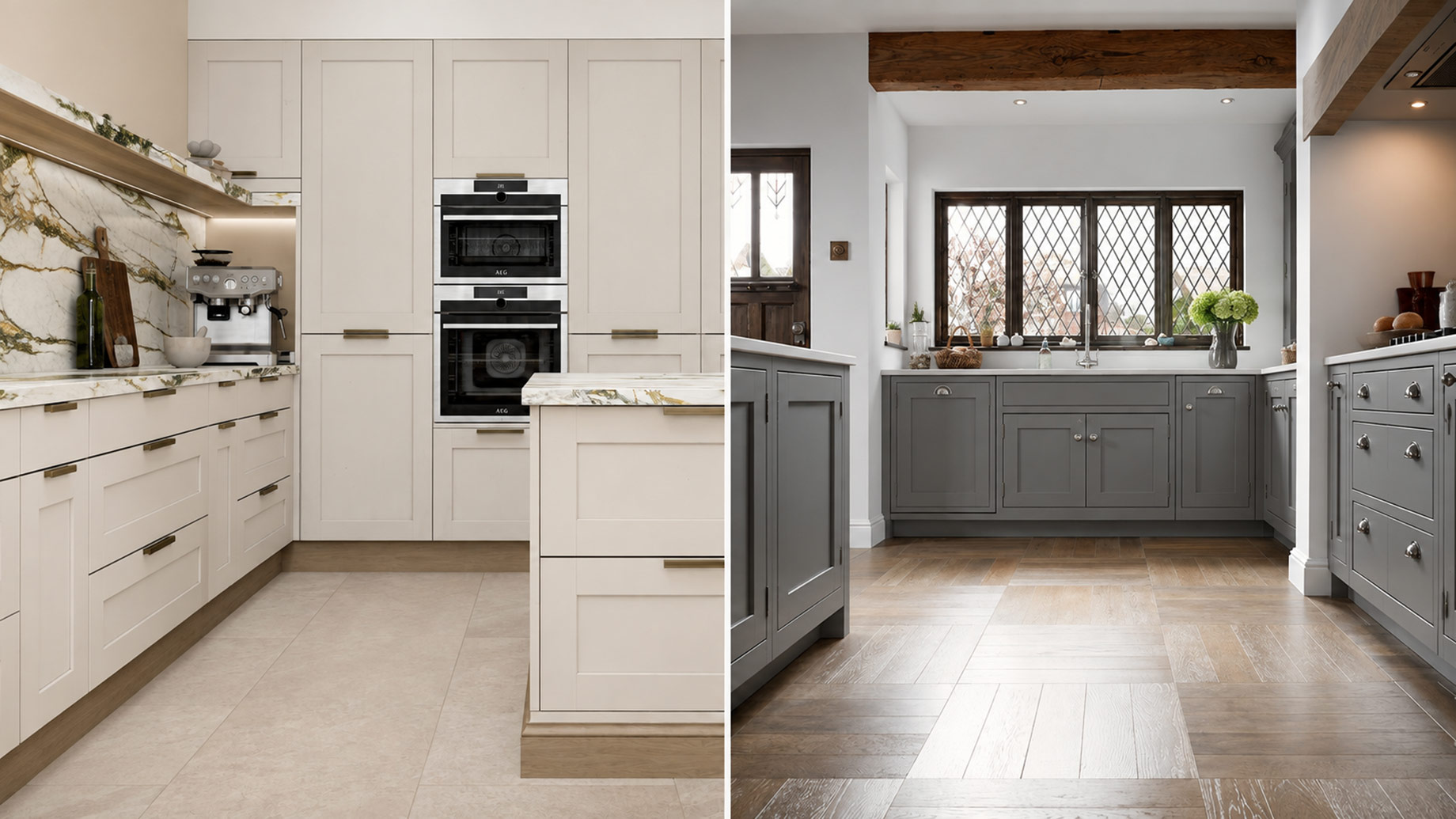
A luxurious kitchen is not defined by the price of its stone, the number of appliances, or the prominence of a designer name. Those elements can make a room expensive, but they do not automatically make it refined. True luxury is read through proportion, material integrity, construction quality, and the degree to which the kitchen belongs to the architecture around it.
No single cabinet style can therefore claim to be the most luxurious. A restrained shaker scheme may be perfect for a Georgian townhouse, while a precisely detailed slab kitchen may be the stronger choice for a glass-walled contemporary residence. The question is not which style costs the most, but which makes the property feel more complete.
Shaker: Quiet Confidence That Ages Well
Shaker kitchens remain compelling because they do not depend on ornament for their character. The familiar recessed-panel door creates depth and rhythm without overwhelming a room, allowing the quality of the materials and the discipline of the layout to take precedence.
Shaker ideas of well-proportioned cabinetry can move comfortably between traditional and contemporary settings. Broad rails, painted finishes, and classic knobs suit country houses and period properties. Narrower profiles, muted colours, and streamlined pulls can look equally convincing in an urban apartment or a newly built home.
This versatility gives shaker design considerable long-term appeal. It can accommodate changes in wall colour, hardware, countertops, or lighting without forcing the entire room to be reconsidered. It also tends to age more gracefully than highly decorative cabinetry tied to a particular fashion cycle.
The difference between understated and ordinary lies in execution. Door and drawer proportions should relate to one another. End panels should feel intentional. Tall units should align with architectural features rather than appear to have been inserted wherever space permitted. In a luxury kitchen, simplicity exposes mistakes; it does not conceal them.
In-Frame: Craftsmanship as an Architectural Signal
In-frame construction has long been associated with bespoke cabinetry because the doors and drawers sit within a visible face frame. The resulting lines create a composed, furniture-like quality, with every opening clearly defined.
Well-made in frame kitchens communicate quality through consistent reveals, aligned rails, accurately fitted doors, and carefully considered hinges. These details show that the room has been designed as a complete system rather than assembled from a collection of units.
This style is particularly persuasive in architecture with traditional weight: country estates, Georgian and Victorian houses, classically detailed townhouses, and new residences with substantial mouldings and millwork. The cabinetry can hold its own beside deep window casings, panelled walls, stone fireplaces, and other permanent architectural elements.
Yet in-frame does not have to mean ornate. Clean rails, restrained hardware, and minimal cornice detailing can create a transitional look that feels current without losing its sense of craftsmanship.
Its success depends on precision. Uneven gaps or poorly aligned drawers are immediately visible because the frame acts as a reference line. Appliance integration and internal storage also require early planning, as the face frame can affect clear openings and pull-out placement. The style reads as luxurious only when the construction justifies the visual promise.
Handleless and Slab: Luxury Through Restraint
At the opposite end of the visual spectrum, slab and handleless kitchens express luxury through reduction. Their flat planes, uninterrupted runs, and limited hardware place extraordinary emphasis on geometry. There is nowhere for an awkward junction or inconsistent reveal to hide.
This approach is especially effective in modern villas, minimalist apartments, converted industrial spaces, and homes where the kitchen forms part of a larger open-plan interior. Slab fronts can allow cabinetry to read almost like wall panelling, particularly when appliances are integrated and tall units continue to the ceiling.
Material selection becomes central. Natural veneer can bring warmth and movement to a restrained composition, while lacquer offers a crisp architectural finish. Textured laminates and composite surfaces can also look sophisticated when their colour, edge treatment, and scale are carefully coordinated.
The common mistake is to assume that minimalism is automatically luxurious. Premium results depend on exact shadow gaps, consistent grain direction, flush appliance panels, disciplined lighting, and a limited palette. When those details are resolved, the room feels calm and intentional. When they are not, it can feel merely blank.
Planning is the Foundation of Every Luxury Kitchen
Cabinet style is visible, but planning determines how the room performs. A beautiful kitchen loses its authority when appliance doors collide, circulation routes cross the main work area, or storage is disconnected from the activities it should support.
The NKBA Kitchen & Bath Planning Guidelines address passageways, activity centres, seating, equipment placement, cabinetry, functional storage, lighting, electrical planning, systems coordination, accessibility, and code compliance. These fundamentals should be resolved before finishes and decorative details dominate the conversation.
The plan should reflect how the household actually lives. A family kitchen may need several people to move through the room at once. An entertainer’s kitchen may require a secondary preparation area or discreet service zone. A compact city residence may gain more from carefully designed internal storage than from an oversized island.
Lighting should be layered rather than treated as a final accessory. Ventilation should suit the cooking equipment and volume of the room. Outlets, charging locations, waste systems, pantry storage, and small appliances should be incorporated without disturbing the cabinetry’s visual order.
The Most Luxurious Style Is the One That Belongs
Shaker, in-frame, handleless, and slab kitchens can all represent genuine luxury. They can also all be poorly conceived. The deciding factors are architectural fit, material quality, proportion, construction, installation, and usability.
A period home may preserve more of its architectural integrity through cabinetry that respects its craftsmanship and scale. A contemporary property may be strengthened by a quieter kitchen that continues the lines of the architecture. In either case, the room should feel inevitable—as though no other solution would have suited the house quite as well.
That is the distinction between a kitchen that is merely expensive and one that defines true luxury. The former displays its cost. The latter demonstrates judgement.
