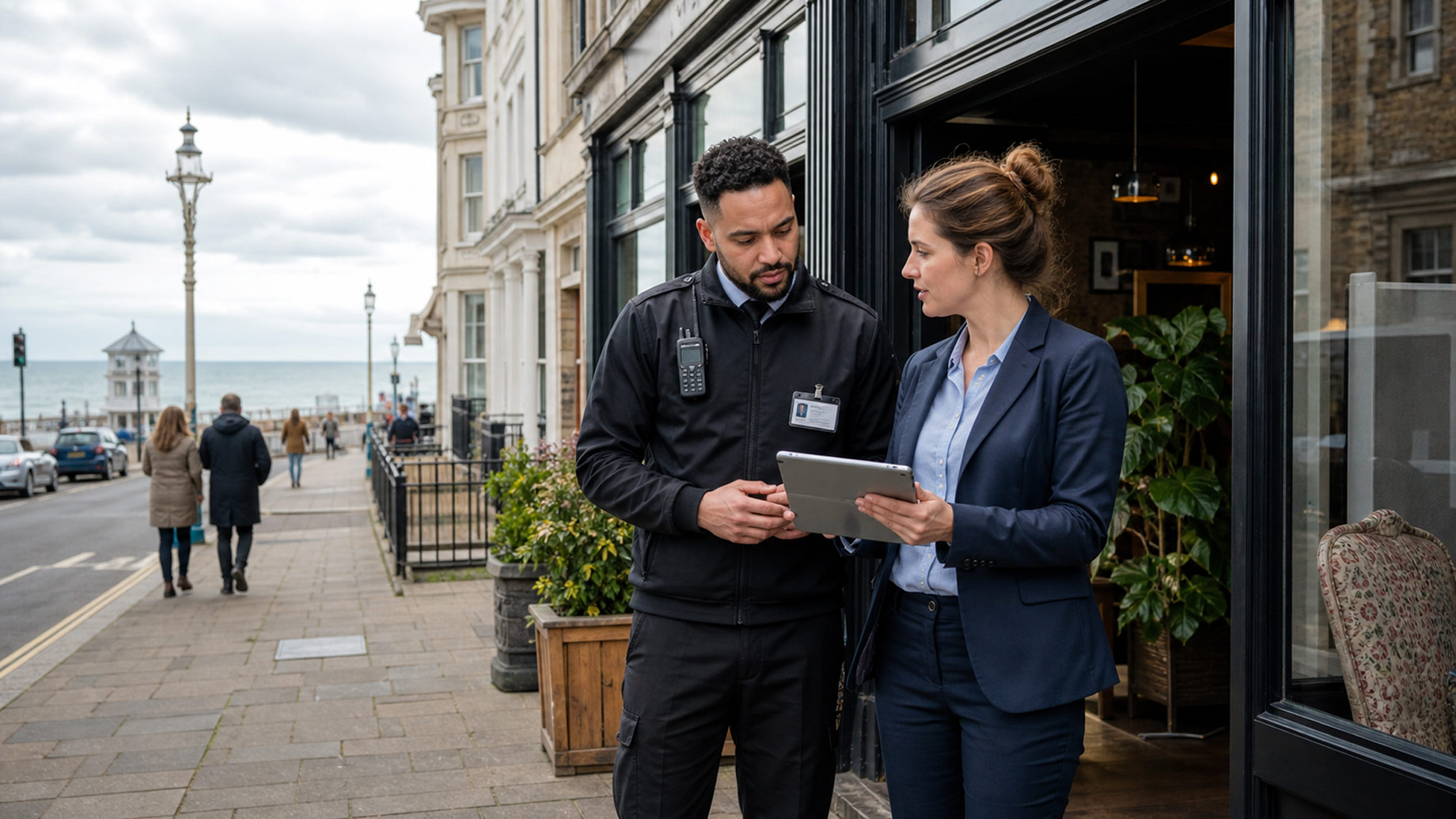
Brighton thrives on foot traffic. The Lanes attract shoppers every weekend, the seafront becomes lively as soon as the sun rises, and West Street’s nightlife continues late into the night. This vibrant mix offers both opportunities and challenges, leading many local businesses to wonder: who ensures safety when the crowds gather?
What Manned Guarding Covers in Brighton
Manned guarding means placing trained, SIA-licensed officers on site to monitor premises, control access, and respond to incidents in real time. It differs from remote CCTV monitoring because a guard can intervene immediately rather than flag an issue after the fact. In Brighton specifically, that immediacy matters. A retail unit near Churchill Square has a different rhythm of foot traffic than a warehouse on the outskirts near Hollingbury, and manned guarding Brighton operations tend to be shaped around whichever environment a client sits in. Officers working the seafront during peak summer months handle crowd flow and antisocial behaviour. Officers on a construction site off the A23 are watching for theft of plant equipment overnight. Same core service, different daily reality.
Brighton’s Unique Security Risks
Brighton carries risks that a generic coastal town doesn’t share, largely because of its density and its calendar. The city hosts several major events across the year, including the Brighton Festival, Pride, and a steady stream of conferences at the Brighton Centre, and each of those draws crowds far beyond the resident population. Licensed premises along the seafront and in the North Laine deal with late-night disorder on a near-weekly basis during summer. Retail theft climbs in the lead-up to Christmas, particularly around The Lanes, where narrow streets make it harder to spot shoplifters moving between shops. Student housing around Moulsecoomb and Falmer adds another layer, since void periods between tenancies leave properties exposed to squatting and vandalism if nobody’s checking on them.
None of that means every business needs the same solution. A boutique on East Street might only need a static guard on Saturday afternoons. A student accommodation block might need weekly patrol visits between tenancy periods. Matching the guarding pattern to the actual risk profile, rather than buying a generic package, is where most of the value sits.
What to Check Before Hiring a Security Guarding Provider
Confirm three things before signing anything: SIA licensing status, local response capability, and insurance cover. Every guard deployed in the UK has to hold a valid SIA licence for the specific sector they’re working in, whether that’s door supervision, close protection, or general security guarding, and a reputable security company Brighton businesses can trust will show you those licences without being asked twice. Response capability matters just as much. A firm running officers already based around Brighton and Hove can be on site within minutes of an alarm trigger, while a provider dispatching from Croydon or further out is working against the clock before they’ve even left the yard.
Ask what happens outside normal hours too. A shop that’s fine on weekdays can still get broken into on a bank holiday Monday, if nobody’s covering that gap. Alpha Security Services structures its Brighton coverage around exactly that kind of gap, pairing static guards with mobile patrol backup so a single officer isn’t left isolated during a quiet 3 am shift on the seafront.
SIA Licensing and Compliance
SIA licensing is not optional, and any provider suggesting otherwise should be dropped from consideration immediately. The Security Industry Authority sets the national standard for vetting, training, and conduct, covering areas like conflict management, basic first aid, and legal powers of arrest. A licensed guard has passed background checks and completed accredited training before ever stepping onto a client site. Unlicensed operators do exist, usually undercutting on price, and the risk they carry (unvetted staff, no accountability if something goes wrong, zero recourse if a claim needs making) rarely shows up until it’s too late to matter.
Check the licence category matches the job. A door supervisor’s licence is not interchangeable with a CCTV operator’s licence, and a provider quoting one rate across every service type is usually blurring that distinction rather than respecting it.
Response Times and Local Coverage
Response time depends almost entirely on how close a provider’s officers already are. A Brighton-based team covering Hove, Portslade, and the surrounding coastline can typically reach a triggered alarm inside 10 to 15 minutes. Providers running everything from a London hub add travel time on top of dispatch time, and that gap widens fast during rush hour on the A23 or A27. For a jeweller on East Street, or a nightclub dealing with a fight breaking out at closing time, those extra minutes are the entire difference between a contained incident and a serious one.
Local coverage also means familiarity. Guards who patrol Brighton regularly know which alleyways off the seafront get used for break-ins, which student blocks sit empty over summer, and which retail units back onto poorly lit service roads. That knowledge doesn’t show up on a spec sheet, but it shapes how fast a real threat gets spotted.
Brighton’s mix of tourism, nightlife, and a large student population means the security risks shift by season and even by day of the week. Getting the right provider in place, one that understands those patterns rather than applying a one-size template, is what separates a business that handles an incident calmly from one that’s caught off guard.
