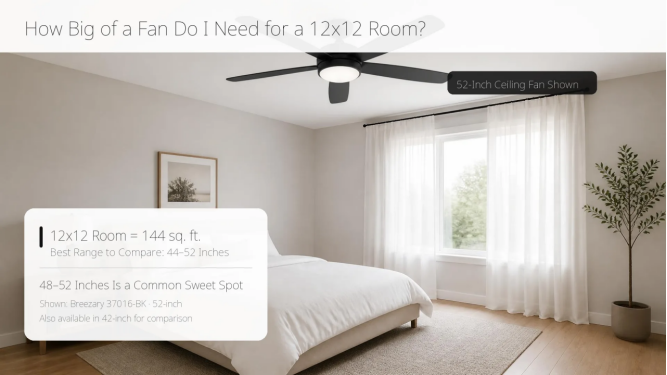
alt=”Breezary 37016-BK ceiling fan in a 12×12 room showing recommended 44 to 52 inch fan size range ”
A 12×12 room is 144 square feet. For most rooms this size, a ceiling fan around 44 to 52 inches is a practical range to compare, with 48 to 52 inches often providing broad room coverage. A slightly smaller 42-inch fan can also work well when the room has a lower ceiling, more furniture, limited blade clearance, or a fan specifically designed for bedrooms and smaller spaces. The best size depends on more than square footage, so also check ceiling height, mounting type, blade clearance, and the fan’s published airflow before buying.
What Size Ceiling Fan Is Best for a 12×12 Room?
A 12×12 room sits in a middle range where several ceiling fan diameters can work. That is why sizing charts often disagree by a few inches. The most useful approach is to compare a range of sizes and then narrow the choice based on the actual fan and the room layout.
| Fan Size | How It Fits a 12×12 Room |
| 42 inches | Good compact option for some bedrooms, lower ceilings, or visually busy rooms |
| 44-48 inches | Strong all-around comparison range for many 144 sq. ft. rooms |
| 50-52 inches | Useful when broader coverage is wanted and there is enough ceiling space |
| 54 inches and larger | Usually worth checking room proportions and blade clearance more carefully |
For 144 square feet, 44 to 52 inches is a useful overall comparison range. A 48-inch fan is an easy middle-ground choice, while 42-inch and 52-inch models can both make sense when their design, airflow, and installation requirements suit the room.
Why Do Ceiling Fan Size Guides Give Different Answers for a 12×12 Room?
Ceiling fan sizing charts simplify a decision that actually involves several variables. One guide may recommend 44 inches, another may extend the range to 50 or 52 inches, and another may classify the same room differently based on whether it is a bedroom, office, or general living space.
Sizing charts use different room categories
Some guides group rooms by square footage, while others use broad labels such as small, medium, bedroom, or standard room. The boundaries between those categories are not universal, so a 144-square-foot room can land in slightly different size bands.
Blade span does not tell the full airflow story
A 52-inch fan is not automatically better than a 48-inch fan. Actual airflow also depends on the motor, blade geometry, pitch, speed settings, and complete fan design. When airflow data is published, CFM gives you a more direct performance comparison than diameter alone.
Furniture and usable space matter
A 12×12 bedroom with a large bed, wardrobe, tall storage, or a beam can feel very different from an open 12×12 home office. The ceiling footprint and visual weight of the fan matter as well as the total floor area.
Is a 52-Inch Ceiling Fan Too Big for a 12×12 Room?
Not necessarily. A 52-inch ceiling fan is at the larger end of the range for a 12×12 room, but it can still work when the fan is mounted centrally, there is adequate clearance, the ceiling height is appropriate, and the selected model has comfortable speed control for the room.
The better question is whether the specific 52-inch fan fits the room physically and performs well at the speeds you are likely to use. If the room has a low ceiling, heavy furniture, an off-center electrical box, or a visually crowded ceiling, a 42- to 48-inch fan may feel more balanced.
42, 48 or 52 Inches: Which Is Better for a 12×12 Room?
| Size | Best When | Main Tradeoff |
| 42 inch | Compact bedroom, more furniture, lower ceiling, or lighter visual footprint | Less blade span, so check airflow |
| 48 inch | Balanced middle-ground choice for many 12×12 rooms | Still verify CFM and mounting |
| 52 inch | Open ceiling layout, enough clearance, and broader coverage wanted | Stronger visual presence |
There is no automatic winner. If all three sizes physically fit, the best choice comes down to the actual airflow, ceiling height, mounting style, controls, lighting needs, and how much visual presence you want from the fan.
A Real 42/52-Inch Example for a 12×12 Bedroom
A useful way to see why one room size can support more than one fan diameter is to look at a model offered in multiple spans.a
alt=”42-inch vs 52-inch ceiling fan comparison for a 12×12 room using Breezary 37016-BK ”
One example is this 42/52-inch ceiling fan for a bedroom from Breezary (model 37016-BK). The same design is offered in 42-inch and 52-inch versions. It uses five plywood blades, an integrated 18W LED light, three color-temperature settings, a quiet DC motor, six speeds, reversible airflow, timer functions, remote control, and a low-profile flush-mount design.
The two sizes illustrate the real decision well. The 42-inch version provides a lighter visual footprint for a compact bedroom, while the 52-inch version offers a wider sweep when the ceiling layout and clearance allow it. The room dimensions are the same, but the preferred size can change with the fan design and the way the room is furnished.
Is a 48-Inch Fan a Good Size for a 12×12 Room?
Yes. A 48-inch ceiling fan is a very reasonable middle-ground size for many 12×12 rooms. It offers more coverage than a compact 42-inch model without creating as much ceiling presence as a 52-inch fan.
A 48-inch fan is especially easy to consider when the room is a simple square, the electrical box is near the center, and the ceiling is not crowded by other fixtures. As always, compare the actual fan’s CFM and installation requirements before making the final choice.
How Much Clearance Does a Ceiling Fan Need in a 12×12 Room?
A 12-foot-wide room gives you plenty of theoretical space around a centrally mounted fan, but real rooms contain more than four empty walls. Wardrobes, bunk beds, beams, cabinets, hanging lights, and architectural projections can all reduce usable clearance.
Measure from the actual fan location, not just from wall to wall. Follow the installation instructions for the selected model and confirm that the blades, housing, and light fixture will remain clear of nearby obstacles throughout the full rotation.
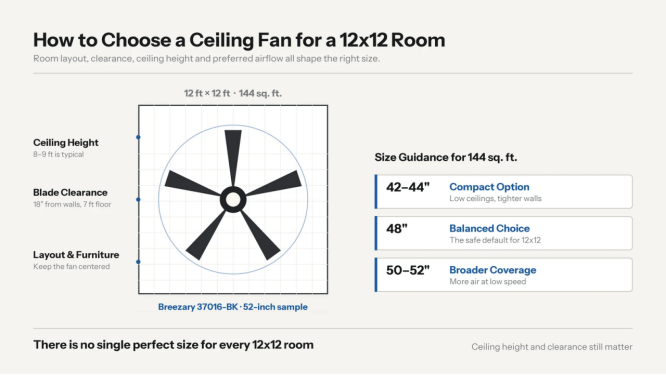
alt=”Breezary 37016-BK ceiling fan diagram showing 12×12 room size, blade clearance, ceiling height, and fan size options ”
Does Ceiling Height Change the Best Fan Size for a 12×12 Room?
Yes, but ceiling height and fan diameter are separate decisions. A higher ceiling gives you more flexibility with mounting depth, while a lower ceiling makes total installed height more important.
Standard 8-foot ceiling
Focus on total installed height and headroom. A flush-mount or low-profile fan can be useful when you want to reduce vertical drop.
9-foot ceiling
A 9-foot ceiling generally gives more flexibility with short downrods or standard mounting, but the fan still needs to be proportionate to the room.
Higher ceilings
A taller room may require a longer downrod to place the fan at an effective height. A higher ceiling does not automatically mean you need a wider blade span.
Flush Mount or Downrod Fan for a 12×12 Room?
Mounting type changes how far the fan hangs from the ceiling. It does not change the room’s 144-square-foot floor area, so it should be treated as an installation decision rather than a substitute for proper fan sizing.
· Flush mount: useful for standard or lower ceilings where reduced vertical drop is important.
· Short downrod: common when the ceiling height allows the fan to sit lower for better air circulation.
· Longer downrod: more relevant to tall or vaulted ceilings and should follow the fan manufacturer’s guidance.
How Much Airflow Does a 12×12 Room Need?
Some room-size guides place a 144-square-foot room in an airflow comparison range of roughly 2,000 to 4,000 CFM, but that should be treated as a reference rather than a universal requirement. The ideal airflow depends on fan size, speed setting, room use, and how directly occupants are exposed to the breeze.
Blade span tells you the physical diameter of the fan. CFM tells you the published volume of air moved. For a 12×12 room, use both numbers together rather than choosing the widest fan you can physically install.
Do Longer Fan Blades Move More Air in a 12×12 Room?
Potentially, but not automatically. A 52-inch fan sweeps a larger circle than a 42-inch fan, yet actual airflow still depends on the motor, blade pitch, blade shape, RPM, and complete design.
More airflow is not always more comfortable in a small or medium room. If the fan is directly over a bed, desk, or seating position, good low-speed control can be just as important as maximum CFM.
Does Blade Count Matter in a 12×12 Room?
Blade count should not determine the fan size. Three-, four-, and five-blade ceiling fans can all work in a 12×12 room when their span, motor, airflow, noise, and controls suit the space.
Do not assume that more blades automatically mean more airflow. Compare the complete fan specifications instead.
What Size Fan for a 10×10, 10×12, 11×11, 12×14 or 13×13 Room?
Nearby room dimensions are useful for understanding how quickly floor area changes. They should not be treated as a rule that requires a new fan diameter every time one wall becomes a foot longer.
| Room | Area |
| 10×10 | 100 sq. ft. |
| 10×12 | 120 sq. ft. |
| 11×11 | 121 sq. ft. |
| 12×12 | 144 sq. ft. |
| 12×14 | 168 sq. ft. |
| 13×13 | 169 sq. ft. |
| 15×15 | 225 sq. ft. |
Think in size bands rather than exact one-inch steps. Once you identify a reasonable diameter range, compare the real products by airflow, installed height, and room fit.
When Should You Move Up to a Large Ceiling Fan?
If the room is substantially larger than 12×12 – such as a large living room, great room, open-concept space, or a room approaching several hundred square feet – the compact and medium-size range discussed here may no longer be the best place to start.
For those spaces, compare large ceiling fans for large rooms by blade span, published airflow, room guidance, ceiling height, and mounting requirements instead of extending a 12×12 sizing rule into a much larger space.
How to Measure a 12×12 Room Before Buying a Ceiling Fan
Use a simple measurement process before choosing the fan:
· Measure the room length.
· Measure the room width.
· Multiply 12 x 12 to confirm 144 square feet.
· Measure the ceiling height at the planned mounting point.
· Check nearby obstacles, furniture, beams, and other fixtures.
· Confirm the selected fan’s full blade span, installed height, CFM, and mounting instructions.
Ceiling fan diameter is measured across the full blade span from one blade tip to the opposite side of the rotating circle. Use the manufacturer’s listed span rather than estimating from blade length alone.
Quick Decision: What Fan Size Should You Buy for a 12×12 Room?
Start around 42 to 44 inches if:
· the room feels compact;
· the ceiling is low;
· furniture occupies a lot of visual space; or
· you prefer a lighter ceiling footprint.
Compare 48 inches if:
· you want a balanced middle ground;
· the room is a simple square;
· the mounting point is central; and
· the selected model has suitable airflow.
Compare 50 to 52 inches if:
· the ceiling layout is open;
· there is enough blade clearance;
· you want broader room-wide circulation; and
· the selected fan’s performance and controls fit the room.
Final Answer: How Big of a Fan Do You Need for a 12×12 Room?
For a 12×12 room, which equals 144 square feet, roughly 44 to 52 inches is a useful ceiling fan size range to compare. Around 48 inches is a balanced middle-ground choice, while a 52-inch fan can work when the room has enough ceiling space and the selected model’s airflow is appropriate. A 42-inch model can also be a sensible option for bedrooms with lower ceilings, more furniture, or a preference for a smaller visual footprint.
There is no single universal diameter for every 12×12 room. The actual fan design and installation matter, so compare the room and documented product specifications first. Breezary offers ceiling fans in multiple blade spans, mounting styles, lighting configurations, and control options for different residential spaces.
Frequently Asked Questions
How big of a fan do I need for a 12×12 room?
A 12×12 room is 144 square feet. For many rooms this size, roughly 44 to 52 inches is a useful range to compare, with 48 inches offering a balanced middle ground.
Is a 52-inch ceiling fan too big for a 12×12 room?
Not necessarily. A 52-inch fan is at the larger end for a 12×12 room, but it can work when there is enough blade clearance, appropriate ceiling height, and suitable airflow control.
Is a 48-inch ceiling fan good for a 12×12 room?
Yes. A 48-inch fan is a practical middle-ground size for many 12×12 rooms because it provides useful coverage without the stronger visual presence of a 52-inch model.
Do I need a 42-inch or 52-inch ceiling fan?
Choose 42 inches when you want a more compact visual footprint or have lower ceilings and more furniture. Compare 52 inches when the ceiling is open, the mounting point is central, and you want broader coverage.
What size fan should I get for a 10×12 room?
A 10×12 room is 120 square feet, so it is usually worth comparing compact to medium residential fan sizes rather than automatically using the same diameter as a larger room.
What size fan should I use for a 12×14 room?
A 12×14 room is 168 square feet. It sits slightly above a 12×12 room, so compare the selected model’s airflow and room guidance rather than changing size based only on the extra 24 square feet.
How much CFM does a 12×12 room need?
Some guides use roughly 2,000 to 4,000 CFM as a comparison range for a room around 144 square feet, but airflow should be evaluated together with fan size, speed settings, room use, and manufacturer guidance.
Does ceiling height affect fan size?
Ceiling height affects mounting and installed height more directly than blade diameter. A low ceiling may favor a flush-mount design, while a high ceiling may require a downrod, but neither condition automatically determines blade span.
What happens if a ceiling fan is too big for a room?
An oversized fan can dominate the ceiling visually, reduce clearance around walls or fixtures, and create more airflow than occupants want at common seating or sleeping positions.