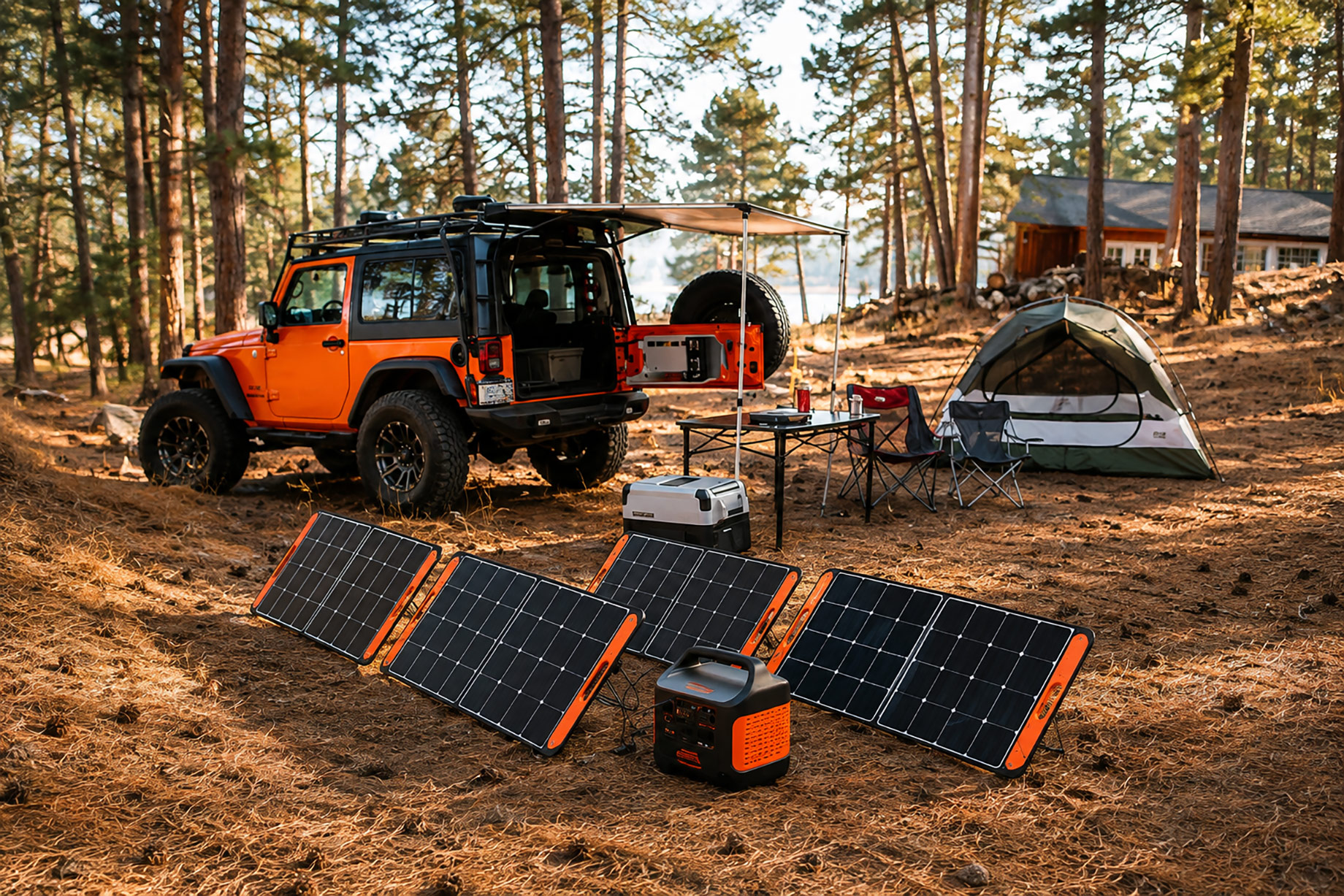
There is a particular disappointment in rolling into camp and finding the fridge warm. It usually means the solar was sized on optimism rather than arithmetic.
Choosing panels is not complicated in the right order. Work out what you draw, add a margin for reality, then pick hardware that matches the number.
Key Takeaways
- Size your panel from your daily amp-hour draw, not from what happens to fit on the roof.
- Add 30 to 50% to your calculated figure to cover real-world charging losses.
- Blankets pack down small while rigid panels produce more and last longer.
- The regulator must be set to your battery chemistry or the battery will suffer.
- Expect 10 to 15% less output on a 40°C day, since panels are rated at 25°C.
- Solar and alternator charging work together, provided a DC-DC charger is fitted.
Start With What You Draw, Not What You Buy
Almost every undersized setup begins at the wrong end. Someone picks a panel that looks about right, plugs it in, and hopes the numbers work out.
The honest approach runs backwards. Add up the amp-hours your gear consumes in a day, then multiply by 1.3 to 1.5 to account for charging inefficiency, cloud cover, and imperfect panel angles.
A Worked Example
A typical 12V camping fridge draws 40 to 50Ah a day, and lights plus phone charging add another 10 to 15Ah on top. That puts a standard setup at roughly 80Ah of daily generation.
A 160W panel covers that figure in decent sun. Weekend trips generally run fine on 120 to 160W, while extended touring or anything running air conditioning needs 250W or more, or several panels working together.
Blankets, Rigid Panels or Flexible?
Solar Blankets
Blankets roll up compactly and use marine-grade materials built for constant setup and packdown. They are the pick for motorbikes, boats, and anywhere storage is tight.
The compromise is output. A blanket produces slightly less than a rigid panel of the same rated wattage, which is what you trade away for portability.
Rigid Folding Panels
Rigid panels sit in aluminium frames with built-in legs, so you can angle them at the sun instead of laying them flat. Angle affects daily generation more than most people expect.
They also survive longer. Better protection around the cells means rigid panels outlast blankets, which matters if the gear lives in the ute year-round.
Flexible Panels
Flexible panels sit between the two, thin enough to mount permanently on a curved caravan or canopy roof. They suit setups where you want solar generating without unpacking anything.
The iTechWorld range covers all three formats. That spans 150W and 200W flexible panels, hard frame options up to 250W, and blankets running from 100W through to 400W.
Matching the Panel to Your Number
Once you have your daily amp-hour figure, you can shop iTechWorld solar panels online and match wattage to that number rather than guessing. Buying based on a calculation is the easiest way to avoid a warm fridge on day three.
Complete kits are worth considering for a first setup. They bundle the panel, regulator, cables and Anderson plugs together, so nothing needs chasing across three different suppliers.
The Regulator Matters as Much as the Panel
A panel wired straight to a battery will damage it, which is what the solar regulator prevents. It sits between the two and controls the charging voltage going in.
Chemistry decides the setting. Lithium wants roughly 14.2 to 14.6V while AGM sits at 14.4 to 14.7V, and gel and flooded lead-acid have their own requirements again.
Selectable Battery Profiles
Most kits ship with regulators offering selectable battery profiles. Switching to the right one takes thirty seconds and protects a component costing far more than the regulator.
Compatibility is rarely an issue beyond that. Standard MC4 connectors mean these panels work with quality regulators from other brands, provided yours handles the combined amperage feeding into it.
Running Solar and Alternator Together
These two charging sources complement each other rather than competing. Solar tops up the batteries while you are parked through the day, and the alternator does the work while you are driving.
The requirement is a proper DC-DC charger between the alternator and your auxiliary battery. With that in place, both systems run side by side happily.
What Australian Heat Does to Output
Panels are rated at 25°C, which is not what a summer afternoon up north delivers. On a 40°C day, expect output around 10 to 15% below the rated figure.
Longer summer days usually make up the shortfall. Winter runs the opposite way, with cold weather improving panel efficiency even as daylight hours shrink.
How Long Panels Actually Last
Quality solar panels typically hold around 80% of their rated output after 20 to 25 years. Degradation runs slowly, at roughly 0.5 to 1% per year.
Rigid panels outlive blankets because the cells are better protected. Both give decades of service provided you keep them clean, store them dry, and avoid physical damage.
Buying Considerations
Outback SafeTrack carries the iTechWorld range with free shipping over $299 and a price match guarantee. Returns run 30 days with no restocking fees, which removes some risk if you are unsure about sizing.
Delivery is quoted at 2 to 10 business days. If it runs longer than that, the company puts a $100 gift voucher behind the delay.
Conclusion
Good camping solar is mostly a maths problem wearing a hardware costume. Count your daily amp-hours, add the real-world margin, then pick the format that suits how you camp rather than what looked good in the photo.
The rest is setup discipline. Match the regulator to your battery, angle the panel properly, fit a DC-DC charger if you are also charging off the alternator, and the fridge stays cold for the whole trip.
Frequently Asked Questions
What size solar panel do I need for a camping fridge?
A 12V fridge draws 40 to 50Ah daily, and lights and charging add 10 to 15Ah. That lands most setups near 80Ah a day, which a 160W panel covers in reasonable sun.
Will a solar blanket charge any battery type?
Yes, blankets work with lithium, AGM, gel, and flooded lead-acid batteries. The critical part is setting your regulator to the correct profile, since each chemistry wants a different charging voltage.
Can I use solar and alternator charging at the same time?
Yes, and the two complement each other well. Solar charges while parked and the alternator charges while driving, provided a DC-DC charger sits between the alternator and the auxiliary battery.
Does heat reduce solar panel output?
It does, because panels are rated at 25°C. On a 40°C day, output typically drops 10 to 15%, though longer summer daylight usually compensates.
Should I choose a blanket or a rigid panel?
Choose a blanket if storage space is tight or the panel moves around constantly. Choose rigid if you want maximum output per watt and a longer service life.
How long do camping solar panels last?
Expect around 80% of rated output still available after 20 to 25 years, with roughly 0.5 to 1% degradation annually. Rigid panels last longer than blankets thanks to better cell protection.
