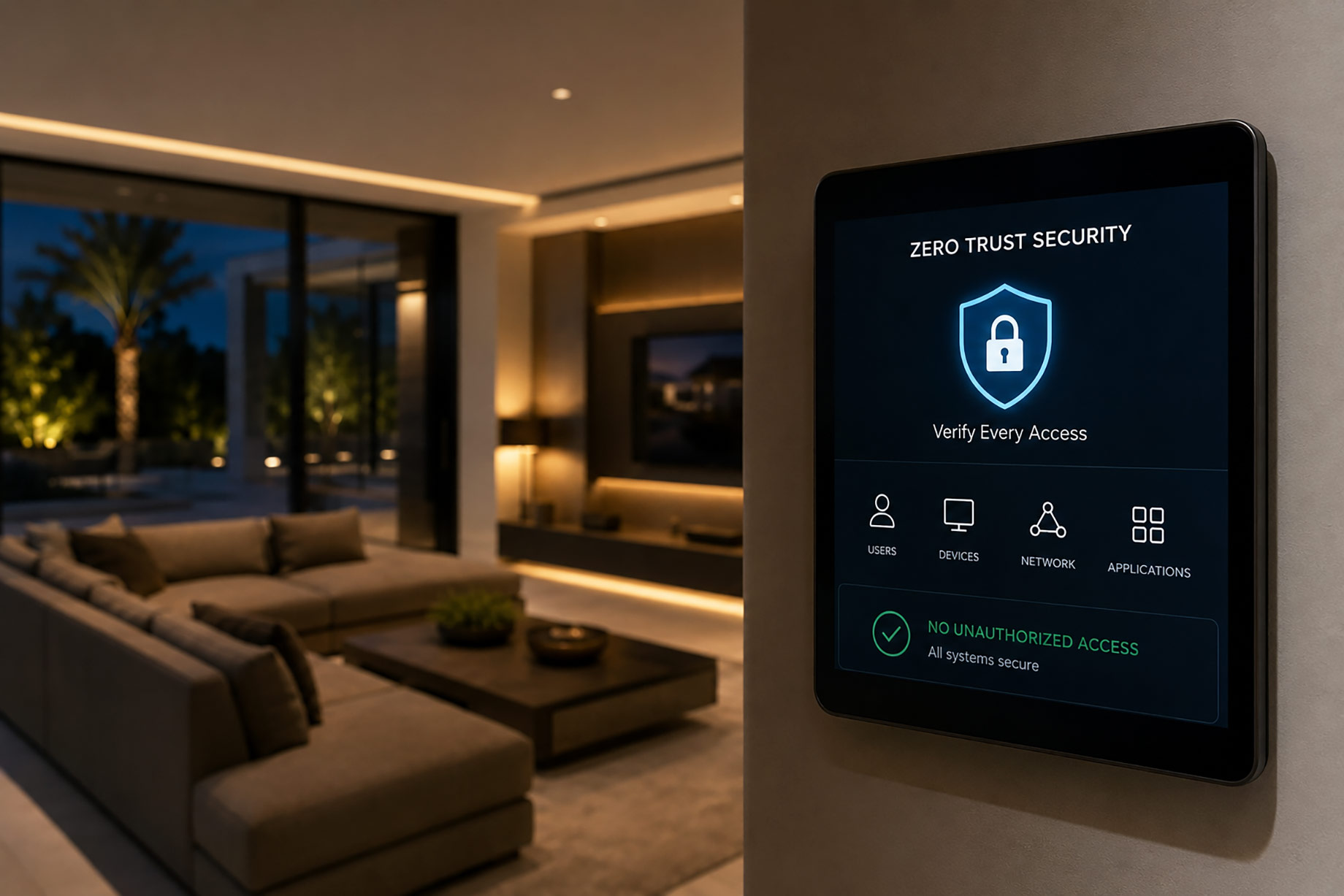
Most luxury smart homes run on invisible decisions. The following are some common features:
- Doors unlock
- Climate systems adapt
- Cameras classify movement
- Art galleries maintain exact environmental settings.
Still, convenience expands the digital perimeter. This is where Zero Trust security ensures that no device, user, or service receives confidence merely because it sits inside the home network.
Why the Trusted Network No Longer Works
Primarily, the traditional residential model places a hard shell around a soft interior. So, when a device joins the Wi-Fi network, it mostly communicates broadly. Moreover, it keeps that privilege for months. Although that feels simple, it is a bit risky.
In those cases, a compromised television, gate controller, or irrigation hub might become a stepping stone. These might lead to cameras and access systems. Also, attackers might get access to private files and occupancy data.
Meanwhile, luxury properties make the weakness sharper. They contain more
- Endpoints
- Vendors
- Remote administration
- People moving through temporary roles.
Of course, the following entities may all need access:
- Housekeepers
- Chefs
- Estate managers
- AV specialists
- Guests
- Contractors.
However, they never go through the same systems. Consequently, one shared password or flat network turns everyday convenience into accumulated exposure.
A Better Security Architecture
By contrast, advanced zero trust security solutions treat every request as conditional. In fact, the following factors shape the decision:
- Identity
- Device health
- Location
- Time
- The requested resource.
Moreover, access might expire automatically. Meanwhile, unusual behavior will trigger another verification step. That is a positive shift because protection becomes precise rather than simply restrictive. Although the house remains comfortable, trust stops being permanent.
Primarily, the architecture starts with segmentation.
- Security cameras should not share an open lane with entertainment equipment.
- Building controls should remain separate from guest devices.
- A home office containing sensitive commercial material needs its own protected zone.
If one endpoint fails, the damage stays contained. That containment matters more than another glossy control panel.
From Perimeter Defense to Continuous Verification
At the outset, a conventional system usually asks one question: Did somebody enter correctly?
Meanwhile, a zero-trust model keeps asking quieter questions afterward.
- Is this the expected device, and does the request match its normal function?
- Should a pool controller contact a cloud server at 3 a.m.?
Basically, continuous evaluation catches misuse that valid credentials alone cannot reveal. Also, building cyber hygiene is necessary.
| Security Element | Conventional Smart Home | Zero-Trust Luxury Home |
|---|---|---|
| Network design | Broad internal access | Segmented zones with narrow pathways |
| User permissions | Standing access | Least privilege with timed expiration |
| Device treatment | Trusted after connection | Verified before sensitive actions |
| Monitoring | Alerts after obvious events | Behavioral review throughout each session |
| Vendor support | Persistent remote login | Approved, recorded, task-specific sessions |
Moreover, identity must also become more granular. For instance, a resident may control the entire property. Meanwhile, a guest may use lighting, climate, and selected doors for a defined period.
Likewise, a technician may reach one equipment rack during an appointment without viewing camera archives. In fact, a good zero trust security model maps permission to purpose. Then, it removes it when that purpose ends.
What Estate Owners Should Prioritize
Of course, technology alone will not fix weak governance. So, before buying another appliance, owners and integrators should –
- Document every connected asset
- Identify who manages it
- Note how long the vendor supplies updates.
Older devices deserve scrutiny. In practice, an elegant automation system with abandoned firmware will carry more risk than a newer, modest component.
Implementing Zero Trust
A focused implementation should include:
- Separate networks for:
- Life safety
- Surveillance
- Automation
- Business systems
- Household staff
- Guests
Also, traffic between them must be tightly controlled.
- Phishing-resistant multifactor authentication for administrators. This must be alongside individual accounts. No passwords must be shared among family members, employees, and external service providers.
- Central logging that records –
- Access changes
- Vendor sessions
- Failed sign-ins
- Unusual device communication.
This must be done without turning private domestic life into needless surveillance.
- A tested response plan covering:
- Lost phones
- Terminated staff access
- Internet failure
- Power disruption
- A compromised home automation controller.
Still, restraint matters a lot. For instance, collecting every possible signal might –
- Create noise
- Privacy concerns
- An unmanageable stream of warnings.
Therefore, monitoring should focus on meaningful events and protect stored logs through –
- Encryption
- Limited retention
- Strict administrator access.
In fact, a secure residence should not become a residence that watches its occupants without boundaries.
Design, Ownership, and Daily Livability
The best systems disappear into ordinary life.
- Residents authenticate with familiar devices
- Guests receive simple time-limited credentials.
- Staff members see only the controls required for their work.
Meanwhile, higher-friction checks appear when risk rises. This might be a new phone requesting camera history from another country. In those cases, security becomes adaptive rather than constantly annoying.
Moreover, ownership is equally important. In fact, luxury systems mostly blend products from the following:
- Architects
- Integrators
- Security firms
- Network specialists
- Cloud vendors.
In addition, somebody must remain accountable for the whole environment. For instance, the following factors prevent small exceptions from turning into permanent gaps:
- Clear configuration records
- Quarterly access reviews
- Tested backups
- Defined update schedules.
Frankly, expensive hardware cannot compensate for fuzzy responsibility.
Resilience Beyond Internet Connectivity
Obviously, a hardened smart home must also function when the following aspects fail:
- Cloud services
- Broadband links
- Central controllers.
To build resilience beyond internet connectivity, the following functions are necessary:
- Secure local operation with defined manual overrides is necessary for:
- Critical doors
- Alarms
- Lighting
- Environmental controls.
- Backup pathways should preserve essential functions without creating hidden administrative access.
- Recovery procedures must specify how technicians:
- Restore configurations
- Rotate credentials
- Validate devices after an outage.
Basically, failover testing exposes brittle dependencies before an emergency does. This approach keeps convenience from becoming a single point of failure.
More importantly, it ensures that digital safeguards support physical safety. This holds even when the connected environment becomes unavailable or behaves unpredictably.
Secure Luxury Depends on Verified Access
Ultimately, connected living is not becoming simpler. To be honest, more sensors, artificial intelligence, remote services, and personalized automation will enter premium residences.
So, the sensible response is not to reject smart technology. Rather, the focus must be to control its relationships. This is where Zero Trust security provides that discipline. It does so through least privilege, segmentation, continuous verification, and accountable
