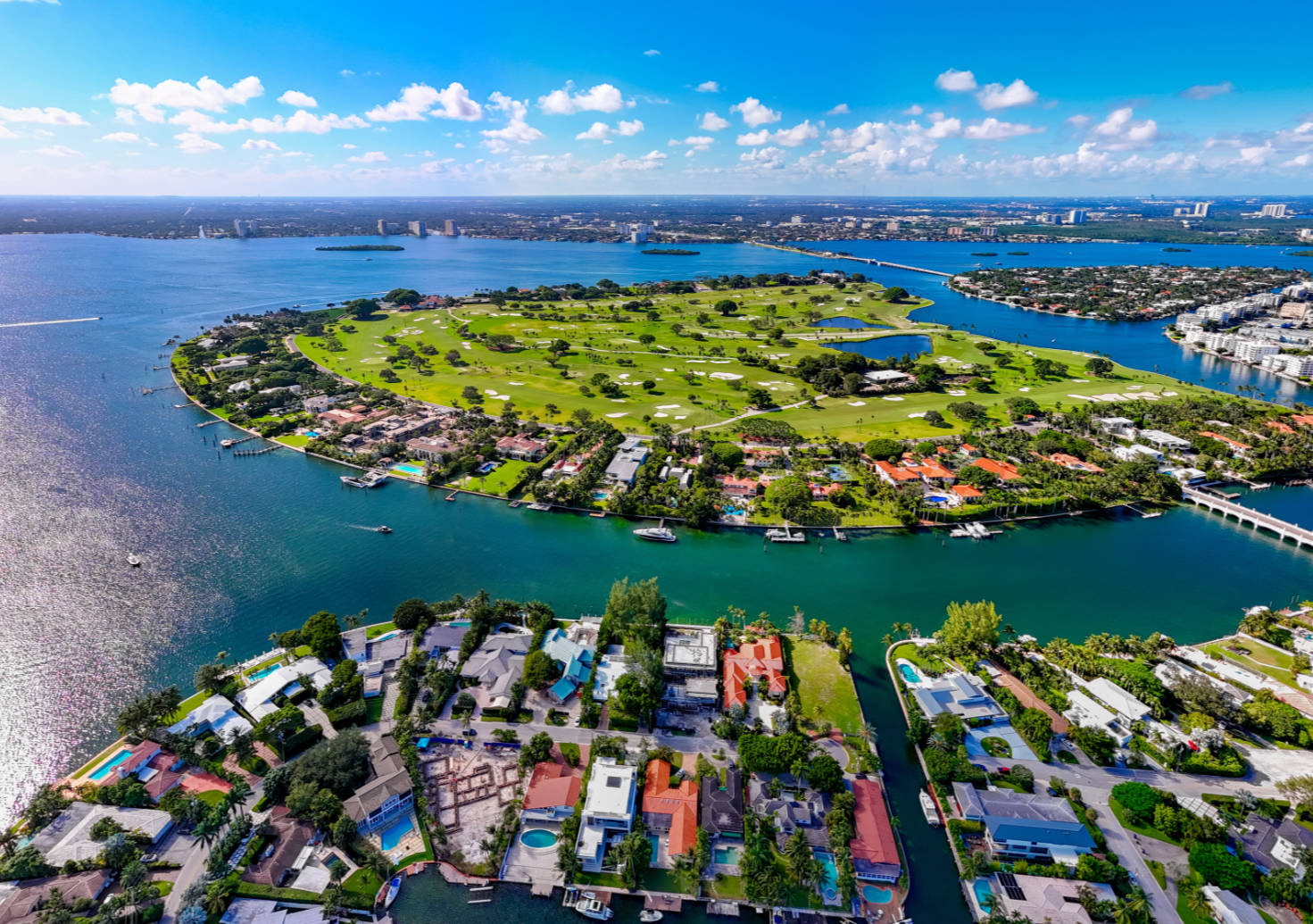
Few cities have changed their place on the global wealth map as fast as Miami. Once a seasonal escape, South Florida is now a permanent base for hedge-fund founders, technology billionaires and international families relocating their lives — and their capital — to the water. Nowhere is that shift clearer than on the city’s private islands: a handful of guarded enclaves in Biscayne Bay that sit at the very summit of the American luxury market.
They are often discussed as a single idea — “the private island” — but each is its own distinct world, with its own rules, its own residents and its own price of entry.
Star Island is the original. A guard-gated ring of roughly thirty waterfront estates off the MacArthur Causeway, it was for decades the address for Miami’s famous, from Gloria and Emilio Estefan to Shaquille O’Neal and, more recently, Jennifer Lopez and Alex Rodriguez. In March 2025, an estate at 26 Star Island Drive traded for $120 million — and was reportedly bought as a teardown, a sign of just how much the land alone is worth.
Indian Creek, the so-called “Billionaire Bunker,” is more rarefied still. It is its own incorporated village, with its own government and its own private police force, and only 41 home sites ring the private golf course at its center. In 2026 it set the record for the most expensive home sale in Miami-Dade history — a $170 million compound — and counts Jeff Bezos and Tom Brady among its publicly reported owners.
Fisher Island takes seclusion further than any of them: there is no bridge and no road. Residents arrive by private ferry, boat or helicopter, and the island’s ZIP code has long ranked as the wealthiest in the United States. It is also the only one of the four to offer both single-family estates and ultra-luxury condominiums, anchored by a private club with a golf course, marina and beach.
Brickell Key proves that island living need not mean isolation. A guarded, master-planned island of waterfront condominium towers wrapped by a continuous baywalk, it sits a short walk across a single bridge from Brickell’s financial district — the most accessible way to live behind the gate.
What unites all four is scarcity. None can be replicated, and that fixed supply is precisely what has held their values through every market cycle while the mainland rises and cools around them. For a buyer weighing one against another, the differences — security, product type, access and price — matter enormously. This guide to Miami’s most exclusive islands breaks down how each enclave truly compares, and which one suits which buyer.
Buying on any of these islands is rarely as simple as browsing a listing. The most significant transactions happen quietly — off-market, through relationships and trusted introductions, often before a property is ever publicly marketed. Discretion is part of the product, and the right local representation is what separates a buyer who sees the best of this inventory from one who only ever sees what is left.
In a city defined by relentless new construction, these islands remain Miami’s most finite, and most coveted, asset — and the clearest signal yet of where the world’s wealth is choosing to put down roots.
