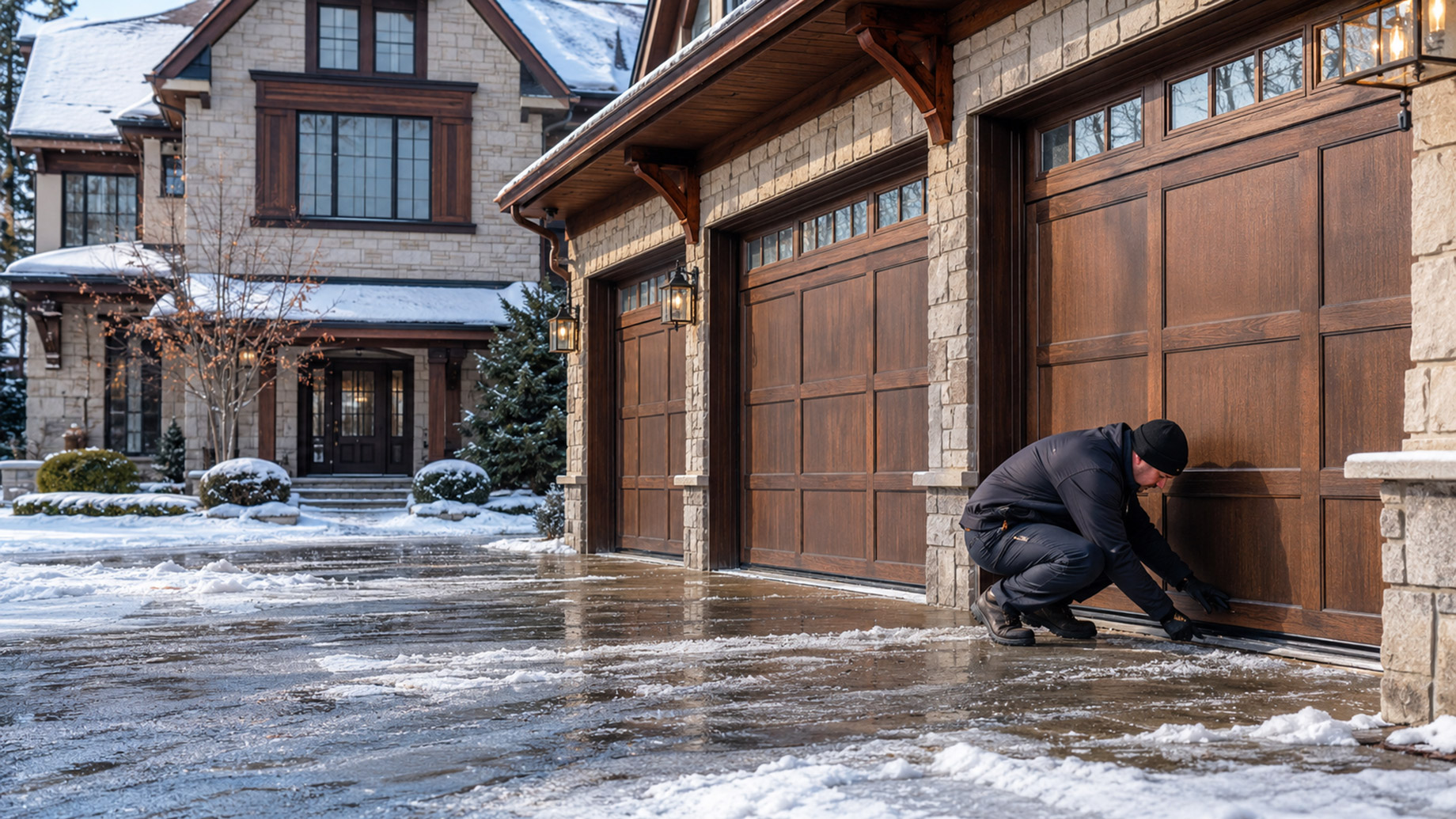
A house tells the truth in February.
I’ve spent fourteen winters servicing garage doors and exterior systems across Chicago’s affluent suburbs — Barrington, Lake Forest, Hinsdale, Long Grove. You can read more about what we do at https://firstlinegarage.com/garage-door-repair-chicago-il/ but the short version is this: I see what breaks, who calls, and which homes glide through January untouched. The houses that fail aren’t the old ones. They’re not the cheap ones either. They’re the ones whose owners assumed a beautiful exterior didn’t need a winter strategy.
Here’s what I’ve learned. Cold doesn’t damage homes. The freeze-thaw cycle does. And the freeze-thaw cycle hunts for the smallest oversight on the most expensive property, then magnifies it until it costs five figures to put right.
The Real Threat is the Swing, Not the Cold
Constant deep cold is benign for a structure. A steady twelve degrees does almost nothing. What we get in the upper Midwest — forty at noon, eight overnight, thirty-seven the next afternoon, then a hard plunge — is what tears houses apart from the outside in.
Water seeps into the hairline gap where bluestone meets mortar. It freezes overnight, expanding by roughly nine percent. By morning, the joint is a millimeter wider. Repeat that fifty times in a winter, and a stone walkway that cost twenty thousand dollars to install begins lifting unevenly. The same physics works on driveways, garage slabs, exterior caulking, copper flashings, and any seam in your envelope where moisture can find a residence.
Owners of premium homes tend to underestimate this because nothing dramatic happens in the first season. Or the second. The damage is patient. It compounds quietly until a contractor comes out in April and quotes a number that would have been a fraction of the cost if someone had spent a Saturday in October closing the openings.
Why the Garage is the Quietest Vulnerability on a High-End Home
The largest opening in almost any luxury home isn’t the front door. It’s the garage. A three-car carriage configuration is roughly four hundred square feet of thin steel and insulation standing between a climate-controlled interior and a ten-degree night. Even a premium R-18 insulated door — the kind that costs ten thousand dollars and looks like hand-finished walnut — performs at a fraction of the thermal resistance of a properly insulated wall.
That alone isn’t a problem. The seal is the problem.
The bottom of every garage door rests on a rubber gasket pressed against the concrete slab. That gasket has a working life of roughly seven to ten years before it cracks, compresses flat, or pulls away from the retainer. When it goes, you get a half-inch gap running the entire width of the opening. Cold air pours under the door, settles into the garage, and rises through any shared wall into the rooms above. On homes with a primary suite over the garage — which describes a meaningful share of newer builds in this market — that translates into a noticeable cold floor in the bedroom and a heating bill that climbs without explanation.
The fix is unremarkable. A new bottom seal runs under fifty dollars in materials. A qualified technician completes the work in under an hour. The savings on a single winter often exceed the lifetime cost of replacing the gasket five times over. And yet I encounter expensive homes every November where the seal has been failing for years and no one has thought to look at it.
The same goes for the perimeter weatherstripping along the sides and header of the door. PVC stop molding becomes brittle in cold climates. It separates from the jamb. It admits moisture into the framing behind the trim. By the time water staining appears on the interior of the garage wall, the sheathing is already compromised.
What Snow Actually Does to Architectural Elements
Custom awnings, pergolas, retractable shades, and architectural canopies are designed for rain, sun, and reasonable wind. Wet snow is a different category of load entirely.
A heavy lake-effect snowfall can deposit five to seven pounds per square foot of accumulated weight on a horizontal fabric surface. Multiply that across a twelve-foot retractable awning and you are loading a structure rated for moving wind with hundreds of pounds of static, freezing weight. The fabric stretches. Seams tear. Aluminum frames bend at the elbow joints where the load is concentrated.
The protocol on premium properties is simple. Retract every retractable element before the first sustained freeze. Not at the first snow — before. Once a wet snowfall freezes onto an open awning, retracting it can damage the mechanism worse than leaving it. Fixed canopies and pergolas need a different approach: they should be cleaned dry in the last warm week of October, with any organic debris cleared from the seams where moisture accumulates.
Mounting hardware deserves a separate inspection. Aluminum and steel expand and contract at different rates than the cedar siding or limestone facade behind them. Over four or five seasons, lag bolts work loose by fractions of an inch. A single sustained gust during a winter storm is sometimes enough to pull the entire assembly off the wall. I stood in front of homes the next morning where a forty-thousand-dollar architectural canopy was lying in the boxwood, and the only thing that failed was four bolts no one had checked.
Drainage is the Discipline That Separates Houses That Last
The single most consistent variable across homes that come through winter undamaged is drainage. Not architecture. Not age. Not price. Drainage.
Water that moves away from the foundation does no harm. Water that pools, flows toward, or collects against the structure produces every expensive winter problem I see. Settled garage slabs. Cracked driveway aprons. Efflorescence on basement walls. Frost-heaved walkways. Spalled brick veneer at grade. All of it begins with water that was supposed to leave and didn’t.
The audit is straightforward. Gutters need to be clear before the leaves drop, then again after. Downspouts need to terminate at least four feet from the foundation, ideally connected to a buried drain that exits well away from the house. Grades should fall a minimum of six inches over the first ten feet from the structure. Mulch beds should sit lower than the adjacent grade, not higher, and they should never be banked against siding or stone veneer.
These are unglamorous corrections. They cost very little. They are also the difference, on a million-dollar property, between a quiet winter and a five-figure repair.
The Quiet Season Tells You Who Was Paying Attention
I’ve been doing this long enough to predict, by mid-November, which homes will call me before March and which won’t.
The ones that won’t call have done a few specific things. The garage door has been serviced — rollers lubricated, hinges tightened, the bottom seal replaced if it’s near end of life. Weatherstripping has been inspected. Awnings are retracted, fixed canopies are cleaned and dry. Gutters are clear. Downspouts are extended. Concrete joints have been re-caulked where the previous winter opened them. None of this took longer than a Saturday. None of it was visible to anyone driving past.
The ones that will call almost always make the same mistake. They assumed the house, because it looked perfect on October fifteenth, would still look perfect on March fifteenth without intervention. Houses don’t work that way. The exterior of a home in a cold climate is in constant negotiation with the weather, and winter is when the negotiation gets one-sided.
The most expensive lesson in real estate isn’t location. It’s deferred maintenance.
If you own a house in this part of the country, walk the exterior this October. Look at every seam, every seal, every fastener. Listen for what isn’t quite right. Address it before the first hard freeze.
The homes I admire most after fourteen winters in this business aren’t the newest or the largest. They’re the ones whose owners understood that a beautiful house demands a quiet, consistent kind of attention — and gave it, every fall, without being asked.
Alex is a garage door specialist with over fourteen years of field experience servicing premium properties across the Chicago suburbs.
