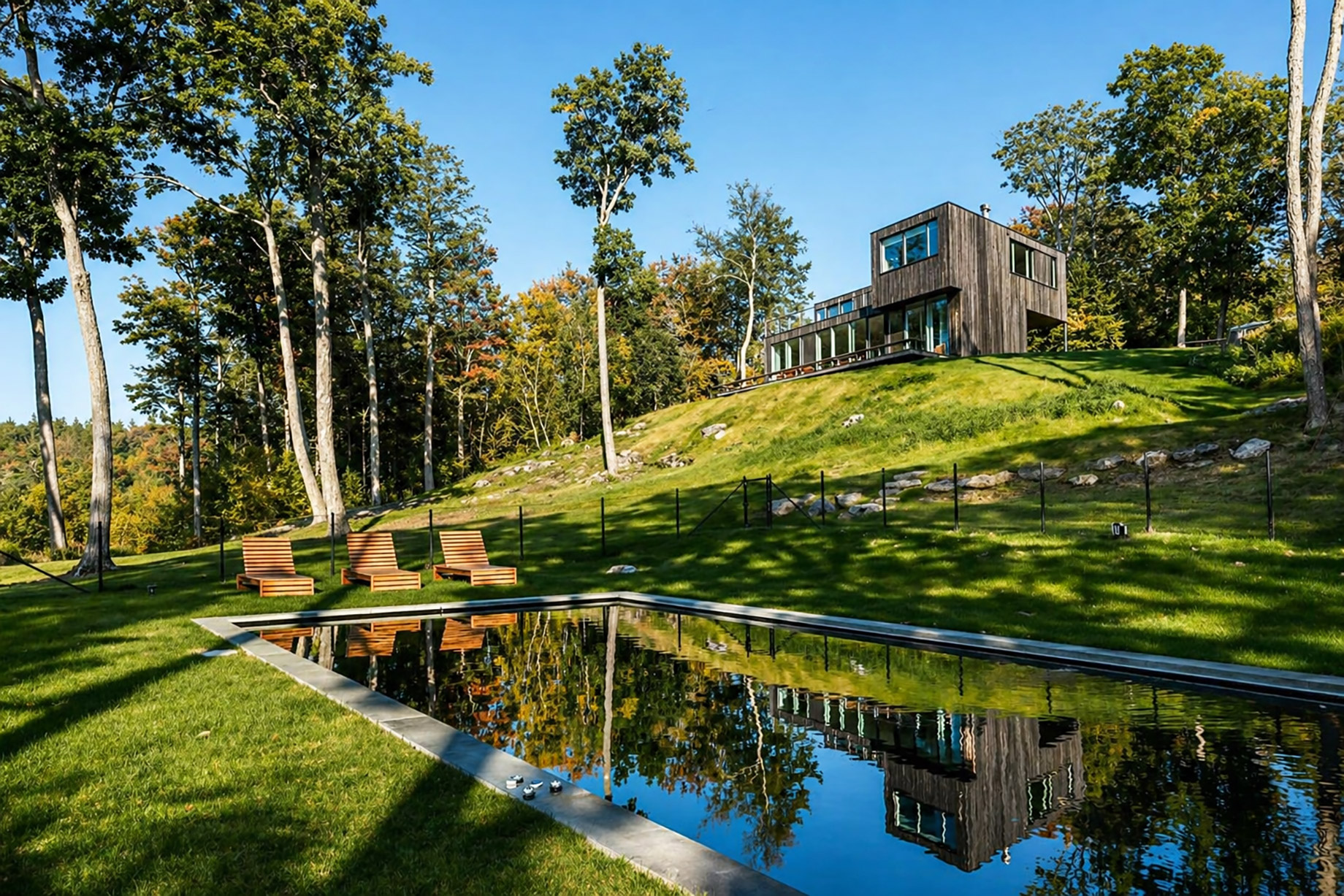
Two hours north of Manhattan, the Hudson Valley has quietly become one of the most interesting regions in the Northeast. The landscape is the same one that inspired the 19th-century Hudson River School painters, but the culture around it has changed substantially in the last two decades.
Former industrial river towns now hold some of the most considered restaurants in the country. Centuries-old farmhouses have been restored with a restraint that favors honest materials over showy renovation. And the pace remains deliberately slower than the city to the south.
The River as an Architectural Spine
The Hudson River itself organizes the region. Towns grew up along its banks in the 18th and 19th centuries, connected to each other and to New York City by water. Many of the great private estates of that era still stand, and several are open to the public.
Olana, the former home of painter Frederic Edwin Church, sits on a hilltop overlooking the river near Hudson, New York. The house is Persian-inspired, unexpected in a valley of Federal and Dutch Colonial architecture, and the grounds were designed as a three-dimensional landscape painting.
A short drive south, the Vanderbilt Mansion in Hyde Park offers a very different aesthetic: Gilded Age formal, with landscaped gardens and river views that defined American wealth at the turn of the last century.
The Agricultural Counterpoint
Away from the river, the valley opens into farmland that has been worked continuously for more than three hundred years. The soil is exceptional, and a generation of chefs and farmers has rebuilt the local food economy around it.
Stone Barns Center for Food and Agriculture, near Tarrytown, operates as a working farm and education center. Blue Hill at Stone Barns, the restaurant on site, sources almost exclusively within a 25-mile radius.
Design Towns, One by One
Hudson, roughly two hours north of Manhattan, is the busiest of the design-forward river towns. Warren Street runs through the center and is lined with antique dealers, independent design shops, and restaurants that have earned national attention.
Tivoli, smaller and quieter, attracts a weekending crowd from the city and has a concentration of mid-century furniture dealers and small galleries. Rhinebeck is slightly more polished, with an historic inn and a main street that has resisted chain retail.
Further north, Kingston combines a deep-water port and a walkable historic downtown, and serves as the entry point for travelers heading into the Catskills proper.
For stays across the region, Hudson Valley rental homes range from restored farmhouses to modernist retreats, and the inventory tends to concentrate in a handful of specific towns.
What to Do Beyond the Towns
The valley’s landscape draws travelers who want outdoor time between meals and gallery visits. Mohonk Preserve and Minnewaska State Park, on the Shawangunk Ridge, offer well-maintained trails with dramatic cliff views and quiet interior forest.
Fall foliage peaks between mid-October and the first week of November, though the exact timing varies by elevation. The western slopes color first, followed by the river valley, followed by the eastern highlands.
Winter brings a different register. Hudson Valley Skiing happens at smaller mountains (Belleayre, Windham, Hunter) rather than the Vermont resorts to the north. The scale fits families and weekend travelers who want ski time without a long drive.
The Arts Infrastructure
The valley has become a serious cultural destination. Dia Beacon occupies a former Nabisco printing factory and houses large-scale minimalist and conceptual works from the 1960s onward. Storm King Art Center, on 500 acres of meadow near Cornwall, is an outdoor sculpture park that changes with the seasons.
The Fisher Center at Bard College presents a strong opera and dance program from summer into late fall. Smaller venues in Hudson, Kingston, and Beacon round out the calendar.
Planning the Visit
Two or three nights is enough for a first visit focused on one area. A full week allows for a loop that takes in the river towns, the Catskills, and the eastern highlands around Millbrook and Rhinebeck.
Amtrak runs along the east side of the river from Penn Station, making weekend visits without a car workable. A car, though, opens up the farms, the preserves, and the quieter towns off the main routes.
