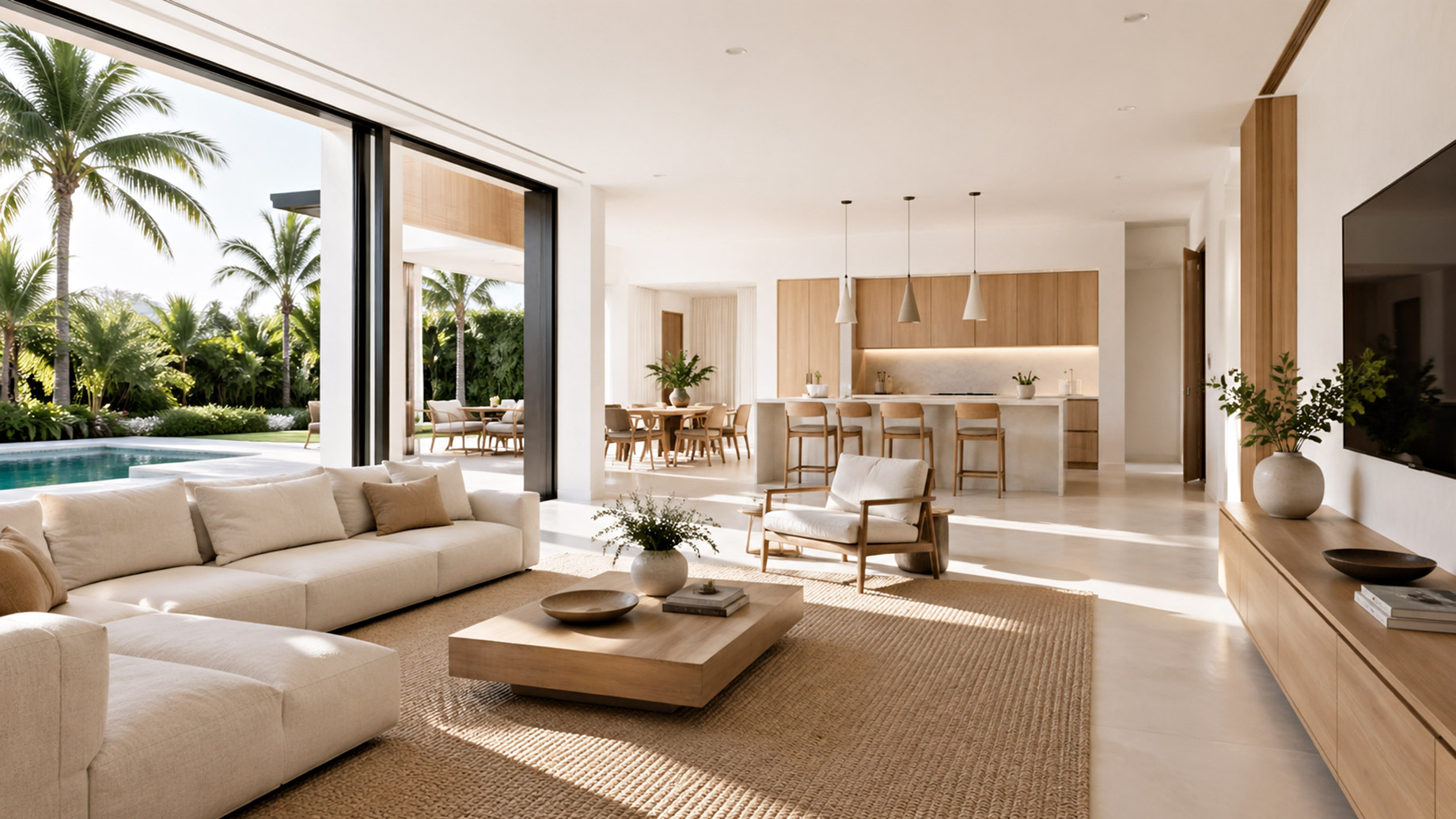
Minimalism has quietly shifted from “design trend” to “default aspiration” across South Florida. Not the cold, gallery-like minimalism of a decade ago, but a warmer, livable version that still feels crisp and intentional. You see it in renovated condos along the coast, in new builds heading west, and in older homes being reworked to better match the way people actually live here—lighter, simpler, and less visually crowded.
So why is the clean, minimal look landing so well in this region? Part of it is climate and lifestyle. South Florida is bright, humid, and indoor-outdoor by nature. The most successful homes embrace that reality: they reduce visual noise, prioritize airflow and light, and use durable finishes that don’t demand constant fussing.
Minimalism in South Florida Isn’t “Empty”—It’s Strategic
Minimal design works when it’s rooted in function. In practice, that means editing down what you see so the space feels calm, but ensuring the home still performs for real life—guests, sand, kids, pets, and the occasional storm prep.
The real goal: fewer interruptions to light and sightlines
Clean interiors amplify daylight. They also make smaller spaces feel larger, which matters in many South Florida condos and townhomes where square footage is at a premium. When you remove heavy visual breaks—busy tile patterns, bulky cabinetry, ornate trim—your eye travels farther. The home feels more open without changing the footprint.
A minimal aesthetic also pairs naturally with the region’s architectural direction: modern coastal, contemporary Mediterranean updates, and new construction that favors large openings and simple forms.
Materials That Make Minimalism Feel Warm (Not Sterile)
One reason minimalism sometimes fails is that it gets interpreted as “all white everything.” In South Florida, the more sophisticated approach is to keep the palette quiet while letting materials provide depth.
Go quiet on pattern, rich on texture
Instead of competing colors and high-contrast veining everywhere, designers are leaning into surfaces that read clean from a distance but reward you up close:
- Large-format porcelain with subtle movement
- Honed or leathered stone (used selectively)
- Light oak and white oak tones for warmth
- Microcement-style finishes for seamlessness
- Brushed metals that don’t shout for attention
This matters here because bright sun is unforgiving. High-gloss, high-contrast surfaces can feel harsh at midday. Softer textures and matte or satin finishes tend to look better for longer, especially as homes are lived in.
The humidity factor: choose finishes that forgive
South Florida’s humidity is real, and minimal homes often rely on fewer, larger surfaces—meaning each material choice shows more. Prioritize moisture-resistant paint, quality ventilation, and finishes that won’t warp, peel, or stain easily. Minimalism is easier to maintain when the materials are chosen for the climate, not just for a showroom.
Bathrooms: Where “Clean” Becomes a Daily Experience
If there’s one place minimal design delivers immediate lifestyle benefits, it’s the bathroom. This is where clutter, grout lines, and bulky fixtures can make a space feel dated fast.
Minimal bathrooms tend to share a few traits: larger tiles (fewer grout lines), floating vanities (more visual floor space), recessed niches (less product clutter), and glass that keeps the room feeling open.
Around the midpoint of many renovations, homeowners realize the shower enclosure is doing a lot of visual work. Heavy frames and busy hardware can break the clean look even if everything else is updated. If you’re comparing options, it helps to review what’s involved with modern bathroom enclosure services in South Florida—not as an afterthought, but as part of the overall design plan alongside tile layout, drainage, and ventilation.
Frameless isn’t just about style—it’s about continuity
The minimalist appeal of frameless glass is obvious: fewer lines. But the functional advantage is just as important. A well-designed enclosure supports better sightlines (the room reads larger), makes tile work the star (if you invested in it), and simplifies cleaning by reducing seams and places for buildup.
That said, “minimal” shouldn’t mean “delicate.” Hardware choice, glass thickness, proper sealing, and professional installation matter—especially in high-use homes and properties near salt air.
The Hidden Engine of Minimalism: Storage That Disappears
Minimal spaces don’t magically stay tidy. They’re engineered to make tidiness easier.
What to prioritize in a South Florida home
If you want the clean look without living like a minimalist monk, build in storage that’s convenient and specific:
- Drop zones near entries for sunglasses, keys, and mail
- Closed storage in kitchens (fewer open shelves than you think)
- Vanity drawers with organizers instead of deep cabinets
- Laundry storage that accounts for beach towels and swimwear
- A place for hurricane supplies that isn’t your living room
That’s the only “formula” here: decide what tends to accumulate in your home, then design a place for it to go. Minimalism works when it reduces decision fatigue—when putting something away is effortless, not a scavenger hunt.
Lighting: The Difference Between “Clean” and “Flat”
South Florida sunlight can be dramatic, but it shifts throughout the day. A minimal interior needs layered lighting so it doesn’t fall apart at night.
A simple lighting strategy that reads high-end
Think in three layers: ambient, task, and accent. In bathrooms, that might mean recessed ceiling lights (ambient), vertical sconces at the mirror (task), and a subtle shower light or toe-kick glow (accent). In kitchens, under-cabinet lighting does more than brighten counters—it adds dimension so the room feels designed, not just “white.”
Also worth noting: minimal interiors often use fewer decorative objects, so lighting becomes a primary way to add mood.
A Clean Look That Still Feels Like South Florida
The best minimal homes here don’t ignore the region—they translate it. You’ll see nods to coastal life without the clichés: softer neutrals instead of nautical themes, natural textures instead of seashell décor, and art that feels personal rather than mass-produced.
Try this mindset shift
Instead of asking, “How do I make this look minimal?” ask, “What can I remove or simplify without losing comfort?” That could mean swapping a busy countertop for a quieter surface, choosing one statement pendant instead of three competing fixtures, or reworking a bathroom layout so it functions better with fewer visual elements.
Closing Thought: Minimalism is a Maintenance Plan, Not Just a Style
A clean, minimal look photographs well, sure—but its real value is how it supports daily life. In South Florida, where light is abundant and the pace is active, calm interiors can feel like a practical luxury. When you choose durable materials, prioritize invisible storage, and keep sightlines open, the home doesn’t just look better. It works better.
And that’s the point. Minimalism isn’t about having less for the sake of it—it’s about making room for what matters, in a space that feels bright, breathable, and unmistakably current.
