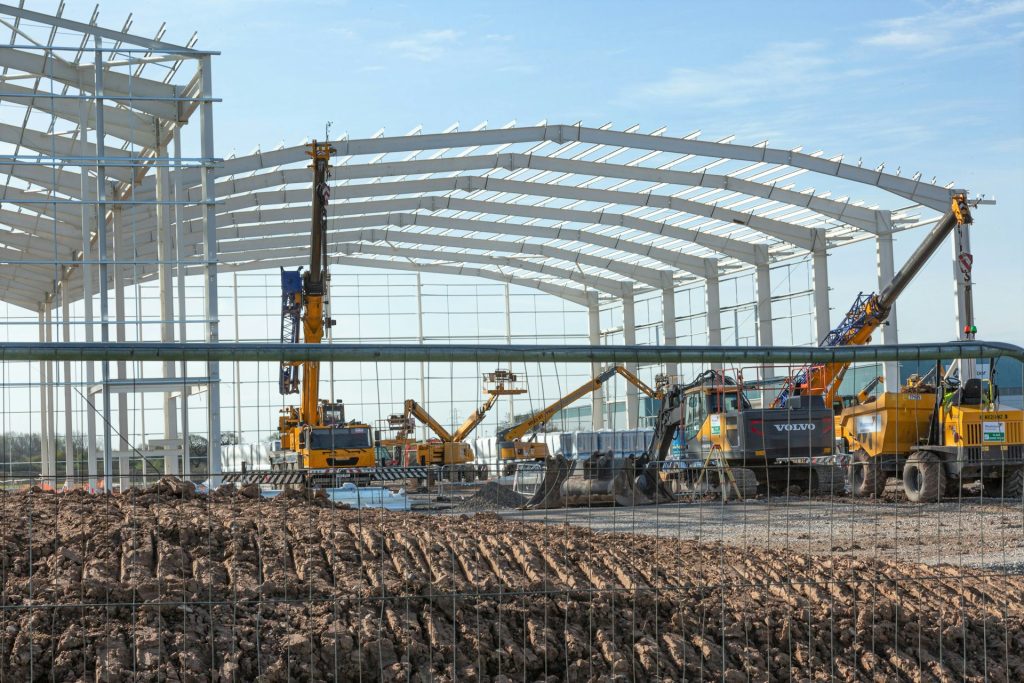
Walk through the pages of any leading luxury architecture publication today and a clear visual language emerges: floor-to-ceiling glass facades that dissolve the boundary between interior and landscape, living spaces that extend dramatically over ocean cliffs or mountain ridges, open-plan interiors vast enough to feel more like curated galleries than conventional homes. These are the hallmarks of contemporary high-end residential design — and almost without exception, they are made possible by one material working quietly behind the scenes.
Steel structure has become the defining engineering foundation of luxury architecture. While it rarely features in the lifestyle photography or the designer interviews, the structural steel frame is increasingly the element that separates what is possible from what is merely imagined. Understanding why requires a closer look at what today’s most visionary architects and discerning private clients are actually demanding — and why traditional construction methods are struggling to keep pace.
The Design Demands of the Modern Luxury Home
The expectations placed on high-end residential architecture have shifted fundamentally over the past two decades. Where previous generations of luxury homes were defined by ornate detailing, grand proportions, and material opulence, today’s most coveted properties are characterized by restraint, openness, and a deep integration with their natural surroundings.
This shift has profound structural implications. Open-plan living areas demand the elimination of interior columns and load-bearing walls. Panoramic glazing requires frames capable of supporting enormous glass panels without visible interruption. Cantilevered terraces projecting ten, fifteen, or even twenty meters beyond the building footprint require tensile strength that concrete and timber simply cannot provide at scale. Hillside and clifftop sites introduce complex load conditions and seismic considerations that demand precision engineering from the ground up.
In each of these scenarios, structural steel is not merely a practical choice — it is often the only choice that allows the architectural vision to be realized without compromise.
Achieving the Impossible Cantilever
Few architectural gestures command as much attention — or require as much structural ingenuity — as the dramatic cantilever. The image of a luxury villa extending boldly over a coastal cliff, its living room suspended in apparent defiance of gravity above the water below, has become one of the defining visual signatures of contemporary residential architecture.
Behind that image is invariably a steel structure engineered to transfer extraordinary tensile and compressive forces back through the building core. Reinforced concrete cantilevers are feasible at modest spans, but they become prohibitively heavy and require massive counter-balancing mass at larger scales. Steel, by contrast, achieves the required strength at a fraction of the weight, allowing architects to push cantilevered spans to lengths that would otherwise be structurally or economically impossible.
For private clients building on dramatic topography — coastal bluffs, alpine ridges, riverfront escarpments — this capability is not an aesthetic indulgence. It is the fundamental requirement that makes the project viable at the location they have chosen.
Dissolving the Wall: Steel and the Glass Facade
The luxury residential market’s appetite for panoramic glazing has driven one of the most significant convergences between structural engineering and architectural aesthetics in recent history. Full-height glass walls, frameless corner glazing, and retractable glass systems that open entire elevations to the landscape are now standard expectations at the upper end of the custom home market.
Achieving these effects demands a thoughtful structural design approach capable of carrying the building’s vertical and lateral loads without relying on the perimeter walls for support. A conventional masonry or timber-framed structure is inherently dependent on its walls for stability, making large-scale glazing a structural compromise at best. A steel moment frame, by contrast, concentrates load paths within a skeletal system of columns and beams, freeing the entire facade to be treated as a purely visual and environmental membrane.
This structural freedom is what allows an architect to specify a living room with four walls of glass, or a bedroom where the exterior wall retracts entirely to merge the interior with a private terrace. The glass is doing no structural work at all — it is simply the skin of a building whose skeleton has already solved every load requirement independently.
Open-Plan Living at Architectural Scale
The open-plan interior has long been a hallmark of modernist residential design, but in luxury architecture, the scale of openness demanded has escalated considerably. Today’s high-end clients expect living, dining, and kitchen areas to flow together across footprints of several hundred square meters, with no columns, no dividing walls, and no structural interruptions of any kind.
Achieving column-free spans of 20, 30, or even 40 meters within a residential structure is a challenge that steel addresses more elegantly than any alternative. Through the use of deep steel beams, transfer structures, and moment-resisting frames, architects and engineers can create interior environments of genuine spatial grandeur — spaces that feel less like rooms within a house and more like pavilions within a landscape.
This quality of spatial openness is increasingly a primary driver of value in the ultra-high-net-worth residential market. When a property can offer an uninterrupted view corridor from the entry hall to the far glass wall overlooking the sea, or a dining room that reads as a single unbroken volume at full architectural scale, the structural engineering that made it possible is embedded invisibly in the asking price.
Precision, Speed, and the Custom Home Timeline
Beyond the purely architectural advantages, steel structure offers high-end residential clients a significant practical benefit that is rarely discussed but acutely felt: schedule certainty.
Custom luxury homes are complex, long-duration projects, and delays are costly — not only financially, but in terms of the personal disruption experienced by clients who may be managing an international relocation, a school enrollment deadline, or the concurrent sale of a previous residence. Conventional site-built construction is vulnerable to weather delays, subcontractor sequencing issues, and the cumulative variability of hand-crafted work at scale.
The pre-engineered steel construction process fundamentally changes this dynamic. Structural components are fabricated under controlled factory conditions to tolerances measured in millimeters, arriving on site ready to assemble. Erection proceeds on a predictable schedule, and the building envelope can be closed quickly, allowing interior work to advance independently of weather conditions. For clients and their project managers, this predictability is not a minor convenience — it is a meaningful reduction in project risk.
Durability That Matches the Investment
A luxury residence is rarely treated as a short-term asset. For the private clients, family offices, and estate developers who commission these projects, the building is expected to perform — structurally, aesthetically, and mechanically — across generations. This long-term perspective makes the durability characteristics of structural steel particularly relevant.
Modern high-grade steel structures, properly detailed and protected with advanced corrosion-resistant coatings, are engineered for service lives of 50 to 70 years with minimal structural maintenance. In coastal environments where salt air accelerates the degradation of conventional materials, hot-dip galvanized steel with appropriate surface treatment systems significantly outperforms the alternatives. In seismically active regions, steel’s ductility — its ability to absorb and dissipate energy without catastrophic failure — provides a level of structural resilience that is increasingly specified by insurers and lenders as a condition of coverage on high-value properties.
When the investment in a residential property reaches eight or nine figures, the structural system is not merely a construction decision. It is a long-term risk management decision, and steel’s performance credentials across extreme environmental and seismic conditions make it a compelling choice at that level of asset value.
Sustainability as a Luxury Standard
The relationship between luxury living and environmental responsibility has evolved significantly. The most sophisticated private clients today are not choosing between a beautiful home and a sustainable one — they are demanding both, and the architectural and development communities are responding accordingly.
Steel is one of the most sustainable primary structural materials available, with recycling rates approaching 99% globally. A steel-framed residence can be designed from the outset with deconstruction in mind, its structural components recoverable and recyclable at the end of the building’s life without the material loss associated with demolition of concrete structures. When combined with high-performance insulation systems, passive solar orientation, and integrated renewable energy infrastructure, steel-framed luxury homes can achieve the highest green building certifications without any sacrifice of spatial quality or aesthetic ambition.
For clients seeking LEED Platinum certification, living building standards, or net-zero operational performance, the structural steel frame is a natural foundation — both literally and philosophically — for a home built to the highest standard in every dimension.
A New Architectural Vocabulary, Written in Steel
The transformation of high-end residential architecture over the past generation has been extraordinary. The homes that define the upper reaches of the global luxury property market today bear little resemblance to the palatial estates and grand manor houses that once set the standard for premium residential living. In their place: a new architectural vocabulary of radical openness, structural transparency, landscape integration, and spatial minimalism.
That vocabulary is written in steel. Not visibly, not ostentatiously — but fundamentally, at the level of the structural logic that makes these designs not just beautiful but buildable. As architectural ambition continues to push against the boundaries of what is structurally achievable, the role of steel in enabling the next generation of luxury residential design will only deepen.
For architects, developers, and private clients engaged at the frontier of high-end residential architecture, understanding the structural systems that underpin exceptional design is no longer optional. The most ambitious visions demand the most capable foundations — and increasingly, that foundation is steel.
The integration of pre-engineered steel building systems into luxury residential and commercial architecture represents one of the most consequential — and least visible — developments in contemporary construction. For design and development professionals exploring the structural possibilities of modern steel systems, working with specialists in commercial steel building solutions from the earliest stages of a project remains the most effective path to achieving both architectural ambition and construction performance.