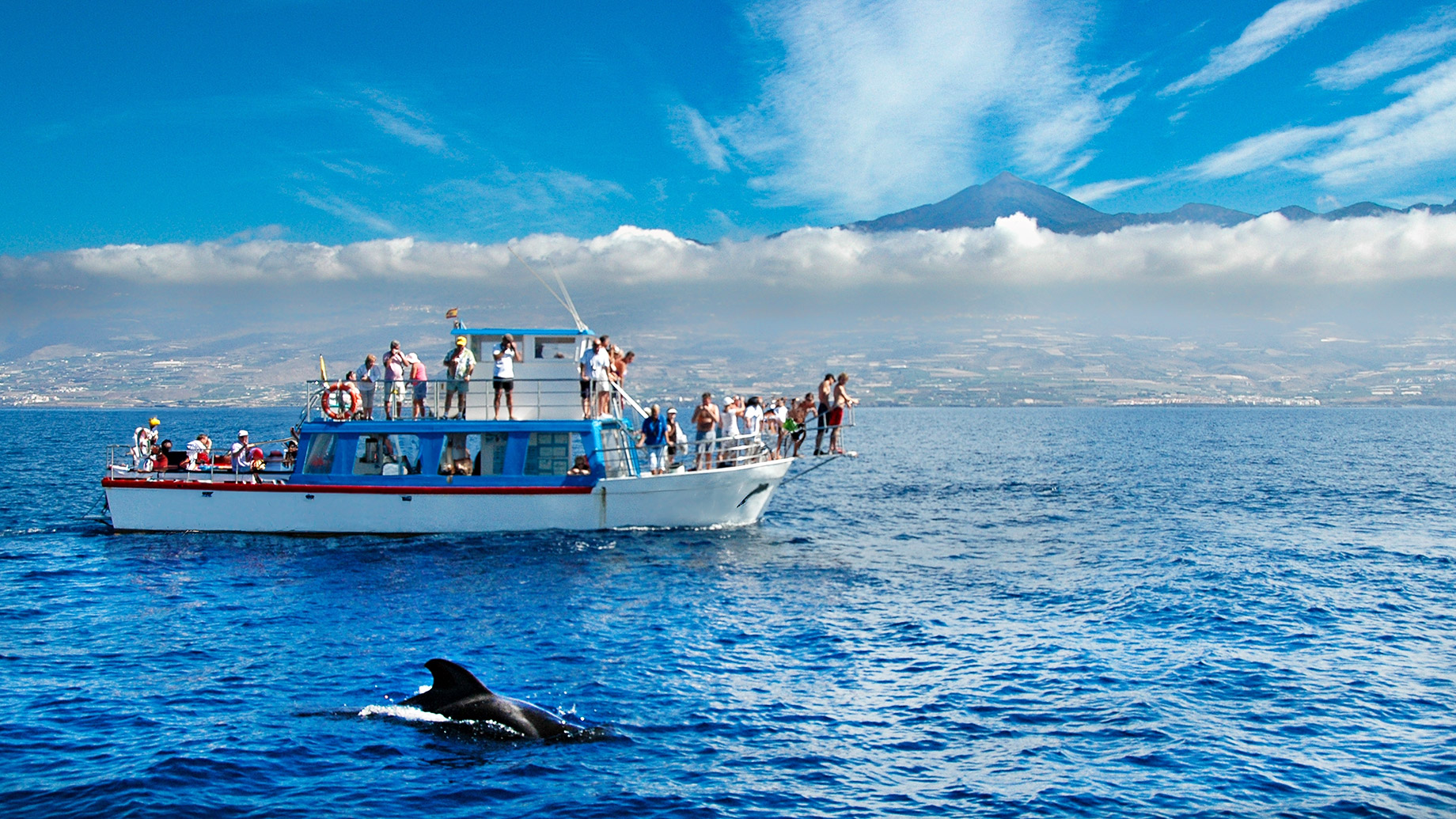
Off the south-western coast of Tenerife, marine mammals live here all year round. They don’t just pop in for a couple of weeks or pass through; they actually live here. Around 500 short-finned pilot whales have made this stretch of water their home, thanks to the warm deep-sea currents and the abundance of food. Bottlenose dolphins and striped dolphins keep company with them, whilst sperm whales and even blue whales appear during the winter months. It is no surprise that the whales and dolphins of Tenerife attract over a million tourists from all over the world every year.
According to the Canary Islands government in Spain, this is one of the most popular marine ecotourism destinations in Europe. Over the past twenty years, whale watching in Tenerife has developed into a distinct branch of ecotourism, with strict regulations and a licensing system for operators.
Key coastal points for heading out to sea
It all depends on the seabed topography. Along the south-western coast of the island, depths reach 2,000 metres just a few kilometres from the shore. Cold water rises to the surface, drawing plankton in its wake; the fish follow the plankton, and the cetaceans follow the fish. Between Los Cristianos and Punta de Tenos there are four main areas from which most trips depart. Each is associated with a section where the depth drops sharply:
- The strait between Tenerife and La Gomera: Depths exceed 1,500 metres; this is the main gathering place for pilot whales and bottlenose dolphins. In winter, sperm whales pass through here, and occasionally fin whales too.
- The waters off Los Gigantes: Six-hundred-metre-high cliffs plunge into the ocean, with the seabed dropping to a depth of one kilometre just a couple of miles from the jetty. Dolphin and whale watching in Los Gigantes is prized for its frequent encounters with spotted dolphins.
- The coastal area of Costa Adeje: The main departure point for catamarans and motor yachts. A speedboat reaches the pilot whale habitats in 15–20 minutes.
- The stretch from Playa San Juan to Alcalá: A less crowded area where the chances of encountering striped dolphins are significantly higher.
The principle is simple: the steeper the seabed slopes away from the shore, the greater the variety of fish species. The operator will advise you on the best spot to start, based on the season and the latest information from colleagues out on the water.
Seasonality and species calendar
There is no ‘off-season’ in Tenerife. Humpbacks and bottlenose dolphins don’t go anywhere, so whale-watching tours in Tenerife run every day. However, the variety of species does change. From November to March, migrating sperm whales and fin whales pass through the strait. On a good day, the crew can spot up to eight species in a single trip. In spring, striped dolphins appear in groups of 50–100, and the spectacle is worth a trip out to sea in its own right. In summer, the ocean is calmer and visibility is better, but the large migratory whales have already headed north.
Operators quote the following figures: the probability of encountering at least one species of cetacean per trip is 95–98%. The best chance of seeing large whales is between December and February. Empty trips do happen, but they are extremely rare.
Any month is fine for spotting grinds. However, it’s best to go in winter if you’re after rare species.
How the tours are organised and what to look out for
There is a wide range of options: from a budget two-hour catamaran trip to an intimate sailing yacht cruise. All licensed operators are required to comply with the law on the protection of cetaceans. You must not come within 60 metres of them, nor chase or feed them. When booking, it is worth clarifying a few points:
- How many passengers are allowed on board;
- Whether there is a hydrophone for listening to underwater sounds;
- Whether a marine biologist will be on board;
- Which area the route covers.
The two-hour trips cover the shallower waters and are suitable for families with young children. The three- and four-hour trips venture further into the strait, allowing for more time spent in the company of the cetaceans. Whale Watching Tenerife offers both options and has a biologist on board to comment on what is happening during the trip. When the biologist explains the behaviour of the pilot whales whilst they swim just a few dozen metres from the boat, the experience is quite different.
Code of conduct and environmental responsibility
The Canary Islands were among the first in Europe to adopt a specific law on the protection of marine mammals. Since 2000, regulations have limited the number of vessels permitted near groups of cetaceans and the length of time they may remain in their vicinity. Operators must renew their licences following an annual audit, whilst offenders face fines and have their licences revoked. Passengers should also be aware of the basic rules:
- Do not lean over the side of the boat, and do not throw anything into the water.
- Turn off your flash when taking photos: bright light startles dolphins at the surface.
- Speak quietly when the boat is near a pod.
- Use binoculars rather than asking the captain to get closer.
- Check that the operator has a blue certification flag.
When the water is quiet and everyone keeps their distance, the grinds swim up to the catamaran of their own accord out of curiosity, whilst the dolphins swim alongside in the wake. Sometimes they swim parallel to the boat for as long as ten minutes. The experience is far more vivid without the hustle and bustle on deck and the excessive noise.
What to pack and the best time to set off
It won’t take more than twenty minutes to prepare, but you’ll really notice the difference in the water. A quick checklist:
- Sunscreen and a hat: Water reflects UV rays, so you can still get sunburnt even on a cloudy day.
- Motion sickness tablets: The strait gets quite choppy in winter. It’s best to take a tablet half an hour before leaving the port.
- A camera with a good zoom: From a distance of 60+ metres, a phone won’t capture the details. A 200mm lens gives noticeably better results.
- Book early: In winter, places on small boats sell out a week in advance.
A word about departure times. Trips leaving between 9.00 and 10.00 am take advantage of the calm morning sea. After midday, the wind picks up and the swell increases. If comfort is your priority, or if you have children on board, the morning is the better option.
South-west Tenerife is home to a resident pod of pilot whales, as well as winter migrations of large whales and several species of dolphins close to the coast. You can head out to sea all year round, and trips are almost never empty. All that remains is to choose an operator, select the season for the species you’re interested in, and pack some sun cream. And following the rules of conduct on the water will help preserve this ecosystem for those who come here after you.
