Your home is your sanctuary, a place where you should feel safe and protected from the elements.
The primary defender of this sanctuary is your roof. It endures the scorching sun, heavy rains, piling snow, and whipping winds so that you don’t have to.
Yet, despite its critical role, the roof is often the most neglected part of a house.
The “out of sight, out of mind” mentality is common among homeowners, but it can lead to devastating financial and structural consequences.
A roof doesn’t usually fail overnight. Long before a catastrophic collapse or a waterfall in your living room, your roof sends out distress signals.
These warnings are often subtle, manifesting as cosmetic issues that are easily dismissed as minor annoyances.
However, learning to interpret these signs—specifically water stains, structural sagging, and unusual odors—can be the difference between a simple repair job and a complete, costly roof replacement.
By understanding the language of your home, you can catch issues early, extend the lifespan of your roof, and protect the investment you’ve made in your property.
This guide will walk you through the three major indicators of roof distress, explaining the science behind them and the steps you must take to address them before they compromise your home’s safety.
The Story Behind the Stain: Decoding Water Marks
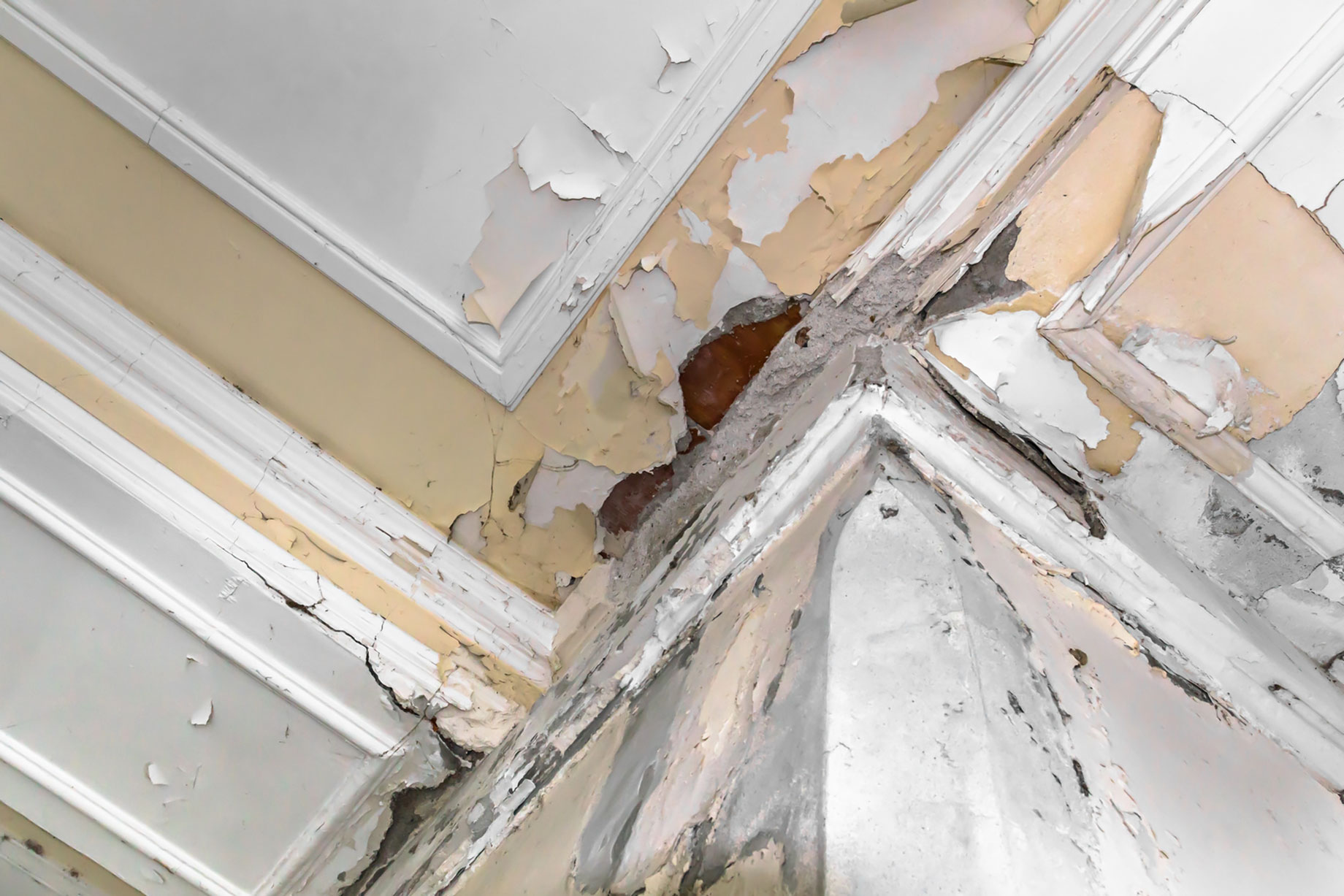
The first and most common sign of a roofing issue is the appearance of water stains.
These often manifest as discolored rings or blotches on your ceiling or running down your walls.
They typically range in color from a faint yellow to a deep, rusty brown.
While it might be tempting to simply paint over these spots and move on, doing so is akin to putting a bandage on a broken bone.
A stain is merely a symptom; the disease is the water infiltrating your home’s envelope.
Water is an incredibly persistent force. When a shingle is damaged, flashing is loose, or an ice dam forms, water finds a way in. However, it rarely travels in a straight line.
It moves along trusses, rafters, and wiring, seeking the path of least resistance until it pools on your drywall.
NOTE: A water stain on the ceiling often does not align perfectly with the leak on the roof; water can travel several feet along beams before dripping onto the ceiling below.
The presence of a stain indicates that moisture has been present long enough to saturate the insulation and soak through the drywall.
This moisture compromise reduces the effectiveness of your insulation, leading to higher energy bills, and weakens the structural integrity of the drywall itself.
If left unchecked, that small brown ring can turn into a collapsed section of the ceiling.
Identifying the source requires a bit of detective work. You should look for missing shingles, cracked caulk around vents, or damaged flashing around chimneys.
In areas with heavy foliage, clogged gutters can also back up water under the shingles, leading to interior leaks.
The Gravity of the Situation: Recognizing Sagging Areas
While water stains are cosmetic indicators of leaks, a sagging roof is a structural alarm bell that requires immediate attention.
A healthy roof line should be straight and strong. If you notice a dip, a curve, or a sway in the roof deck (the flat surface beneath the shingles) or the ridge line, your roof is under significant stress.
Sagging can occur on the exterior, visible when you step back to the curb and look at your home’s silhouette.
It can also be visible from the inside if you have access to the attic, where you might see bowing rafters or trusses.
This deformation is rarely a superficial issue; it suggests that the structural components of the roof are no longer able to support the load they were designed to carry.
There are several culprits behind a sagging roof. The most common is long-term water damage. When timber is exposed to moisture repeatedly or over a long period, it begins to rot.
Rotting wood loses its structural integrity and becomes soft, bending under the weight of the roofing materials (shingles, underlayment) and environmental loads like snow or ice.
NOTE: If your roof is sagging, do not attempt to walk on it to investigate; the structure may be unstable and could collapse under additional weight.
Another cause is undersized framing. In some older homes or poorly constructed additions, the rafters might not be substantial enough to handle the weight of the roof, especially if a new layer of shingles was added over an old one—a practice known as a “layover.”
Furthermore, inadequate ventilation in the attic can lead to excessive heat and moisture buildup, which can warp the wood sheathing over time, leading to a wavy or rippled appearance on the roof’s surface.
The Nose Knows: Detecting Musty Odors
Sometimes, you can smell a roof problem before you can see it.
A persistent, musty odor in your attic or upper floors is a strong indicator of moisture accumulation and, subsequently, mold and mildew growth.
While old houses have a particular smell, a sharp, earthy, or moldy scent is not normal and signals that the environment within your roof structure is damp.
A leaking roof provides the perfect breeding ground for mold. Insulation acts like a sponge, trapping moisture from small leaks that might not yet be visible as stains on the ceiling below.
In the dark, warm, and humid environment of an attic, mold spores can colonize rapidly on wood, insulation, and drywall.
The danger of musty odors extends beyond just an unpleasant smell.
Mold can compromise indoor air quality, posing serious health risks to your family, particularly those with asthma, allergies, or compromised immune systems.
As air circulates through your home—often pulled from the attic through gaps in the ceiling or via the HVAC system—these spores are distributed throughout the living spaces.
NOTE: Mold can begin to grow on damp surfaces within 24 to 48 hours; if you smell mustiness, act quickly to locate the moisture source before the infestation spreads.
High humidity in the attic caused by poor ventilation can also contribute to this smell, even without a direct leak.
If the warm, moist air from your showers and cooking cannot escape through roof vents, it condenses on the underside of the roof deck.
Over time, this condensation creates the same destructive environment as a leak, rotting the wood and feeding mold growth.
The Inspection: How to Check Safely
Vigilance is your best defense against premature roof failure.
Homeowners should aim to inspect their roofs at least twice a year—typically in the spring and fall—and after any major severe weather events.
However, safety must always be the priority. You do not need to climb a ladder to perform a preliminary check.
Start inside. Go to your attic on a sunny day and leave the lights off. Look for pinpricks of sunlight coming through the roof boards; these indicate gaps where water can enter.
Use a flashlight to inspect the rafters and insulation for dark streaks, water stains, or compacted insulation, which suggests it has been wet. Take a deep breath to check for that tell-tale musty odor.
Next, move outside. Walk around the perimeter of your house and use a pair of binoculars to scan the roof. Look for:
- Shingles that are curling, cracked, or missing.
- Granules in your gutters (which indicates the shingles are nearing the end of their life).
- Damaged flashing around the chimney, vents, and skylights.
- Any visible sagging or uneven lines along the ridge or roof plane.
If you spot any of these warning signs, the clock is ticking. The gap between a minor repair and a major restoration closes quickly when water is involved.
Partnering with Professionals for Long-Term Protection
While DIY inspections are excellent for early detection, addressing these issues usually requires professional intervention. Roofing is a complex system of layers, ventilation, and structural engineering.
Fixing a leak isn’t just about patching a hole; it’s about ensuring the water flow is correctly managed and that any underlying rot is removed and reinforced.
Attempting to fix structural sagging or widespread water damage yourself can be dangerous and, if done incorrectly, may void insurance policies or warranties.
Professional roofers have the tools to detect moisture levels behind walls and the expertise to determine if a roof can be repaired or if it requires replacement.
For homeowners in New York, where the weather can range from blistering summers to snowy winters, having a reliable partner is essential.
Companies like Saratoga Roofing understand the specific challenges the local climate poses to residential structures.
Whether it’s reinforcing a roof against heavy snow loads or ensuring proper ventilation to prevent ice dams, expert guidance ensures the fix is permanent.
When you notice the signs of wear, don’t delay.
Seeking out top-tier roofing services in Saratoga Springs can provide you with a comprehensive evaluation.
A professional team can offer a detailed analysis of your roof’s condition, moving beyond the surface symptoms to address the root cause of stains, sags, and smells.
NOTE: Regular professional maintenance can extend the life of your roof by years, saving you thousands of dollars compared to a premature full replacement.
Prioritizing the Shield Over Your Head
Your roof is a complex system that demands respect and attention.
The signs of failure—water stains, sagging structures, and musty odors—are your home’s way of communicating that it is under duress.
Ignoring these signs allows minor issues to metastasize into major structural failures that threaten your safety and your finances.
By staying vigilant and performing regular visual inspections, you empower yourself to act early.
However, recognizing the signs is only the first step.
Partnering with qualified professionals to address the root causes ensures that your home remains the safe, dry, and comfortable sanctuary it was meant to be.
Do not wait for the drip bucket to become a permanent fixture in your living room; listen to what your roof is telling you today.
